Bicameral Congress: House and Senate
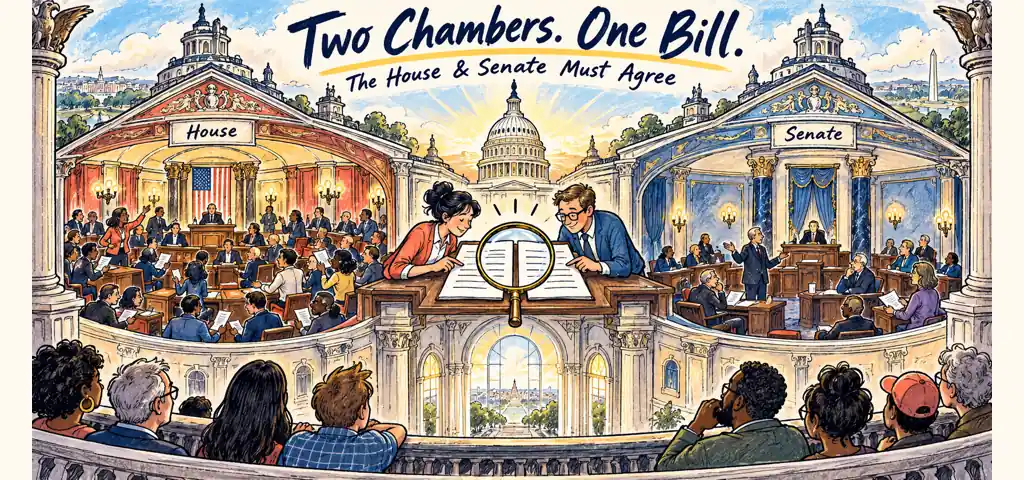
Bicameralism divides Congress into two chambers with different constituencies, terms, sizes, and procedures. Ordinary legislation must pass both chambers in identical form, creating an additional veto point and encouraging broader or differently constructed coalitions.
The two chambers rest on different principles of representation. House seats follow population, while every state receives two senators. Requiring agreement between those constituencies slows legislation and protects more interests, but it also permits a coalition representing less of the national population to block a bill favored by a House majority.
Bicameral Congress: House and Senate in practice
Bicameralism is distinct from a supermajority rule. Each chamber usually acts by an ordinary majority, yet passage in one does not carry the measure through the other. Differences can be resolved through amendment exchanges or a conference, after which both chambers must approve identical text.
Bicameral Congress: House and Senate: where the analysis gets complicated
When a scenario describes delay, ask which veto point produced it. A bill may fail because one chamber never acts, because the chambers approve different versions, or because the president vetoes the enrolled bill. Only the first two consequences follow directly from bicameral structure.
A concrete scenario for bicameral congress: house and senate
For Bicameralism, compare House and Senate rules, constituencies, qualifications, terms, and representational incentives before selecting an answer. Give one concrete example.
Check your reasoning
Bicameralism divides Congress into two chambers with different constituencies, terms, sizes, and procedures. Ordinary legislation must pass both chambers in identical form, creating an additional veto point and encouraging broader or differently constructed coalitions. The House represents population through districts, uses two-year terms, begins revenue bills, brings articles of impeachment, and relies on majoritarian procedures suited to a large chamber.
Video lesson: Bicameral Congress: House and Senate
CrashCourse gives a focused explanation of this topic in The Bicameral Congress: Crash Course Government and Politics #2.
If the player does not load, watch this lesson directly on YouTube.
Connect this lesson to the larger course
For a broader map connecting bicameral congress: house and senate to Congress, the presidency, the courts, and the bureaucracy, use the AP U.S. Government and Politics learning hub.

Related to This Article
More math articles
- The Best Grade 3 ELA Practice Tests for Washington Students
- CLEP U.S. History I 097: Major Campaigns and Turning Points
- Area of a Trapezoid
- The Best Grade 8 ELA Practice Tests for Texas Students
- Multistep Chemistry Problems: Moles to Gas Volume
- 4th Grade NHSAS Math Worksheets: FREE & Printable
- The Respiratory System
- Committee referral
- ASVAB Math: Complete Guide and Study Tips
- HiSET Math vs GED Math: A Side-by-Side Comparison





















What people say about "Bicameral Congress: House and Senate"?
No one replied yet.