The Ultimate ACT Math Formula Cheat Sheet
TL;DR: The ACT does NOT give you a formula sheet on test day. This cheat sheet covers every formula the test expects you to know — algebra, geometry, and trig included.
Key takeaways:
- ACT Math is 60 minutes long with 60 questions, so you have about a minute per problem.
- There is no formula sheet on the ACT — every formula must be memorized.
- Around 14 questions test geometry and 4 to 6 questions test trigonometry.
- Calculators are allowed on the entire math section, with model restrictions.
- Test scoring goes from 1 to 36 on the math section.
Here’s something the ACT and the SAT do very differently: the ACT does not give you a formula sheet. None. You’re expected to walk in with every formula already in your head. That sounds intimidating, but the good news is that the ACT’s formulas are mostly the standard ones you’ve seen in high school algebra and geometry — there’s nothing exotic, just a lot to keep straight.
This cheat sheet is the working list I give my ACT Math students. Every formula below has shown up on real ACT tests, written in the same notation you’ll see on test day.
The best way to work through this page is in small daily doses. Pick one section a day — slopes today, exponents tomorrow, trig the day after — and actually copy each formula into a notebook. Then immediately try one or two practice problems that use it. That pattern builds real memory; just reading does not.
The ACT Math Formula Cheat Sheet
The Absolute Best Book to Ace the ACT Math Test
Mixed Numbers
A number is composed of a whole number and a fraction. Example: \(2 \frac{2}{ 3}\) Converting between improper fractions and mixed numbers: \(a \frac{c}{b}=a+\frac{c}{b}= \frac{ab+ c}{b}\)
Factoring Numbers
Factor a number means breaking it up into numbers that can be multiplied together to get the original number. Example:\(12=2×2×3\)
Integers
\( \{…,-3,-2,-1,0,1,2,3,…\} \)
Includes: zero, counting numbers, and the negative of the counting numbers
Real Numbers
All numbers that are on a number line. Integers plus fractions, decimals, and irrationals, etc.) (\(\sqrt{2},\sqrt{3},π\), etc.)
Order of Operations
PEMDAS
(parentheses/ exponents/ multiply/ divide/ add/ subtract)
Absolute Value
Refers to the distance of a number from \(0\) on the number line. the distances are positive as the absolute value of a number cannot be negative. \(|-22|=22\)
or \(|x| =\begin{cases}x \ for \ x≥0 \\x \ for \ x < 0\end{cases} \)
\(|x|<n⇒-n<x<n\)
\(|x|>n⇒x<-n or x>n\)
Ratios
A ratio is a comparison of two numbers by division.
Example: \(3: 5\), or \(\frac{3}{5}\)
Percentages
Use the following formula to find part, whole, or percent
part \(=\frac{percent}{100}×whole\)
Proportional Ratios
A proportion means that two ratios are equal. It can be written in two ways:
\(\frac{a}{b}=\frac{c}{d}\), \(a: b = c: d \)
Percent of Change
\(\frac{New \ Value \ – \ Old \ Value}{Old Value}×100\%\)
Expressions and Variables
A variable is a letter that represents unspecified numbers. One may use a variable in the same manner as all other numbers: Addition: \(2+a\): \(2\) plus a
Subtraction: \(y-3\) : \(y\) minus \(3\)
Division: \(\frac{4}{x}\) : 4 divided by x
Multiplication: \(5a\) : \(5\) times a
Distributive Property
\(a(b+c)=ab+ac\)
Equations
The values of the two mathematical expressions are equal.
\(ax+b=c\)
Distance from A to B:
\(\sqrt{(x_{1}-x_{2})^2+(y_{1}-y_{2})^2 }\)
Parallel and Perpendicular lines:
Have equal slopes. Perpendicular lines (i.e., those that make a \(90^° \) angle where they intersect) have negative reciprocal slopes: \(m_{1}\).\(m_{2}=-1\).
Parallel Lines (l \(\parallel\) m)
Mid-point of the segment AB:
M (\(\frac{x_{1}+x_{2}}{2}, \frac{y_{1}+y_{2}}{2}\))
Slope of the line:
\(\frac{y_{2}- y_{1}}{x_{2} – x_{1} }=\frac{rise}{run}\)
Point-slope form:
Given the slope m and a point \((x_{1},y_{1})\) on the line, the equation of the line is
\((y-y_{1})=m \ (x-x_{1})\).
Slope-intercept form:
given the slope m and the y-intercept b, then the equation of the line is:
\(y=mx+b\).
Factoring:
“FOIL”
\((x+a)(x+b)\)
\(=x^2+(b+a)x +ab\) “Difference of Squares”
\(a^2-b^2= (a+b)(a-b)\)
\(a^2+2ab+b^2=(a+b)(a+b) \)
\(a^2-2ab+b^2=(a-b)(a-b)\) “Reverse FOIL”
\(x^2+(b+a)x+ab=\) \((x+a)(x+b)\)
You can use Reverse FOIL to factor a polynomial by thinking about two numbers a and b which add to the number in front of the x, and which multiply to give the constant. For example, to factor \(x^2+5x+6\), the numbers add to 5 and multiply to 6, i.e.: \(a=2\) and \(b=3\), so that \(x^2+5x+6=(x+2)(x+3)\). To solve a quadratic such as \(x^2+bx+c=0\), first factor the left side to get \((x+a)(x+b)=0\), then set each part in parentheses equal to zero. For example, \(x^2+4x+3= (x+3)(x+1)=0\) so that \(x=-3\) or \(x=-1\).
To solve two linear equations in x and y: use the first equation to substitute for a variable in the second. E.g., suppose \(x+y=3\) and \(4x-y=2\). The first equation gives y=3-x, so the second equation becomes \(4x-(3-x)=2 ⇒ 5x-3=2\) \(⇒ x=1,y=2\).
Exponents:
Refers to the number of times a number is multiplied by itself.
\(8 = 2 × 2 × 2 = 2^3\)
Scientific Notation:
It is a way of expressing numbers that are too big or too small to be conveniently written in decimal form.
In scientific notation all numbers are written in this form: \(m \times 10^n\)
Decimal notation:
5
\(-25,000\)
0.5
2,122.456
Scientific notation:
\(5×10^0\)
\(-2.5×10^4\)
\(5×10^{-1}\)
\(2,122456×10^3\)
Square:
The number we get after multiplying an integer (not a fraction) by itself. Example: \(2×2=4,2^2=4\)
Square Roots:
A square root of \(x\) is a number r whose square is \(x: r^2=x\)
\(r\) is a square root of \(x\)
Pythagorean Theorem:
For any right triangle with legs \(a\) and \(b\) and hypotenuse \(c\): \(a^2+b^2=c^2\)
Solving for the hypotenuse: \(c=\sqrt{a^2+b^2}\)
Solving for a leg: \(a=\sqrt{c^2-b^2}\)
Common Pythagorean triples: \(3,4,5\); \(5,12,13\); \(8,15,17\); \(7,24,25\)
Triangles
Area: \(A=\frac{1}{2}bh\) where \(b\) is the base and \(h\) is the height.
Perimeter: \(P=a+b+c\) (sum of all three sides).
Pythagorean Theorem (right triangles): \(a^2+b^2=c^2\) where \(c\) is the hypotenuse.
Sum of interior angles: \(180°\)
All triangles:
Area \(=\frac{1}{2}\) b. h
Angles on the inside of any triangle add up to \(180^\circ\).
The length of one side of any triangle is always less than the sum and more than the difference between the lengths of the other two sides.
An exterior angle of any triangle is equal to the sum of the two remote interior angles. Other important triangles:
Equilateral:
These triangles have three equal sides, and all three angles are \(60^\circ\).
Isosceles:
An isosceles triangle has two equal sides. The “base” angles (the ones opposite the two sides) are equal (see the \(45^\circ\) triangle above).
Circles

Area \(=πr^2\)
Circumference \(=2πr\)
Full circle \(=360^\circ\)
Rectangles
(Square if l=w)
Area=lw
Parallelogram
(Rhombus if l=w)
Area=lh
Regular polygons are n-sided figures with all sides equal and all angles equal.
The sum of the inside angles of an n-sided regular polygon is
\((n-2).180^\circ\).
Area of a trapezoid:
\(A =\frac{1}{2} h (b_{1}+b_{2})\)
Surface Area and Volume of a rectangular/right prism:
\(SA=ph+2B\)
\(V=Bh\)
Surface Area and Volume of a cylinder:
\(SA =2πrh+2πr^2\)
\(V =πr^2 h \)
Surface Area and Volume of a Cone
\(SA =πrs+πr^2\)
\(V=\frac{1}{3} \ πr^2 \ h\)
Surface Area and Volume of a Sphere
\(SA =4πr^2\)
\(V =\frac{4}{3} \ πr^3\)
(p \(=\) perimeter of base B; \(π ~ 3.14 \))
Simple interest:
\(I=prt\)
(I = interest, p = principal, r = rate, t = time)
mean:
mean: \(\frac{sum \ of \ the \ data}{of \ data \ entires}\)
mode:
value in the list that appears most often
range:
largest value \(-\) smallest value
Median
Middle value in the list (which must be sorted)
Example: median of
\( \{3,10,9,27,50\} = 10\)
Example: median of
\( \{3,9,10,27\}=\frac{(9+10)}{2}=9.5 \)
Average
\( \frac{sum \ of \ terms}{number \ of \ terms}\)
Average speed
\(\frac{total \ distance}{total \ time}\)
Probability
\(\frac{number \ of \ desired \ outcomes}{number \ of \ total \ outcomes}\)
The probability of two different events A and B both happening is:
P(A and B)=p(A).p(B)
as long as the events are independent (not mutually exclusive).
Powers, Exponents, Roots
\(x^a.x^b=x^{a+b}\)
\(\frac{x^a}{x^b} = x^{a-b}\)
\(\frac{1}{x^b }= x^{-b}\)
\((x^a)^b=x^{a.b}\)
\((xy)^a= x^a.y^a\)
\(x^0=1\)
\(\sqrt{xy}=\sqrt{x}.\sqrt{y}\)
\((-1)^n=-1\), if n is odd.
\((-1)^n=+1\), if n is even.
If \(0<x<1\), then
\(0<x^3<x^2<x<\sqrt{x}<\sqrt{3x}<1\).
Simple Interest
The charge for borrowing money or the return for lending it.
Interest = principal \(×\) rate \(×\) time
OR
\(I=prt\)
Powers/ Exponents
\(x^a×x^b=x^{a+b}\)
\(\frac{x^a}{x^b}=x^{a-b}\)
\((x^a)^b=x^{ab}\)
\(x^0=1\)
\(x^{-a}=\frac{1}{x^a}\)
\(x^{\frac{1}{n}}=\sqrt[n]{x}\)
Positive Exponents
An exponent is simply shorthand for multiplying that number of identical factors. So \(4^3\) is the same as (4)(4)(4), three identical factors of 4. And \(x^3\) is just three factors of x, \((x)(x)(x)\).
Negative Exponents
A negative exponent means to divide by that number of factors instead of multiplying.
So \(4^{-3}\) is the same as \( \frac{1}{4^3}\) and
\(x^{-3}=\frac{1}{x^3}\)
Factorials
Factorial- the product of a number and all counting numbers below it.
8 factorial \(=8!=\)
\(8×7×6×5×4×3×2×1=40,320\)
5 factorial \(=5!=\)
\(5×4×3×2×1=120\)
2 factorial \(=2!=2× 1=2\)
Multiplying Two Powers of the SAME Base
When the bases are the same, you find the new power by just adding the exponents
\(x^a.x^b=x^{a+b }\)
Powers of Powers
For power of a power: you multiply the exponents.
\((x^a)^b=x^{(ab)}\)
Dividing Powers
\(\frac{x^a}{x^b} =x^a x^{-b}= x^{a-b}\)
The Zero Exponent
Anything to the 0 power is 1.
\(x^0= 1\)
College Entrance Tests
More from Effortless Math for ACT Test …
Are you looking for a FREE ACT Math course to help you prepare for your test?
Check out our Ultimate ACT Math Course.
Need Math worksheets to help you measure your exam readiness for your upcoming ACT test?
Have a look at our comprehensive ACT Math Worksheets to help you practice and prepare for the ACT Math test.
Looking for FREE ACT Math websites to find free online resources?
Here is our complete list of Top 10 Free Websites for ACT Math Preparation.
Need a practice test to help you improve your ACT Math score?
Have a look at our Full-Length ACT Math Practice Test and Free ACT Math Practice Test.
Do you know the key differences between SAT Math and ACT Math?
Find your answer here: SAT Math vs. ACT Math: the key differences.
The Perfect Prep Books for the ACT Math Test
Have any questions about the ACT Test?
Write your questions about the ACT or any other topics below and we’ll reply!
What the ACT Tests That the SAT Doesn’t
If you’re prepping for both tests, here’s the difference that catches people off-guard: the ACT goes wider. You’ll see more geometry (including some classical geometry the SAT skips), more trigonometry (including the law of sines and law of cosines), matrices, logarithms, and a sprinkling of probability and counting. The SAT goes narrower but deeper.
That width is why the formula list above is longer than what you’d need for the SAT. The ACT rewards breadth — the student who knows a little bit about everything tends to score better than the student who’s mastered three topics and ignored the rest.
One tutoring tip: the ACT loves the law of sines and law of cosines. They appear on most tests, usually as one of the harder problems. If you have those memorized cold, you’re already in better shape than half the people taking the test.
Books That Pair With This Cheat Sheet
For a step-by-step walkthrough of every formula above — with worked examples and short practice sets — ACT Math for Beginners is the book I’d hand you. It assumes you’ve forgotten things and explains each concept the way a patient teacher would.
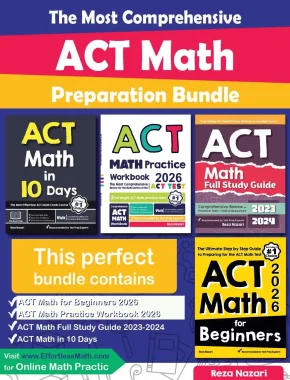
If you want the complete prep package — book + workbook + full-length practice tests — the Comprehensive ACT Math Preparation Bundle pulls everything together into one set. It’s what most of my students end up using in the month before their test date.
Trigonometry, Logs, and Matrices — Formulas the Above Sheet Doesn’t List
The ACT goes wider than the SAT, so a complete ACT cheat sheet has to cover trig, logarithms, and matrices. These show up on every test:
Right-Triangle Trig (SOH-CAH-TOA)
\(\sin\theta = \frac{\text{opposite}}{\text{hypotenuse}}\), \(\cos\theta = \frac{\text{adjacent}}{\text{hypotenuse}}\), \(\tan\theta = \frac{\text{opposite}}{\text{adjacent}}\).
Pythagorean and Reciprocal Identities
\(\sin^2\theta + \cos^2\theta = 1\); \(\csc\theta = \frac{1}{\sin\theta}\), \(\sec\theta = \frac{1}{\cos\theta}\), \(\cot\theta = \frac{1}{\tan\theta}\).
Law of Sines and Law of Cosines
Law of sines: \(\frac{a}{\sin A} = \frac{b}{\sin B} = \frac{c}{\sin C}\). Law of cosines: \(c^2 = a^2 + b^2 – 2ab\cos C\). Use law of sines when you have two angles and a side; use law of cosines when you have all three sides or two sides and the included angle.
Logarithm Rules
Product: \(\log_b(xy) = \log_b x + \log_b y\). Quotient: \(\log_b(x/y) = \log_b x – \log_b y\). Power: \(\log_b(x^n) = n \log_b x\). Change of base: \(\log_b x = \frac{\log x}{\log b}\).
2×2 Matrix Determinant
For \(\begin{pmatrix} a & b \\ c & d \end{pmatrix}\), the determinant is \(ad – bc\). For a 3×3 matrix, expansion by cofactors is the standard approach.
Quadratic Formula and Discriminant
For \(ax^2 + bx + c = 0\): \(x = \frac{-b \pm \sqrt{b^2 – 4ac}}{2a}\). The discriminant \(b^2 – 4ac\) tells you how many real solutions exist.
Frequently Asked Questions About ACT Math Formulas
Does the ACT give you a formula sheet?
No — and this is the biggest difference between the ACT and the SAT. The ACT expects you to bring every formula you need in your own head. There is no reference page, no pop-up, no built-in cheat sheet. That’s why memorizing the list above isn’t optional — it’s the whole game.
What math topics show up on the ACT?
The ACT Math section covers six areas: pre-algebra (numbers, fractions, percents), elementary algebra (linear equations, inequalities), intermediate algebra (quadratics, functions), coordinate geometry (slope, distance, lines, parabolas), plane geometry (angles, triangles, circles, area, volume), and trigonometry (SOH-CAH-TOA, identities, law of sines and cosines). All six on the same 60-question test.
How many trig questions are on the ACT?
Usually four to six. Most are basic right-triangle trig (SOH-CAH-TOA), but you’ll typically see at least one question involving the unit circle, one involving an identity (like \(\sin^2\theta + \cos^2\theta = 1\)), and sometimes a law-of-sines or law-of-cosines problem. If trig feels weak, start there — those questions are very memorize-able.
Can I use a calculator on the ACT Math?
Yes, the entire ACT Math section allows calculators. Most graphing calculators are permitted (the TI-84 is the most common); some have restrictions, so check the official approved list before test day. The calculator helps with arithmetic, but it won’t think for you — knowing the formulas above still matters more than knowing your calculator’s shortcuts.
Is the ACT harder than the SAT?
Not harder — different. The ACT tests more topics with shorter time per question (60 questions in 60 minutes). The SAT tests fewer topics but goes deeper, with more time per question. Students who know their formulas cold and can move fast tend to prefer the ACT. Students who like to think slowly and carefully often prefer the SAT.
How long should I spend memorizing ACT Math formulas?
Plan on two to three weeks of focused work, about 30 minutes a day. The first week is straight memorization — write each formula by hand, daily. The second week, pair every formula with a practice problem. By the third week, the formulas should feel automatic, and you can shift to full-section timed practice.
What trigonometry formulas do I need for the ACT?
The big ones: SOH-CAH-TOA (sine = opposite/hypotenuse, cosine = adjacent/hypotenuse, tangent = opposite/adjacent), the Pythagorean identity \(\sin^2\theta + \cos^2\theta = 1\), the law of sines \(\frac{a}{\sin A} = \frac{b}{\sin B} = \frac{c}{\sin C}\), and the law of cosines \(c^2 = a^2 + b^2 – 2ab\cos C\). You’ll also want the unit-circle values for the standard angles (0°, 30°, 45°, 60°, 90°).
What logarithm rules show up on the ACT?
Three to memorize: the product rule \(\log_b(xy) = \log_b x + \log_b y\), the quotient rule \(\log_b(x/y) = \log_b x – \log_b y\), and the power rule \(\log_b(x^n) = n \cdot \log_b x\). The change-of-base formula \(\log_b x = \frac{\log x}{\log b}\) is also useful when your calculator can only do log base 10 or natural log.
What is the quadratic formula and when do I use it on the ACT?
The quadratic formula is \(x = \frac{-b \pm \sqrt{b^2 – 4ac}}{2a}\). Use it whenever a quadratic equation \(ax^2 + bx + c = 0\) doesn’t factor cleanly. The discriminant \(b^2 – 4ac\) tells you the nature of the solutions: positive = two real solutions, zero = one repeated solution, negative = two complex solutions.
Are matrices on the ACT Math test?
Yes — but usually only one or two questions per test. You’ll see basic operations (addition, subtraction, scalar multiplication, matrix multiplication for small matrices) and occasionally a determinant for a 2×2 matrix \(\begin{pmatrix} a & b \\ c & d \end{pmatrix}\), which equals \(ad – bc\). Memorize the 2×2 determinant — it’s an easy point.
Related EffortlessMath Lessons

Related to This Article
More math articles
- FREE 5th Grade Georgia Milestones Assessment System Math Practice Test
- The Best HiSET Math Worksheets: FREE & Printable
- Place Value Word Problems
- Accuplacer Math Worksheets: FREE & Printable
- What is a Good SAT Score?
- FREE 8th Grade PARCC Math Practice Test
- Hawaii Algebra 1 Free Worksheets: Printable Algebra 1 Practice Worksheets with Worked Solutions
- How to Solve Rational Inequalities?
- Function Values of Special Angles
- SIFT Math FREE Sample Practice Questions





What people say about "The Ultimate ACT Math Formula Cheat Sheet - Effortless Math"?
No one replied yet.