Articles

You can find helpful articles about mathematics and test prep here.

Interested in Becoming an Effortless Math Guest Blogger? Click here

Search in Articles articles.

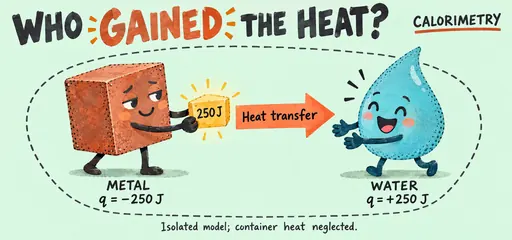
Handmade comic of metal transferring 250 joules to water: metal heat is negative and water heat positive in an isolated model with container heat neglected.

Calorimetry and Heat: Calculate q and Choose Its Sign

Use calorimetry to calculate heat from mass, specific heat, and temperature change. Follow a water example, choose heat signs, and review six questions.
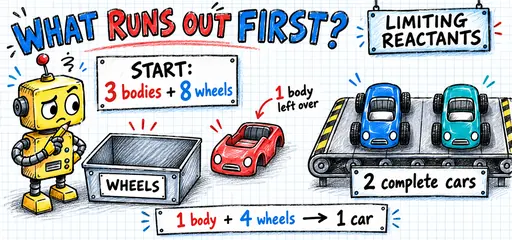
Hand-drawn toy factory analogy for limiting reactants: three car bodies and eight wheels make two four-wheel cars, leaving one unused body and no wheels.

Stoichiometry and Limiting Reactants: Calculate Yield

Use stoichiometry to find the limiting reactant, theoretical yield, and percent yield. Follow mole-ratio examples and check six review questions.
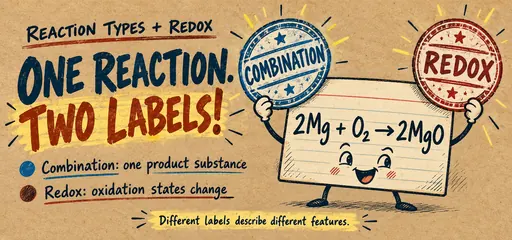
Hand-drawn reaction card with the balanced magnesium-oxygen equation holds combination and redox badges, showing that classifications describe different features.

Reaction Types and Redox: Oxidation, Reduction and Agents

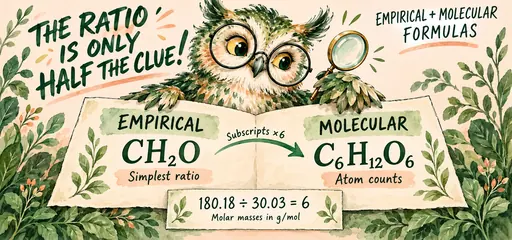
Hand-painted owl compares empirical CH2O with molecular C6H12O6; the molar-mass ratio 180.18 divided by 30.03 gives a subscript multiplier of six.

Empirical and Molecular Formulas: Calculate Atom Ratios

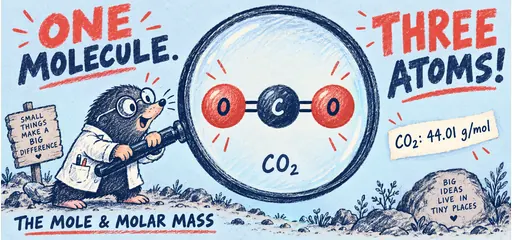
Hand-drawn mole chemist magnifies one carbon dioxide molecule containing one carbon and two oxygen atoms; CO2 has molar mass 44.01 g/mol.

The Mole and Molar Mass: Convert Grams to Molecules

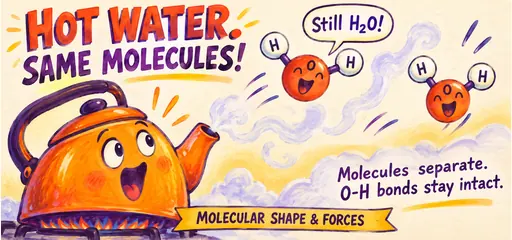
Hand-painted comic kettle releases two intact bent H2O molecules: boiling separates water molecules while their oxygen-hydrogen covalent bonds stay intact.

Molecular Shape and Polarity: Why Bond Dipoles May Cancel

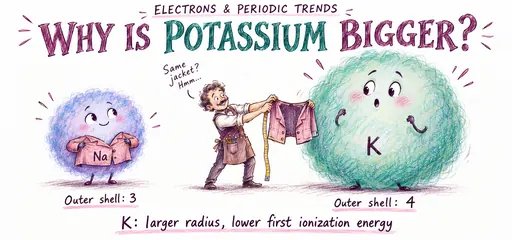
Hand-sketched tailor compares sodium and potassium atom-cloud cartoons: potassium has outer shell four, a larger radius and lower first ionization energy than sodium with outer shell three.

Electrons and Periodic Trends: Explaining Atomic Size and Ionization Energy

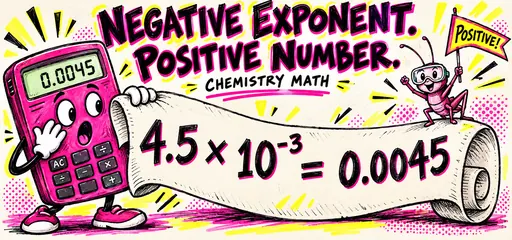
Hand-lettered calculator and cricket comic shows 4.5 times ten to the negative third equals positive 0.0045, distinguishing a negative exponent from a negative number.

Chemistry Math: Scientific Notation, Ratios, and Meaningful Signs

Physics Experiments, Models, and Data

Physics Experiments, Models, and Data

Nuclear Physics, Radiation, and Half-Life

Nuclear Physics, Radiation, and Half-Life

Quantum and Atomic Physics

Quantum and Atomic Physics

Interference, Diffraction, and Polarization

Interference, Diffraction, and Polarization