Articles

You can find helpful articles about mathematics and test prep here.

Interested in Becoming an Effortless Math Guest Blogger? Click here

Search in Articles articles.

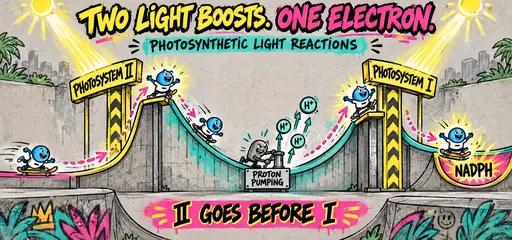
A comic electron follows two light-powered boosts, photosystem II then photosystem I, with proton pumping between them and an NADPH endpoint.

Photosynthetic Light Reactions: ATP, NADPH and Oxygen

A leaf appears green because it reflects and transmits a larger fraction of green light than of much of the red and blue light it receives. That does not mean green light is unused. Some green light is absorbed and can drive photosynthesis, including in deeper leaf layers. Distinguish a lower absorp
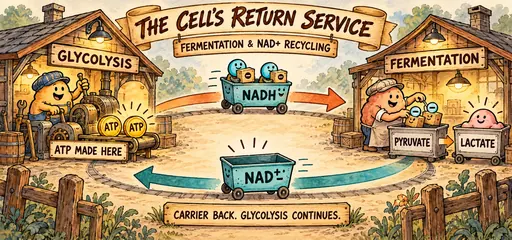
Hand-drawn fermentation comic: NADH delivers electrons to pyruvate, making lactate, while regenerated NAD+ returns to glycolysis, where ATP is made.

Fermentation and NAD+ Recycling: How Glycolysis Continues

During intense exercise, ATP demand rises rapidly and glycolysis can supply ATP at a high rate. Converting pyruvate to lactate regenerates the NAD \(^+\) needed to sustain that pathway. Oxygen limitation can increase reliance on this route, but lactate is also produced when oxygen is available. Neit
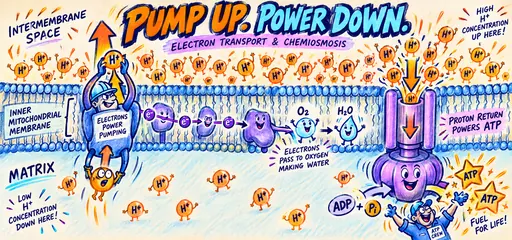
Crayon comic of mitochondrial electron transport pumping H+ into the intermembrane space and proton return through ATP synthase producing ATP in the matrix.

Electron Transport and Chemiosmosis: How ATP Forms

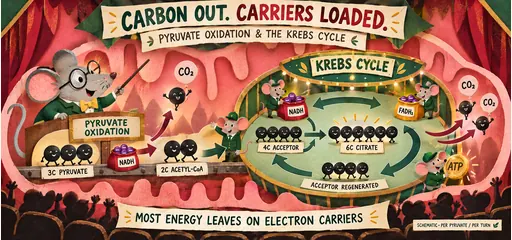
Handmade paper-theater comic showing pyruvate oxidation, acetyl-CoA entering the Krebs cycle, carbon dioxide release, acceptor regeneration and loaded electron carriers.

Pyruvate Oxidation and Krebs Cycle: Carbon and ATP Counts

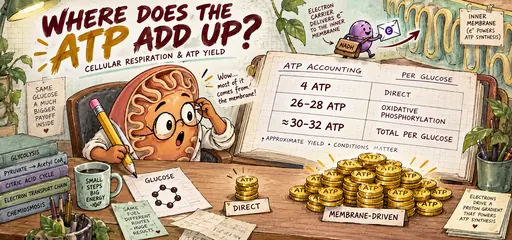
Watercolor mitochondrion accountant comparing 4 direct ATP with approximately 26–28 from oxidative phosphorylation, totaling about 30–32 ATP per glucose depending on conditions.

Cellular Respiration: Stages and 30–32 ATP Yield

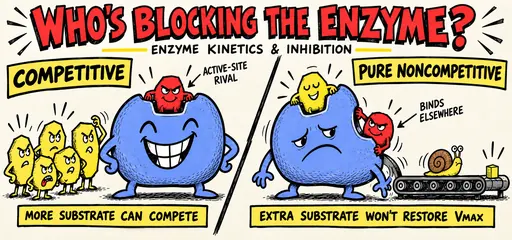
Hand-inked comic comparing competitive inhibition at the active site with pure noncompetitive inhibition at a separate site; extra substrate cannot restore the latter’s Vmax.

Enzyme Kinetics: Km, Vmax and Inhibition

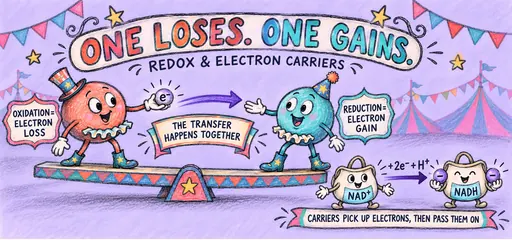
Pastel circus comic showing paired electron loss by oxidation and gain by reduction, with NAD+ accepting two electrons and a proton to form NADH.

Redox and Electron Carriers: NADH, FADH2 and NADPH

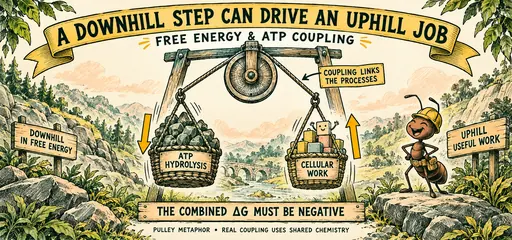
Etched comic pulley metaphor linking favorable ATP hydrolysis to cellular work; the combined free-energy change must be negative, and real coupling uses shared chemistry.

Free Energy and ATP Coupling: Worked Examples

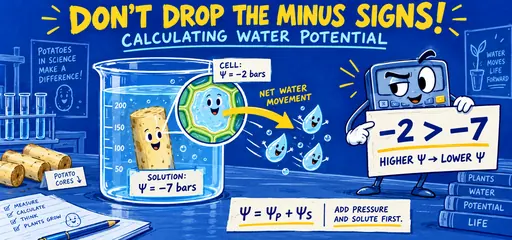
White-pen comic of potato-core water potential: a cell at −2 bars loses water toward solution at −7 bars; compare total pressure plus solute potential.

Calculating Water Potential: Formula and Worked Examples

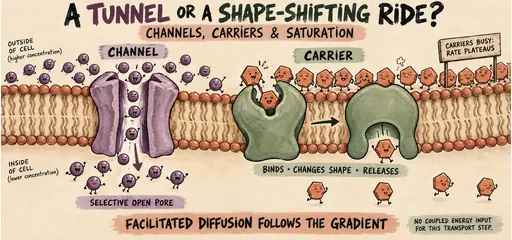
Dry-brush comic contrasting an open selective channel with a carrier binding, changing shape and releasing solute; busy carriers limit rate during facilitated diffusion.

Channels and Carriers: Facilitated Diffusion and Saturation

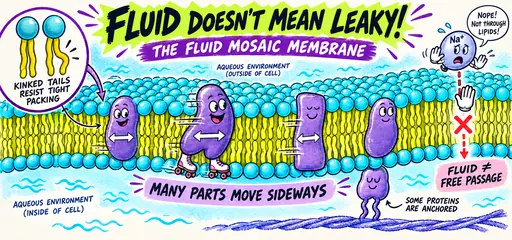
Hand-drawn roller-rink membrane comic showing lateral protein movement, an anchored protein, kinked lipid tails and a sodium ion blocked from passing through the lipid core.

Fluid Mosaic Model: Membrane Structure and Fluidity

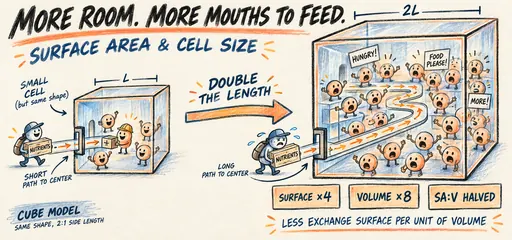
Pencil comic comparing cube-shaped cells: doubling side length multiplies surface area by four and volume by eight, halving exchange surface per unit volume.

Surface Area to Volume Ratio: Cell Size Worked Examples