The Second Amendment and the Right to Bear Arms
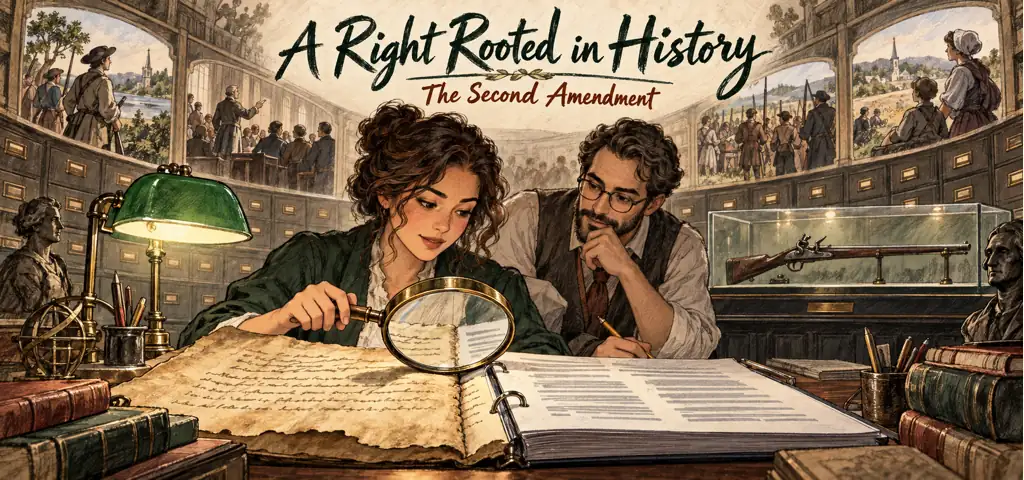
The Second Amendment protects an individual right to keep and bear arms. District of Columbia v. Heller recognized a right to possess a handgun for self-defense in the home, and McDonald v. Chicago applied that protection to state and local governments through the Fourteenth Amendment. The right is not unlimited: a law may regulate arms without violating the Amendment, but the government must justify a covered restriction under the governing historical framework.
Current doctrine proceeds in two stages. A court first asks whether the Amendment’s plain text covers the people, arms, and conduct at issue. If it does, the restriction is presumptively unconstitutional, and the government must show consistency with the nation’s historical tradition of firearm regulation. New York State Rifle & Pistol Association v. Bruen rejected free-form interest balancing at this stage. United States v. Rahimi clarified that history supplies relevant analogues, not necessarily an identical historical twin.
The Second Amendment and the Right to Bear Arms: the working rule
The Court’s 2026 decision in Wolford v. Lopez applied that method to public carry. It held unconstitutional Hawaii’s default rule forbidding licensed concealed carry on private property open to the public unless the owner expressly consented. Property owners remained free to exclude firearms. The constitutional defect was the state’s broad default prohibition, for which it failed to establish a sufficiently representative historical tradition. The decision therefore concerns a governmental carry rule, not a constitutional right to disregard an owner’s choice.
The Second Amendment and the Right to Bear Arms: limits and hard cases
For a test question, identify the regulated conduct, the level of government, and the proposed historical analogue. Do not infer that every firearm rule is valid or that every rule is forbidden. In Rahimi, the Court rejected a facial challenge to a federal law disarming a person subject to a qualifying domestic-violence restraining order, reasoning that the law could constitutionally apply after a judicial finding that the person posed a credible threat. The central distinctions are textual coverage, incorporation, the historical-tradition inquiry, and the difference between public regulation and private property control.
A new case involving the second amendment and the right to bear arms
For a test question, identify the regulated conduct, the government level, and the claimed historical analogue. Give one concrete example. Answer check: The Second Amendment protects an individual right to keep and bear arms. District of Columbia v. This right differs from a general claim of privacy or property.
Video lesson: The Second Amendment and the Right to Bear Arms
National Constitution Center gives a focused explanation of this topic in Second Amendment (High School/College).
If the player does not load, watch this lesson directly on YouTube.
Connect this lesson to the larger course
For a broader map connecting the second amendment and the right to bear arms to civil liberties, civil rights, and equal protection, use the AP U.S. Government and Politics learning hub.

Related to This Article
More math articles
- Free Grade 6 English Worksheets for Ohio Students
- How to Calculate Limits of Functions
- 4th Grade PSSA Math FREE Sample Practice Questions
- How to Graph Quadratic Functions? (+FREE Worksheet!)
- How to Solve Word Problems Involving Completing a Table and Making a Graph?
- Top 10 Tips to Create an ISEE Math Study Plan
- Geometry Puzzle – Challenge 77
- How to Find Determinants of a Matrix?
- How to Solve Rationalizing Imaginary Denominators? (+FREE Worksheet!)
- The Best Grade 3 Math Book for Arizona Students

















What people say about "The Second Amendment and the Right to Bear Arms"?
No one replied yet.