Supply shifts when production conditions change
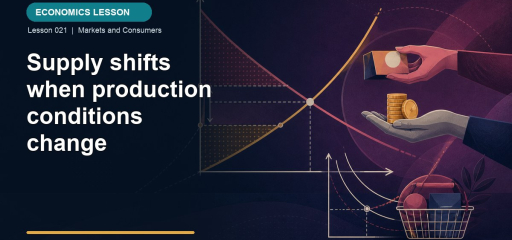
Supply shifts when production conditions change: this Effortless Math guide explains the topic in plain language, shows how it works through solved examples, and gives you free practice to try immediately, so the idea sticks instead of staying abstract.
Translate the event into cost at each output level.
Lower input prices or improved technology reduce marginal cost and shift supply right. Higher input prices shift supply left. Good weather can shift agricultural supply right. A destructive storm can shift it left. A per-unit tax raises marginal cost by the tax and shifts supply upward or left. A per-unit subsidy does the opposite.
Translate every event into a seller sentence: “At the same output price, this event makes producing a given quantity more or less profitable.” If more profitable, sellers offer more and supply shifts right. If less, supply shifts left. This method is more reliable than memorizing a list because it handles unfamiliar inputs and technologies.
A productivity improvement means the same inputs produce more output or a given output uses fewer inputs. Either description lowers the resource cost of units and shifts supply right. Buying an additional machine does not automatically shift the market curve in the short run if it merely replaces a machine or if the question gives no capacity effect. Use the described change in production possibilities or marginal cost.
A fixed license fee raises fixed cost but does not change the marginal cost of another unit in the short run, so it does not shift the competitive firm’s short-run supply curve. It can affect long-run entry and market supply. This short-run/long-run distinction produces a sophisticated but fair distractor.
Compare a per-unit tax with a lump-sum fee. A $2 tax on each unit adds $2 to marginal cost at every quantity, shifting the firm’s supply upward. A $2,000 annual permit fee is paid regardless of current output and therefore raises fixed and average total cost but not marginal cost. In the short run it can reduce profit without changing the firm’s profit-maximizing quantity at a given price. In the long run, lower profit can induce exit, shifting market supply left.
Expectations can change current supply. If sellers of a storable good expect a much higher future price, they may withhold inventory now, shifting current supply left. For perishable output or unavoidable production, the response may differ. Use the assumptions in the stem.
Related production has two forms. Joint products emerge from the same process, as beef and hides do. More production of one can increase supply of the other. Production substitutes compete for shared resources, as corn and soybeans compete for land. A higher soybean price can shift corn supply left. The relationship is on the producer side, so do not apply the consumer substitute rule automatically.
| Event | Supply effect | Marginal-cost or market logic |
|---|---|---|
| Input price falls | Right | Added units cost less |
| Per-unit tax rises | Left or upward | Every unit carries the added tax |
| Fixed fee rises | No short-run firm-supply shift | Marginal cost is unchanged. Long-run entry may change |
| Technology improves | Right | Given output uses fewer resources |
| Sellers expect higher future price | Current supply may shift left | Storable inventory is withheld |
| Number of sellers rises | Market supply shifts right | More firm quantities are horizontally added |
Follow the cost, not the product name
An automated cutter reduces fabric waste per jacket. At every jacket price, producing a given quantity is now cheaper. Supply shifts right. If jacket price itself rises, firms move upward along the new or existing supply curve instead.
Finish by distinguishing cause from adjustment. An input-cost decrease shifts supply right. The resulting lower equilibrium price then causes quantity demanded to rise along demand. Demand did not shift unless a separate buyer-side determinant changed. A complete answer follows both curves without renaming the movement.
Coffee growers expect coffee prices to be substantially higher next month. If stored coffee can be held cheaply, current supply is likely to
- shift right as growers sell sooner
- shift left as growers postpone sales
- remain fixed because expectations affect only demand
- become vertical
- increase only after next month’s price changes
shift left as growers postpone sales Sellers who can store the good may withhold units now to sell later at the expected higher price, reducing current supply.
A per-unit subsidy paid to solar-panel producers will most directly
- shift demand for panels right
- move producers down the existing supply curve
- shift supply right by lowering net marginal cost
- shift supply left because government spending rises
- reduce quantity supplied at every price
shift supply right by lowering net marginal cost A production subsidy lowers the producer’s effective marginal cost, increasing the quantity firms will offer at each buyer price.
Watch the idea in action
A focused video lesson from Marginal Revolution University.

Reza is an experienced Math instructor and a test-prep expert who has been tutoring students since 2008. He has helped many students raise their standardized test scores--and attend the colleges of their dreams. He works with students individually and in group settings, he tutors both live and online Math courses and the Math portion of standardized tests. He provides an individualized custom learning plan and the personalized attention that makes a difference in how students view math.
Related to This Article
More math articles
- 8th Grade IAR Math Practice Test Questions
- Top 10 TSI Math Prep Books (Our 2023 Favorite Picks)
- Top 10 8th Grade PSSA Math Practice Questions
- Cyclins and CDKs: How They Control the Cell Cycle
- P-value Calculator — from z, t, or Chi-Square
- A Comprehensive Collection of Free SHSAT Math Practice Tests
- 8th Grade MCAS Math Worksheets: FREE & Printable
- Limits on judicial power
- Deciphering the Dots: How to Recognizing and Understanding Graph Patterns
- How to Use Partial Products to Multiply Two-Digit Numbers By Two-digit Numbers






















What people say about "When Supply Shifts and Why"?
No one replied yet.