Progressive Jackpot Math: When the Number Gets Big Enough to Matter
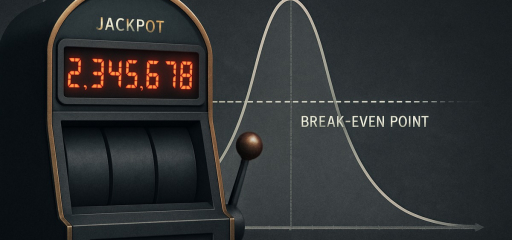
Every progressive jackpot poster screams the same thing, $8 million! $12 million! Life-changing!, and almost nobody in the crowd staring at the digits actually knows when that number crosses the line from “marketing bait” into “mathematically interesting.” There’s a real threshold. It’s calculable. And for most progressives most of the time, the ticker hasn’t hit it yet.
I’ve sat in front of a Mega Moolah machine at 2 a.m. Doing back-of-the-napkin EV math on a cocktail receipt, which is either nerdy or sad depending on your worldview. Either way, the answer is more interesting than the casino wants it to be, and a lot less actionable than slot YouTubers pretend.
What a Progressive Jackpot Actually Is, Mechanically
A progressive slot skims a small slice off every bet, usually somewhere between 1% and 3%, and dumps it into a shared pool. That pool keeps climbing until somebody hits the jackpot combo, at which point it resets to a seed value (often a few hundred thousand dollars) and the climb starts over. The skim is what makes the base game’s RTP lower than a non-progressive equivalent. You’re paying for the lottery on top of the slot.
So when somebody tells you Mega Moolah has an RTP of about 88.12%, that’s the base game only. The jackpot contribution sits separately, and its real value to you depends entirely on how big the pot is when you spin. A $1 million Mega Moolah and a $20 million Mega Moolah are not the same game, even though the reels are identical.
That’s the whole hook. The base RTP is fixed. The jackpot RTP is variable. Add them together and you get a number that occasionally, rarely, pokes above 100%.
The Break-Even Formula, Stripped Down
Here’s the only equation you need, and it isn’t scary:
Base RTP + (Jackpot Size ÷ Bet) × P(hit) ≥ 1.0
Rearrange it and you get the break-even jackpot:
Break-Even Jackpot = (1 − Base RTP) × (1 ÷ P(hit)) × Bet
That’s it. Plug in the published RTP, the published hit probability, and your bet, and the math tells you exactly how big the pot has to be before the game is fair-EV, not profitable, just fair. Profitable comes later, and as we’ll see, “later” is doing a lot of heavy lifting in that sentence.
Mega Moolah, Worked Out
Mega Moolah’s published base RTP is roughly 88.12%, the Mega jackpot hits about once every 50 million spins, and the standard contribution comes from a $1 bet. Drop those into the formula:
Break-even = (1 − 0.8812) × 50,000,000 × $1 = 0.1188 × 50,000,000 = $5,940,000.
So the Mega pot needs to be roughly $5.94 million before the game is mathematically fair. The historical average jackpot when somebody wins is somewhere around $5 million, meaning on average, Mega Moolah is hit just below break-even. Sometimes a player gets lucky and scoops $18 million; the average is dragged up by those, but the median win is meaningfully lower.
Translation: the game lives in a neighborhood that’s surprisingly close to fair, but it never camps out on the positive side. Whether any given hit was +EV or −EV in retrospect is roughly a coin flip, and you don’t get to know which one you’re playing in advance.
Wheel of Fortune, And Why $1M Isn’t Enough
Now do the same math on a Wheel of Fortune progressive. Base RTP somewhere near 88%, jackpot hit probability around 1 in 16 million, and the eligible bet is $3 (you have to max-bet to qualify, which is a tax most players forget about).
Break-even = 0.12 × 16,000,000 × $3 = $5,760,000.
If you walk past a Wheel of Fortune machine and the marquee says “$1,000,000 JACKPOT!”. That’s not a deal. That’s a casino selling you a $5.76M problem dressed up as a million-dollar dream. The pot would need to be almost six times bigger before the math even shrugs and says “okay, fine, it’s fair now.”
Honestly? This is the part that gets to me. The big bright “$1M” sign is doing real psychological work, and the gap between “$1M jackpot” and “EV-fair jackpot” is bigger than the jackpot itself. That’s wild.
Break-Even Thresholds Across Hit Frequencies
Different progressives have wildly different hit probabilities, and the break-even jackpot scales linearly with rarity. Here’s how the threshold moves as the hit gets harder, assuming a fixed 88% base RTP and a $1 eligible bet:
| Hit Probability (per spin) | Expected Spins Between Hits | Break-Even Jackpot ($1 bet, 88% base RTP) |
|---|---|---|
| 1 in 500,000 | 500K | $60,000 |
| 1 in 2,000,000 | 2M | $240,000 |
| 1 in 10,000,000 | 10M | $1,200,000 |
| 1 in 16,000,000 | 16M | $1,920,000 |
| 1 in 50,000,000 | 50M | $6,000,000 |
| 1 in 100,000,000 | 100M | $12,000,000 |
Two things jump out. First, the rarer the hit, the more enormous the headline number has to be before it actually matters. A “must-win-by” jackpot that hits every 500K spins only needs to reach $60K to be fair. Those small local progressives flip positive far more often than the headline-grabbing wide-area network ones. Second, every dollar of bet size multiplies the threshold linearly. A $3 max-bet game with a 1-in-16M hit frequency doesn’t break even until almost $6M, not $1.92M. The eligible-bet requirement is a hidden cost most players never pencil in.
The Variance Problem Nobody Talks About
Let’s say you find a progressive that’s genuinely above its break-even threshold, a Mega Moolah at $8 million, a wide-area Wheel of Fortune at $7 million, whatever. Positive EV, right? Mathematically, yes. Actionably, almost never.
The standard deviation on a single spin of a progressive slot is astronomical because nearly all the variance lives in one tail event. To realize the expected gain with any reasonable confidence, you’d need to play something like:
- Tens of millions of spins to reduce the standard error to a few percent of the jackpot.
- At roughly 600 spins per hour on a typical slot, that’s well over a thousand years of continuous play.
- Even with a syndicate playing in parallel, the bankroll required to survive the dry stretches is in the eight or nine figures.
- And the jackpot resets the moment somebody hits it, which could be you on spin one, or somebody at another machine on a network progressive while you’re mid-spin.
So +EV in theory, totally unrealizable in practice. The Wizard of Odds walks through this exact tension better than most, the math is real, the opportunity is real, and the route from “real on paper” to “real in your bank account” runs through a bankroll most lottery winners don’t have.
This is why I keep telling friends: the right way to play a progressive is to stop waiting for +EV and admit you’re paying for the entertainment of a tiny shot at a giant number, accept the −EV, set a budget, and stop pretending it’s an investment strategy. If you want investment strategies, go learn some probability math at Effortless Math and apply it somewhere with a higher signal-to-noise ratio than a slot floor.
What the Regulators See That You Don’t
The UK Gambling Commission requires operators to publish theoretical RTP figures, and you can actually pull base RTPs for licensed games from their disclosures. What’s almost never on the marquee, though, is the jackpot hit probability. That’s the one number that determines whether the current pot is +EV, and it’s the one number players are reliably denied.
I’ve found myself emailing game studios for hit-frequency disclosures more than once. The serious ones (Microgaming, IGT, Light & Wonder) will give you a number if you push. The shadier ones bury it under “proprietary.” Treat the silence as data, if a studio won’t disclose the hit probability on a progressive, you can’t calculate break-even, and an uncalculatable game is a no-bet game.
One more wrinkle: published RTPs assume the jackpot seed gets paid out as part of the long-run return. If a game advertises 96% RTP “including jackpot,” you’re being sold a number that depends entirely on you contributing across millions of spins. Your personal session of 400 spins will see roughly the base-game RTP and nothing else, the jackpot portion of that 96% is a long-run average across the entire player population, not a promise about your evening. That’s not deceptive exactly, but it’s not honest in the way most players read it either.
FAQ
Are local progressives ever +EV?
Sometimes, yes. Small in-house progressives with hit frequencies in the 1-in-100K to 1-in-500K range can flip positive at surprisingly modest jackpot sizes, sometimes only a few thousand dollars over seed. Card-room rooms with mandatory-hit-by-X bad-beat jackpots are a related example. The catch is they reset fast and the +EV window is short.
Does the casino lose money when the jackpot is +EV?
On that specific outcome, the player has a theoretical edge. On the overall game, the casino is still fine, because the pot was funded by players’ own contributions over months or years, the house never “pays” the jackpot, the previous players did. The house just brokers the transfer and keeps its base hold.
Is it better to bet max on a progressive?
Only if max bet is required to qualify for the full jackpot. If a $1 bet qualifies for the same Mega tier as a $5 bet, the $1 bet is dramatically more efficient, same shot at the same pot, one-fifth the risk. Read the paytable. Read it twice.
What’s the worst progressive structure for players?
Wide-area network progressives with massive hit denominators (1-in-50M and up) plus mandatory max-bet qualifiers. The break-even threshold climbs into mid-eight figures and the variance is essentially uninvestable.
Do “must-hit-by” progressives change the math?
Yes, in the player’s favor. If a progressive is guaranteed to hit before $5,000, the distribution of jackpot sizes when it actually pops shifts heavily toward the upper bound. These games genuinely do drift +EV near the ceiling, but every other gambler in the building knows it, so you’re rarely alone at the machine when it’s close.
So Should You Ever Chase a Big Jackpot?
If you’re chasing for entertainment, knock yourself out, just budget like you’re buying a movie ticket, not buying a lottery ticket. If you’re chasing because you think the +EV math makes it a play, the variance math will eat you alive long before the expectation pays off. There’s a sliver of real edge in the headline-jackpot world, and it belongs to syndicates with seven-figure bankrolls who can sit on a +EV machine for weeks at a time. It does not belong to you on a Saturday night in Vegas, and it does not belong to me, even though I’ve absolutely spent more than I should have testing the proposition.
The number on the marquee is meant to feel big. Run it through the formula and ask whether it’s big enough. Most of the time, the answer’s a polite no, and that polite no is the most useful piece of casino math you’ll ever carry around.

Related to This Article
More math articles
- How to Help Your 8th Grade Student Prepare for the New Jersey NJSLA Math Test
- How to Transform Quadratic Equations?
- Free Grade 3 English Worksheets for Arkansas Students
- Exponent Rules Practice — Laws of Exponents Drills
- NREMT EMR Question Formats: Practice the Official Screen Before Test Day (2027 Prep)
- The Best Grade 8 ELA Practice Tests for Idaho Students
- Analysis, Not Summary
- SAT Calculator Policy
- How to Graph Transformation on the Coordinate Plane: Reflection?
- Alaska AK STAR Grade 3 Math Worksheets — 49 Free Printable Single-Skill PDFs









What people say about "Progressive Jackpot Math: When the Number Gets Big Enough to Matter - Effortless Math"?
No one replied yet.