No-Commission Baccarat: A Better Deal, or a Cleaner Sales Pitch?
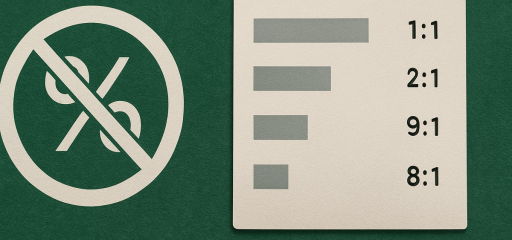
Walk through any modern casino floor and you’ll spot a baccarat table advertising “NO COMMISSION!” in glowing letters, usually with a smaller sign nearby promising side bets that pay 40 to 1. The pitch is obvious, why would you ever play the old version where the house grabs 5% of every Banker win when you can play this shinier one for free? I’ll admit I find this rule almost insulting in its cleverness, because the math behind it is doing exactly what good casino math is supposed to do: hand the player a feeling of generosity while quietly taking the same money back through a different door.
I’ve been teaching probability long enough that I’ve stopped being annoyed by casino marketing and started being a little impressed by it. No-commission baccarat, usually branded as EZ Baccarat, is one of the better magic tricks the industry has invented in the last twenty years. Let’s actually run the numbers and see what the deal really is.
What “no commission” is actually replacing
In standard baccarat, the Banker bet is the strongest wager on the table. Across an 8-deck shoe, ignoring ties, the Banker bet wins roughly 50.68% of decided hands. That’s a genuine player-friendly probability, better than 50/50, which is why the casino has to do something to claw back its edge. Their tool is a 5% commission on every Banker win. You bet $100, Banker wins, you collect $95 in profit instead of $100. That commission is the only thing keeping the Banker bet profitable for the house. Without it, the casino would be paying out fair odds on a wager that wins more than half the time, which is not a business model.
The full house edge on Banker, including ties as pushes, comes in around 1.06%. Player bet sits at 1.24%. Tie bet is the trap, 14.36% house edge, and we don’t need to talk about that one because nobody who’s read this far is betting it.
The EZ Baccarat trick
EZ Baccarat says: forget the commission. Banker wins pay 1:1, clean and simple. There’s one exception, and it’s small enough that the dealer mentions it once and then never again. If Banker wins with a three-card total of 7, the bet doesn’t pay. It pushes. You keep your stake, but you don’t win anything.
That’s the whole rule change. No 5% haircut, but you give up the wins on a specific three-card outcome. The casino’s bet is that the math works out in their favor, and, spoiler, it almost exactly does.
Running the actual probability
Here’s where it gets interesting. The probability that Banker wins with a three-card 7 in an 8-deck shoe is approximately 0.02386, a hair under 2.4% of all hands. That’s not a guess, it’s been computed from full combinatorial analysis of every possible shoe state (the Wizard of Odds publishes the full breakdown).
Now let’s compare the two structures on a per-hand basis. In standard baccarat, every Banker win pays 0.95 units instead of 1.00, a savings to the house of 0.05 per win. Banker wins about 45.86% of all hands (the rest split between Player wins and ties). So the commission costs the player, on average:
0.4586 × 0.05 ≈ 0.02293 units per hand
In EZ Baccarat, you skip the commission entirely. That’s worth getting back 0.05 on every Banker win, or about 0.02293 units per hand recovered. But you also lose the payout on the three-card-7 Banker wins. You don’t lose the bet, you just don’t win it. The cost is one full unit of expected win on each of those hands:
0.02386 × 1.00 ≈ 0.02386 units per hand
So the rule swap costs the player about 0.02386 per hand and gives back about 0.02293 per hand. The net is roughly 0.00093 against the player, basically nothing, but tilted very slightly toward the house. That’s how the published house edge on EZ Baccarat Banker comes in around 1.02% in the most common 8-deck rule set, almost identical to standard baccarat’s 1.06%, sometimes a tick better, sometimes a tick worse, depending on the exact shoe rules and which variant the casino uses.
Side-by-side house edges
Here’s the comparison that matters. I’ve pulled the numbers from the standard 8-deck analyses and rounded to the nearest hundredth of a percent.
| Bet | Game variant | Payout structure | House edge |
|---|---|---|---|
| Banker | Standard baccarat | 0.95:1 (5% commission) | 1.06% |
| Banker | EZ Baccarat (no commission) | 1:1, push on 3-card 7 | 1.02% |
| Player | Both variants | 1:1 | 1.24% |
| Tie | Both variants | 8:1 | 14.36% |
| Tie | Both variants | 9:1 (some tables) | 4.84% |
| Dragon 7 side bet | EZ Baccarat | 40:1 on Banker 3-card 7 | 7.61% |
| Panda 8 side bet | EZ Baccarat | 25:1 on Player 3-card 8 | 10.19% |
If you only look at the Banker row, EZ Baccarat looks like a genuine upgrade, 1.02% beats 1.06%, even if barely. And that would be the honest end of the story if the casino were offering EZ Baccarat by itself. But they aren’t. They’re offering it surrounded by side bets that exist for exactly one reason: to recapture, with interest, whatever the casino gave up on the main bet.
Dragon 7 and Panda 8, where the money actually goes
The Dragon 7 side bet wins when Banker wins with a three-card 7, the exact hand that pushes on the main Banker bet. Pays 40:1. Sounds great until you do the math: the event happens about 2.25% of the time (slightly less than the all-Banker-3-card-7 rate because Dragon 7 is conditional on the specific outcome), and 40:1 payouts don’t come close to fair odds for a 1-in-44ish event. The house edge sits at roughly 7.61%, which is seven times worse than betting Banker directly.
Panda 8 is the same trick on the other side of the table. It pays 25:1 when Player wins with a three-card 8. Probability is around 3.54%, which sounds like it should pay closer to 27:1 to be fair, but again the casino skims a fat margin. The published house edge is about 10.19%, almost ten times what you’d give up on the main Banker bet.
Here’s the kicker. The Banker bet without commission is genuinely a hair better for the player. But the side bets are how the casino pays for that hair. The whole pitch is structured so that you walk up, see “no commission,” feel like you got a deal, and then notice the flashing 40:1 sign and decide to put a small chip on Dragon 7 every hand “just for fun.” That small chip is worth more to the casino than the commission ever was.
A skeptic’s view of the marketing
I sat at an EZ Baccarat table for about an hour last year, mostly to watch how people bet. The pattern was almost exactly what you’d predict. Players who’d switched from standard baccarat felt like they were getting a fair shake on the Banker bet, and they were, technically. But probably four out of five of them had a chip on Dragon 7 or Panda 8 on every hand. Some had a chip on both. The casino had successfully replaced a 1.06% drag on their bankroll with a 1.02% drag plus a 7-10% drag on a side bet they wouldn’t have made in the old game.
It’s a beautiful piece of design. The honest part, removing the commission, is true and verifiable. The side bets are also true and verifiable. They just happen to be financially adjacent in a way the casino is very happy to leave unmentioned. If you want to dig into the precise breakdown, the Wizard of Odds EZ Baccarat analysis has the full combinatorial work, and his general baccarat basics page covers the standard-game math.
When EZ Baccarat is actually the better game
If you’re disciplined, EZ Baccarat is fine. Better, even, by a fraction of a percent. The case for playing it is straightforward:
- You only bet Banker or Player, never the side bets, no matter how many flashing lights are pointed at them.
- You like the speed, no commission means no pausing the game to settle 5% chips, which means faster rounds (this also means faster losses if you’re losing, so don’t pretend speed is purely a benefit).
- You’re tracking your own bankroll and you genuinely understand that 1.02% vs 1.06% is a rounding error over any session shorter than a few thousand hands.
- You’ve already learned the basic probability framework, if you haven’t, Effortless Math has approachable lessons on probability and expected value that make this kind of analysis click.
If you can hold to those rules, EZ Baccarat is mildly better than standard baccarat. If you can’t, it’s worse, sometimes dramatically worse, because the side-bet temptation is part of the table.
Why the rule change is so small on purpose
Here’s something I find genuinely clever about the math. The casino didn’t pick “Banker wins with a 3-card 7” because it’s a memorable hand. They picked it because the probability of that specific event almost exactly cancels the value of the 5% commission. They needed a rule that would feel like a small concession to the player while preserving their long-run advantage to within a few thousandths of a percent. The 3-card 7 was the natural fit. Three-card 8 wins for Banker would have been too rare and the math would tilt toward the player by too much. Two-card 7 wins would have been too common and the math would tilt the other way and players would notice they were getting clobbered. Three-card 7 lands in the Goldilocks zone where the deal looks generous and costs the casino essentially nothing.
I respect the engineering. I don’t recommend the side bets.
FAQ
Is no-commission baccarat actually a better deal than standard baccarat?
Marginally. Banker house edge drops from about 1.06% to about 1.02% in the most common 8-deck rule set. Over 100 hands at $25 a bet, that’s a difference of about $1. It’s real, but it’s not going to change your evening.
What happens on a three-card 7 Banker win?
Your Banker bet pushes. You don’t win, you don’t lose. You keep your original stake. The casino uses this push to offset the commission they’re no longer collecting.
Should I take the Dragon 7 or Panda 8 side bets?
No. The house edges are 7.61% and 10.19% respectively, which means you’re giving up several times more than you would on the main Banker bet. They exist to make the no-commission rule profitable for the casino, not for you.
Does card counting work in EZ Baccarat the way it does in blackjack?
Not meaningfully on the Banker or Player bets, the edge from counting is tiny and impractical. There are documented counting strategies for the Dragon 7 side bet that can flip its edge slightly positive in the last few hands of a shoe, but casinos shuffle aggressively and bar players who try it. Not a realistic strategy for a normal session.
Why does Banker win more than half the time anyway?
Banker plays last and follows a draw rule that takes the Player’s third card into account. Acting on more information is a structural advantage. That’s exactly why the casino needs the commission (or the 3-card 7 push) to make money on the bet at all.
Is the 9:1 tie payout worth taking?
The 9:1 tie cuts the house edge from 14.36% down to 4.84%, which is a huge relative improvement but still terrible compared to Banker. Don’t bet ties even at 9:1 unless you enjoy donating to the dealer’s tip pool.
The takeaway
No-commission baccarat is a real product with a real, tiny improvement to the player’s odds on the Banker bet, and a real, much larger profit center built around it in the form of side bets. If you sit down disciplined and only bet Banker, you’ll do a fraction of a percent better than you would at a standard table. If you sit down and start sprinkling chips on Dragon 7 because the payout is shiny, you’ll do considerably worse. The casino is betting on the second outcome. They wouldn’t have built the game this way if the first outcome were the typical one. The probability math doesn’t lie, but the table layout sure tries to distract you from it.

Related to This Article
More math articles
- Chance is not coincidence, but the mathematics of fate
- Experiments
- Why Live Online Casinos Are So Popular: Essential Facts to Know
- Praxis Core Math Worksheets: Free Printable PDFs
- Best Online Math Tutoring Equipment
- 8th Grade NSCAS Math Worksheets: FREE & Printable
- Ohio OST Algebra 1 Free Worksheets: Printable OST-Ready Algebra 1 Worksheets with Step-by-Step Keys
- 7th Grade MEAP Math Worksheets: FREE & Printable
- Freedom of association
- 6th Grade MEAP Math Practice Test Questions








What people say about "No-Commission Baccarat: A Better Deal, or a Cleaner Sales Pitch? - Effortless Math"?
No one replied yet.