Each trade creates surplus when benefit exceeds cost
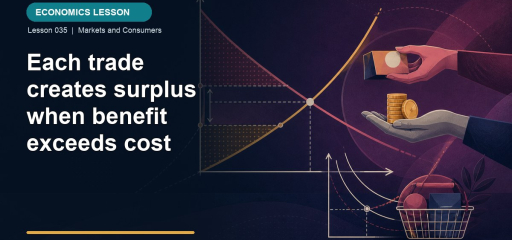
Each trade creates surplus when benefit exceeds cost: this Effortless Math guide explains the topic in plain language, shows how it works through solved examples, and gives you free practice to try immediately, so the idea sticks instead of staying abstract.
Price divides the gain between the two parties.
If a buyer would pay $70 and a seller’s opportunity cost is $46, the trade creates $24 of total surplus. At a $58 price, consumer surplus is $12 and producer surplus is $12. At a $50 price, consumer surplus is $20 and producer surplus is $4. The price changes distribution but not the $24 total from that particular trade.
Willingness to pay is the maximum amount a buyer would give for a unit. Seller cost is the value of resources or the minimum compensation needed to make that unit available. A voluntary trade can create gains whenever willingness to pay exceeds seller cost. Price must fall between them for both parties to accept in the simplest case, but the total gain is determined by benefit minus cost, not by where the price falls.
For the $70 buyer and $46 seller, a price of $65 leaves $5 of consumer surplus and $19 of producer surplus. A price of $48 leaves $22 and $2. In both cases, the amounts sum to $24. This invariance is a useful arithmetic check: for a completed unit, CS+PS=WTP-cost.
Across a market, consumer surplus is the area below demand and above price. Producer surplus is the area above supply and below price. For straight curves, these are often triangles. Producer surplus is not the same as profit because the supply curve typically reflects variable opportunity cost but not all fixed cost.
Demand can be read vertically as marginal willingness to pay. At each quantity, its height states the value of the marginal unit to buyers. Supply can be read as marginal seller cost. The vertical distance between them is the surplus created by that unit. Adding those vertical gains across all traded units produces total surplus.
| Measure | Per-unit definition | Graph region |
|---|---|---|
| Consumer surplus | Willingness to pay minus price | Below demand and above price |
| Producer surplus | Price minus marginal seller cost | Above supply and below price |
| Total surplus | Willingness to pay minus seller cost | Between demand and supply for traded units |
For linear curves, use triangle area only after identifying boundaries. If demand intercepts the price axis at $30, equilibrium price is $18, and quantity is 80, consumer surplus is 1/2(80)($12)=$480. The $12 height is willingness-to-pay intercept minus price. Using $30 as the height counts the money buyers actually pay as if it were surplus.
Producer surplus differs from accounting profit because fixed cost may not appear under the short-run supply curve. If a firm’s revenue exceeds variable cost by $1,000 but fixed cost is $1,200, producer surplus can be positive while profit is negative $200. The concepts answer different questions about operation and overall return.
A market price divides, but does not create, the gain
A collector values a book at $90 and its owner values keeping it at $54. At any transaction price between those values, trade creates $36 of total surplus. Negotiation determines the division. A law that prevents the trade destroys the $36. A price change within the acceptable range merely reallocates it.
Surplus is a model-based measure, not cash sitting in an account. Consumer surplus records the difference between value and payment. Producer surplus records payment above opportunity cost. State whose valuation or cost is being compared before interpreting a shaded area.
For a linear demand curve, consumer surplus at equilibrium is represented by the area
- below supply and above price through the quantity traded
- above supply and below demand through the quantity traded
- between total revenue and total cost through equilibrium output
- below demand and above price through the quantity traded
- above demand and below price through the quantity traded
below demand and above price through the quantity traded Consumer surplus lies under demand, which records willingness to pay, and above the market price for units purchased.
At the current output in a market, the last unit traded has marginal benefit greater than marginal cost. Removing that unit would
- increase total surplus because its production cost disappears
- reduce total surplus by the difference between benefit and cost
- leave total surplus unchanged because the unit was voluntarily traded
- transfer the unit’s producer surplus to consumers
- reduce consumer surplus but increase producer surplus by an equal amount
reduce total surplus by the difference between benefit and cost The unit contributes marginal benefit minus marginal cost to total surplus. Removing it destroys that positive difference.
Watch the idea in action
A focused video lesson from Jacob Clifford.

Reza is an experienced Math instructor and a test-prep expert who has been tutoring students since 2008. He has helped many students raise their standardized test scores--and attend the colleges of their dreams. He works with students individually and in group settings, he tutors both live and online Math courses and the Math portion of standardized tests. He provides an individualized custom learning plan and the personalized attention that makes a difference in how students view math.
Related to This Article
More math articles
- How to Evaluate Logarithms? (+FREE Worksheet!)
- Detour of Variable Changes: A Complete Exploration of Related Rates
- How Digital Interaction Builds Smarter Students
- Free Grade 7 English Worksheets for Connecticut Students
- The Best Grade 6 ELA Practice Tests for Iowa Students
- FREE 3rd Grade Georgia Milestones Assessment System Math Practice Test
- Parallel Lines and Transversals: Rules, Examples and Free Worksheet
- Relevance of Evidence
- Election and succession
- Line Plot




















What people say about "Why Each Trade Creates Surplus"?
No one replied yet.