Federalism Conflicts: Preemption, State Commands and Rights
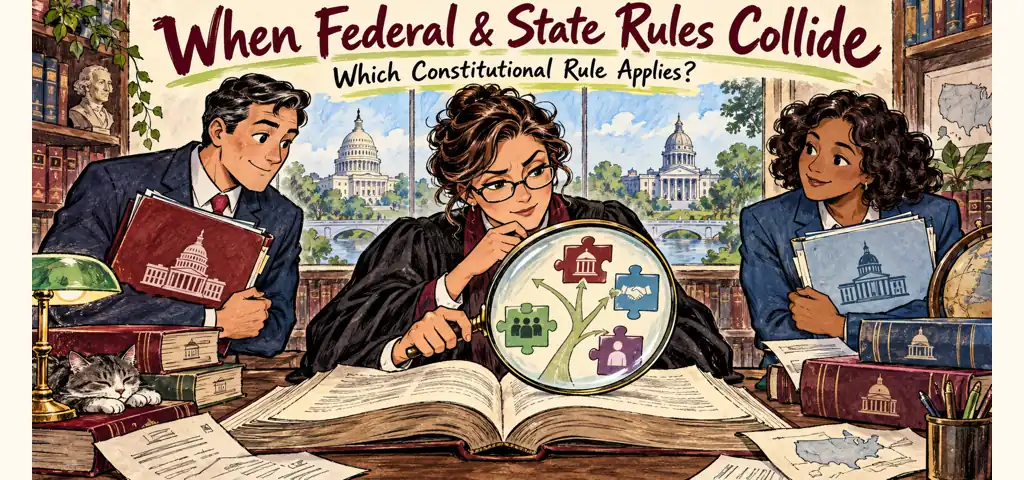
Federalism conflicts require you to identify what the federal measure actually does. Regulating private conduct, displacing a conflicting state rule, offering conditional funding and directing state officials are different mechanisms. The source of authority, the legal form and any individual-rights claim all matter.
Identify the Federal Action Before Choosing a Doctrine
Federal-state conflict is resolved through enumerated powers, supremacy, preemption, anti-commandeering, spending conditions, and rights doctrine. The answer depends on the particular power and form of federal action.
Federalism conflicts turn on the legal mechanism. Congress can regulate private conduct under an enumerated power and preempt incompatible state rules. It can offer funds with lawful conditions. But it generally cannot require a state legislature to enact a federal program or compel state executive officers to administer one.
Keep Individual Rights Separate from Subject-Matter Power
Rights create another path. Even where states possess subject-matter authority, the Fourteenth Amendment and valid federal civil-rights law can restrict how that power is exercised. Reserved power is therefore not immunity from the Constitution.
Classify Preemption, Funding and State Commands
Classify the claim before selecting a doctrine: lack of enumerated power, preemption, coercive spending, commandeering, or violation of an individual right. A state cannot nullify valid federal law merely by declaring disagreement, and the federal government cannot treat states merely as administrative departments. The Constitution preserves both supremacy and a meaningful state role.
Read the Cases by the Kind of State Role Involved
In Murphy v. NCAA, the Court rejected the state-law authorization prohibition before it and distinguished a direct order to state legislatures from valid preemption. A command phrased as “do not enact” can raise the same structural problem as an affirmative legislative command. The Supremacy Clause does not independently grant Congress legislative authority.
Printz v. United States invalidated the interim requirement that state and local chief law-enforcement officers conduct the federal background checks at issue. Distinguish compelled administration from voluntary cooperation; do not read the decision as a ban on every interaction between governments.
By contrast, Reno v. Condon upheld the Driver’s Privacy Protection Act against the federalism challenge. The law regulated states as owners of databases rather than requiring their legislatures to enact a program or their officers to enforce federal regulation of private citizens. The case does not establish that every federal rule affecting a state is valid; it shows why the regulated activity and state role matter.
The Fourteenth Amendment’s text separately prohibits states from denying due process and equal protection, among other provisions. Having authority over a policy subject does not remove those constitutional duties. A structural federalism issue and an individual-rights claim need their own analysis.
Compare Private Regulation with a Legislative Command
Compare two hypothetical federal measures. One regulates private businesses under a valid granted power. The other simply directs a state legislature to enact that regulatory program. Why is a shared policy goal not enough to treat both measures as ordinary preemption?
Check your reasoning
The first measure regulates private actors under the assumed valid authority; its effect on conflicting state law requires a preemption analysis. The second tells the state legislature to enact a program and therefore raises an anti-commandeering issue. A common policy objective does not make those legal mechanisms interchangeable. In an actual dispute, identify the precise law, constitutional source and remedy rather than deciding from the policy label alone.
Federal-state conflict is resolved through enumerated powers, supremacy, preemption, anti-commandeering, spending conditions, and rights doctrine. The answer depends on the particular power and form of federal action. Intergovernmental relations include bargaining, administration, funding, litigation, and information exchange among national, state, and local governments.
Try Three Federalism Conflict Questions
Choose one answer, then check your reasoning. These are short learning checks, not an exam score. If the controls are unavailable, the explanations remain readable below each question.
Answer C. The mechanism is a command to the state legislature. That raises a different question from a valid federal rule regulating private conduct and displacing conflicting state law.
Answer B. The Fourteenth Amendment expressly restricts state action. The existence of a state policy power does not decide whether the way it is exercised respects individual constitutional rights.
Answer A. The Court examined the regulated activity and the state’s role. It upheld the DPPA in that setting, without announcing that every federal-state interaction is valid or invalid.
Video Lesson: Federalism
CrashCourse gives a focused explanation of this topic in Federalism: Crash Course Government and Politics #4.
If the player does not load, watch this lesson directly on YouTube.
First review the source of federal and state powers. Then compare regulation with fiscal federalism and grant conditions.
Continue Studying Authority and Funding Conditions

Related to This Article
More math articles
- Probability and Statistics for Beginners: A Friendly Intro
- AP Business with Personal Finance: Compare APR and APY (2027 Prep)
- The Best Grade 3 ELA Practice Tests for Nebraska Students
- Mississippi MAAP Grade 4 Math Free Worksheets: 72 Free Skill-by-Skill PDFs with Answer Keys
- Polygon Names
- Life tenure
- How to Unlock the Path to Success: “TExES Core Subjects Math for Beginners” In-Depth Solution Manual
- How Is the ALEKS Test Scored?
- Mitosis and Cell-Cycle Data: Chromosome Counts and Examples
- TSI Math FREE Sample Practice Questions












What people say about "Federalism Conflicts: Preemption, State Commands and Rights"?
No one replied yet.