Common resources create excessive use
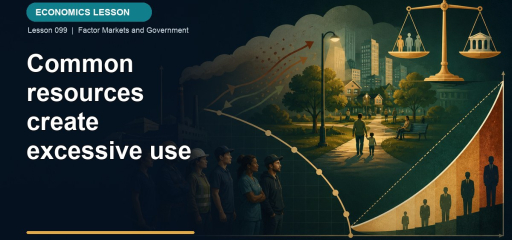
Common resources create excessive use: this Effortless Math guide explains the topic in plain language, shows how it works through solved examples, and gives you free practice to try immediately, so the idea sticks instead of staying abstract.
Each user captures a benefit while sharing depletion cost.
Why may an unregulated common resource be overused?
- Each user bears the full depletion cost of an additional unit.
- Users capture each benefit but share the depletion costs.
- The resource is nonrival in consumption at every quantity.
- Users can readily exclude anyone who does not pay.
- The marginal social benefit of the resource is zero.
Users capture each benefit but share the depletion costs. The private gain from another use exceeds the user’s private share of the social depletion cost, encouraging excessive use.
An open-access fishery is best classified as
- a private good
- a club good
- a pure public good
- a common resource
- a natural monopoly
a common resource Fish are rival because one catch leaves fewer fish, but open access makes exclusion difficult.
Watch the idea in action
A focused video lesson from Khan Academy.
Open-access fisheries, congested roads, and groundwater basins are rival but difficult to exclude users from. The private user considers personal harvest or travel benefit but not the full scarcity or congestion imposed on others. The result is the tragedy of the commons: use exceeds the efficient level.
Possible remedies include property or use rights, quotas, congestion prices, community rules, and monitoring. Turning a resource into private property can improve stewardship but may create distributional and enforcement questions. One policy does not fit every physical and institutional setting.
Same exclusion problem, opposite quantity error
A tornado alert is nonrival: one household receiving it does not reduce another’s alert. Free riding can cause underprovision. Fish in an open lake are rival: one catch leaves fewer fish. Shared depletion causes overharvest.
A common resource is rival but difficult to exclude people from using. A fish caught by one boat is unavailable to another, yet controlling access to a large open fishery may be costly. The individual harvester receives the private benefit of the catch while spreading part of the depletion cost across all users. As a result, private marginal cost understates social marginal cost and use exceeds the efficient level.
Imagine ten fishers share a lake. One more day of fishing gives a fisher $180 of catch and costs $100 in fuel and time. It also reduces future catches by a total of $120 spread across the group. The fisher sees an $80 private gain, but society experiences 180-100-120=-$40. Open access encourages the trip even though total value falls. This is the tragedy of the commons.
| Resource problem | Individual ignores | Likely market result |
|---|---|---|
| Open fishery | Depletion imposed on others | Excess harvest |
| Congested road | Delay imposed on other drivers | Too many peak trips |
| Shared aquifer | Lower water table and pumping cost | Excess withdrawal |
Remedies try to make users face scarcity. A catch quota limits total harvest. Transferable quotas can shift harvest toward lower-cost fishers. Congestion pricing charges for the delay caused at busy times. Community rules may work when users observe one another, share norms, and can punish violations. Defined property or use rights can encourage stewardship, though boundaries, enforcement, equity, and ecological uncertainty still matter.
Private ownership is neither magical nor always feasible. Migrating fish cross boundaries, groundwater flows beneath properties, and monitoring can be expensive. Conversely, common ownership does not necessarily mean open access. A local group can manage a commons successfully through enforceable rules. The core failure is unrestricted access combined with rivalry, not the word “common” in an organization’s name.
Contrast the quantity errors. Public goods are underprovided because people can receive nonrival benefits without paying. Common resources are overused because each user captures a rival unit while sharing the depletion cost. Both are hard to exclude, so a question that asks only about exclusion is incomplete.
On a graph, treat the unrecognized congestion or depletion as a marginal external cost. The market or open-access quantity lies beyond the efficient quantity. A fee equal to marginal external damage at the efficient quantity can internalize the cost. As always, the efficient outcome usually reduces use. It does not require preserving every unit untouched.
A shared watershed supports electricity, irrigation, drinking water, habitat, and recreation. Because one user’s withdrawal or damage can reduce what remains for others, the resource is rival at the margin. Effective management requires rules that make users face the opportunity cost they impose on the rest of the community.

Reza is an experienced Math instructor and a test-prep expert who has been tutoring students since 2008. He has helped many students raise their standardized test scores--and attend the colleges of their dreams. He works with students individually and in group settings, he tutors both live and online Math courses and the Math portion of standardized tests. He provides an individualized custom learning plan and the personalized attention that makes a difference in how students view math.
Related to This Article
More math articles
- Political tolerance
- Superdelegates
- Top 10 Tips You MUST Know to Retake the CBEST Math
- Poker & Probabilities: Is The Game About Luck or Skill?
- Free Grade 7 English Worksheets for South Dakota Students
- The Best Grade 4 Math Book for Vermont Students
- How to Use Multiplication to Compare Customary Units
- Oregon OSAS Grade 8 Math Free Worksheets: Printable Grade 8 Math Practice with Answer Keys
- Voter turnout
- ASVAB Math Cheat Sheet: Every Formula You Need to Know
















What people say about "Common Resources and Overuse"?
No one replied yet.