U.S. History

Search in U.S. History articles.

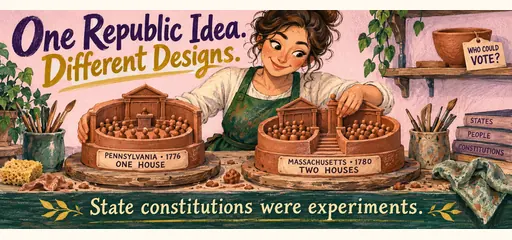
Handwritten pottery-studio comic comparing Pennsylvania’s 1776 one-house legislature with Massachusetts’s 1780 two-house design and asking who could vote.

State Constitutions and Republican Experiments: Power and Participation

Compare Pennsylvania’s 1776 and Massachusetts’s 1780 constitutions, state voting rules and rights declarations with primary sources and CLEP practice.
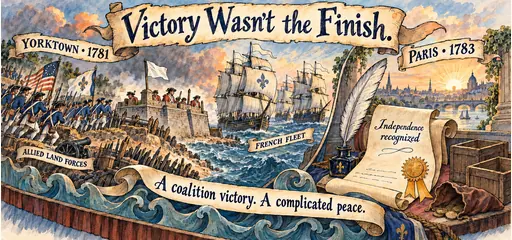
Hand-drawn Yorktown comic contrasts allied land forces and the French fleet in 1781 with independence recognized at Paris in 1783.

Yorktown and the Treaty of Paris: Victory, Peace and Consequences

Explain the allied victory at Yorktown and the Treaty of Paris of 1783. Compare surrender, independence, debts and Loyalist property with CLEP practice.
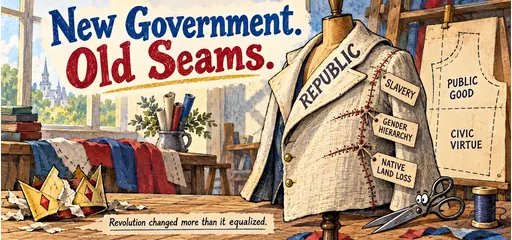
Handwritten dressmaker comic depicts a republic jacket with old seams labeled slavery, gender hierarchy, and Native land loss beside public good and civic virtue.

Republicanism and the Revolution’s Social Limits: Rights and Change

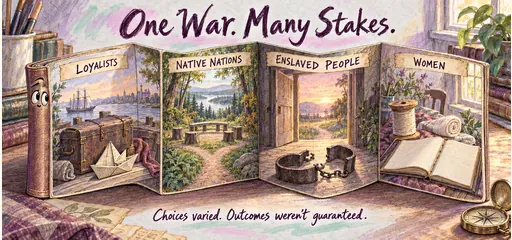
Hand-drawn accordion-book comic presents Loyalists, Native nations, enslaved people, and women, emphasizing varied wartime choices and uncertain outcomes.

Loyalists, Native Nations, Enslaved People and Women in the Revolution

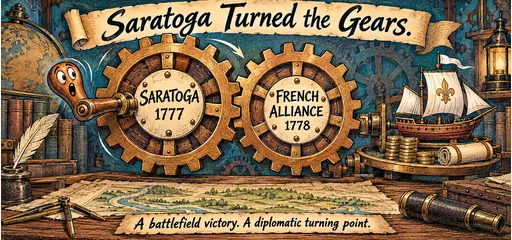
Handwritten gear-workshop comic links Saratoga in 1777 to the French alliance in 1778, illustrated with a French ship, coins, and supplies.

Military Turning Points and the French Alliance: Saratoga to 1778

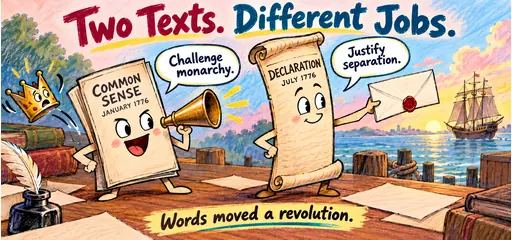
Handwritten comic contrasts Common Sense challenging monarchy in January 1776 with the Declaration justifying separation in July 1776.

Common Sense and the Declaration of Independence: Key Differences

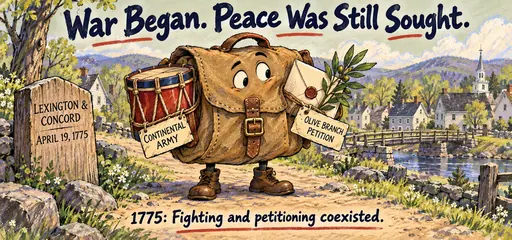
Handwritten satchel comic carries a Continental Army drum and Olive Branch Petition beside a Lexington and Concord marker dated April 19, 1775.

Lexington, Concord and the Move toward Independence: 1775 Explained

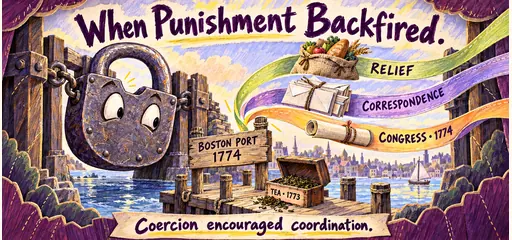
Handwritten harbor comic shows Boston port locked in 1774 as relief, correspondence, and Congress ribbons illustrate coordinated colonial resistance.

Tea Act, Coercive Acts and Intercolonial Resistance Explained

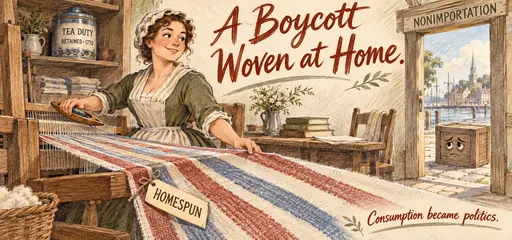
Handwritten homespun comic shows a colonial woman weaving cloth during nonimportation, with the tea duty retained in 1770.

Townshend Duties, Boston and Nonimportation Explained

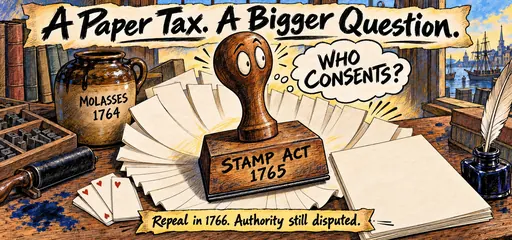
Handwritten printer-workshop comic shows the Stamp Act of 1765, molasses in 1764, and the unresolved question of consent after repeal in 1766.

Sugar and Stamp Acts: Taxation, Representation and Protest

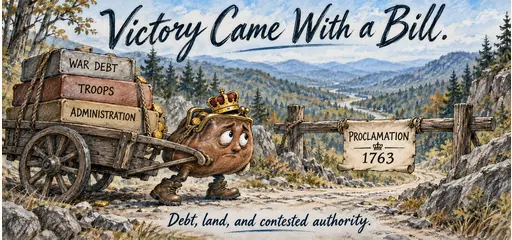
Handwritten comic shows a crowned purse pulling war-debt, troops, and administration costs beside a Proclamation of 1763 barrier in wooded mountains.

Proclamation of 1763: War Debt, Land and Colonial Resistance

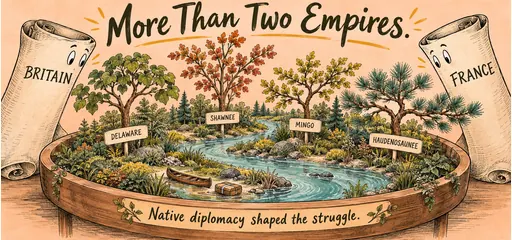
Handwritten garden metaphor depicts Delaware, Shawnee, Mingo, and Haudenosaunee as distinct trees, with British and French claim-scrolls outside.

Ohio Valley Rivalry: Native Diplomacy and the Albany Plan

1 … 4 5 6 7 8 … 19