How to Find the Volume of a Cylinder, Cone, and Sphere

How to find the volume of a cylinder, cone, and sphere, step by step: the rule in plain language, solved examples worked one line at a time, and practice questions so you can try it yourself before moving on.
TL;DR: Three shapes worth memorizing cold. A cylinder’s volume is pi r squared times h. A cone is one-third of that, same base, same height, but one-third the volume. A sphere is four-thirds pi r cubed. Always use the same units throughout your calculation, and remember to cube your units when you write the answer. Lock these three formulas in and most volume problems on your test become a quick plug-and-go.
Key takeaways:
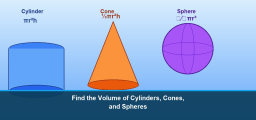
- Cylinder: (V = pi r^2 h).
- Cone: (V = frac{1}{3} pi r^2 h), exactly one-third of a cylinder with the same base and height.
- Sphere: (V = frac{4}{3} pi r^3).
- Always use the radius (half the diameter), not the diameter.
- Units cube: cm gives cm³, in gives in³, ft gives ft³.
Volume is “how much fits inside”, water in a tank, popcorn in a cone, air in a balloon. Three formulas cover most of what you’ll meet in middle school, high school, and on the SAT. Here’s the no-stress way to remember them.
We’ll also cover prisms, pyramids, and composite solids, because the SAT and ACT love combining shapes (a cylinder with a cone on top, for example). Once you understand the building blocks, composite solids are just addition.
Cylinder
A cylinder is a tube, two circles connected by straight sides.
[V = pi r^2 h]
Where \(r\) is the radius of the base and \(h\) is the height.
Example: a can with radius 3 cm and height 10 cm has volume \(pi(3)^2(10) = 90pi approx 282.7,text{cm}^3\).
Think of it as “area of the base × height.” That single idea works for any prism, rectangular, triangular, hexagonal, you name it.
Cone
A cone is exactly one-third of a cylinder with the same base and height.
[V = tfrac{1}{3}pi r^2 h]
That \(tfrac{1}{3}\) is the only thing different from the cylinder formula, remember it as “ice-cream cones are a third as much as the cup they fit on.”
Example: cone with radius 3 and height 6 → \(tfrac{1}{3}pi(9)(6) = 18pi\).
Sphere
A sphere is just a ball.
[V = tfrac{4}{3}pi r^3]
Notice the (r^3), volume always involves three dimensions, so the radius is cubed.
Example: a basketball with radius 12 cm: \(tfrac{4}{3}pi (12)^3 = tfrac{4}{3}pi(1728) = 2304pi approx 7238,text{cm}^3\).
Rectangular prism (box)
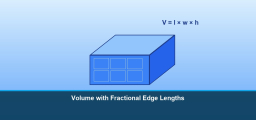
\(V = l cdot w cdot h\). The simplest of them all, length times width times height.
Example: a moving box 24 in × 18 in × 18 in has volume \(7776,text{in}^3\).
Pyramid
A pyramid is exactly one-third of a prism with the same base and height, just like a cone is a third of a cylinder.
\(V = tfrac{1}{3} cdot B cdot h\), where \(B\) is the area of the base.
Memory tricks
- Cylinder = pizza × height.
- Cone = third of a cylinder.
- Pyramid = third of a prism.
- Sphere = \(tfrac{4}{3}pi r^3\) → “four thirds pie cube”, say it three times and you’ll remember it forever.
- Prism = base area × height.
Common mistakes
- Using diameter instead of radius (radius is half the diameter).
- Forgetting to cube units (cm³, not cm).
- Skipping the \(tfrac{1}{3}( on cones/pyramids or the )tfrac{4}{3}\) on spheres.
- Plugging the slant height into the formula instead of the perpendicular height.
- Forgetting to convert units (don’t mix inches with feet without converting).
Composite solid example
A grain silo is a cylinder with a half-sphere on top. The cylinder has radius 4 m and height 10 m. Find the total volume.
- Cylinder: \(pi (4)^2 (10) = 160pi\).
- Half-sphere: \(tfrac{1}{2} cdot tfrac{4}{3}pi (4)^3 = tfrac{128}{3}pi\).
- Total: \(160pi + tfrac{128}{3}pi = tfrac{480 + 128}{3}pi = tfrac{608}{3}pi approx 636.7,text{m}^3\).
Quick practice
- A spherical scoop of ice cream has radius 2 cm. What’s its volume? Answer: \(tfrac{32}{3}pi approx 33.5,text{cm}^3\).
- A cylinder has radius 5 and height 12. Find the volume. Answer: $300pi$.
- A cone has radius 4 and height 9. Find the volume. Answer: $48pi$.
- A rectangular fish tank is 24 in × 12 in × 16 in. Volume in cubic inches? Answer: 4608.
- How many cones of radius 3 and height 6 fit in a cylinder of the same dimensions? Answer: 3.
- A swimming pool 25 m long, 10 m wide, and 2 m deep. Volume? Answer: 500 m³.
- A pyramid has a square base of side 10 and height 12. Volume? Answer: \(tfrac{1}{3}(100)(12) = 400\).
- The diameter of a basketball is 24 cm. What is its volume in terms of \(pi\)? Answer: radius = 12; \(V = tfrac{4}{3}pi(1728) = 2304pi\).
Surface area vs volume, don’t confuse them
A cylinder’s surface area is \(2pi r^2 + 2pi r h\) (two circles plus a rectangle wrapped around). A cylinder’s volume is \(pi r^2 h\). Different formulas, different units.
If a question asks how much paint you need, that’s surface area. If it asks how much water fits, that’s volume.
How volume scales with size
If you double every dimension of a 3D shape, the volume multiplies by \(2^3 = 8\). Triple every dimension, volume goes up by 27. This is one of the most-tested SAT/ACT geometry traps, sliding a question from “increase the radius” to “increase the volume.”
Example. If the radius of a sphere triples, by what factor does the volume grow? Answer: \(3^3 = 27\).
Volume in everyday units
Volume comes in different units depending on what you’re measuring.
- Cubic centimeters (cm³) = milliliters (mL). 1 cm³ = 1 mL.
- Cubic meters (m³) for swimming pools and rooms.
- Cubic feet (ft³) for fridges and shipping crates.
- Liters (L) = 1000 cm³. Common for drinks and gasoline.
- Gallons for fuel in the US (1 gal ≈ 3.785 L).
Knowing these conversions saves time on word problems that switch units mid-question.
Word problem strategy
A reliable 4-step approach for any volume word problem:
- Sketch the shape. Even a rough drawing prevents formula mix-ups.
- Label the given information. Radius? Diameter? Height? Slant height?
- Pick the formula. Match it to the shape.
- Convert units if needed. Then compute. Always include the cubic unit in your final answer.
Common SAT/ACT volume traps
- Giving you the diameter when the formula wants the radius.
- Mixing inches and feet within the same problem.
- Asking for the volume of a half-shape (hemisphere, half-cylinder), remember to divide by 2.
- Asking how many small objects fit inside a larger one, divide the volumes, but check that the small object can actually pack efficiently (this is a packing problem, not pure volume).
FAQ
What’s the formula for the volume of a cylinder?
\(V = pi r^2 h\).
Why is a cone’s volume one-third of a cylinder’s?
Because if you pour three cones of liquid into a matching cylinder, it fills exactly.
What’s the formula for the volume of a sphere?
\(V = tfrac{4}{3}pi r^3\).
Do I need the diameter or the radius?
The formulas use the radius, half of the diameter.
Will volume formulas be given on the SAT?
Yes, the SAT prints a reference sheet at the start of the math section with all the volume formulas you need.
How is volume different from surface area?
Volume measures the inside (cubic units). Surface area measures the outside (square units).
What’s the difference between height and slant height?
Height is the perpendicular distance from base to apex. Slant height runs along the surface of the cone or pyramid. Volume formulas always use the perpendicular height.
Can volume ever be negative?
No. Volume measures a physical quantity (size), so it’s always positive.
What’s the volume of a hemisphere?
Half a sphere’s volume: \(V = tfrac{2}{3}pi r^3\).
What’s the volume of a triangular prism?
Area of the triangular base times the length: \(V = tfrac{1}{2}(b cdot h) cdot ell\).
Does the formula for a cylinder’s volume work for any cylinder, or only “right” cylinders?
A right cylinder (axis perpendicular to base) uses \(V = pi r^2 h\) where \(h\) is the perpendicular height. For an oblique cylinder (tilted axis), the formula still works, just use the perpendicular height, not the slant length.
What about the volume of irregular shapes?
For anything not a clean prism, cylinder, cone, sphere, or pyramid, you use water displacement: drop the object into a graduated cylinder and measure how much the water level rises. The rise (in mL) equals the object’s volume (in cm³).
What is \(pi\), anyway?
\(pi\) is the ratio of a circle’s circumference to its diameter, about $3.14159$. It appears in every formula involving circles, spheres, cylinders, and cones because all of these are built on the geometry of a circle.
Is there a single formula that covers prisms, pyramids, cylinders, and cones?
Yes, in two families. Prisms and cylinders: \(V = (text{base area}) times text{height}\). Pyramids and cones: \(V = tfrac{1}{3} (text{base area}) times text{height}\). That \(tfrac{1}{3}\) is the reason a cone is exactly one-third the volume of the cylinder it sits inside.
One last reminder
Progress in math compounds. A 1% improvement every day for 100 days yields nearly a 3x improvement overall, because each new concept builds on the last. The students who pull ahead aren’t the ones who study the longest. They’re the ones who study consistently, review their mistakes, and refuse to skip the foundations. Show up tomorrow. Then show up the day after. The results take care of themselves.
If you found something useful here, save this article and revisit it after your next practice session. You’ll catch nuances on the second read that you missed on the first, because by then you’ll have the experience to recognize them. Happy practicing.
For loads of practice, head to our 7th- and 8th-grade math worksheets.
Recommended EffortlessMath Books
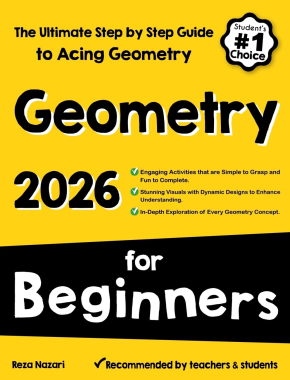
For a workbook that drills volume formulas alongside the rest of geometry, the Geometry for Beginners walks through cylinders, cones, spheres, and more with worked examples. For pre-algebra-level practice, the Pre-Algebra for Beginners covers volume of basic 3D shapes at the right level for grade 7-8.
Frequently Asked Questions
What’s the volume of a cylinder?
(V = pi r^2 h), where (r) is the radius of the circular base and (h) is the height. The base is a circle (area (pi r^2)) and you’re stacking it up to height (h). A cylinder with radius 4 and height 10 has volume (pi (4)^2 (10) = 160pi approx 502.65) cubic units.
What’s the volume of a cone?
(V = frac{1}{3} pi r^2 h). It’s exactly one-third the volume of a cylinder with the same base and height. So if a cylinder holds 30 cups of water, a cone with the same radius and height holds 10 cups. Make sure the height you use is the perpendicular height (from base to tip), not the slant height down the side.
What’s the volume of a sphere?
(V = frac{4}{3} pi r^3). No height variable, only the radius matters. A sphere with radius 6 has volume (frac{4}{3} pi (6)^3 = frac{4}{3} pi (216) = 288pi approx 904.78) cubic units. The radius gets cubed (not squared), which makes spheres grow fast as the radius increases.
What’s the difference between radius and diameter?
The radius goes from the center to the edge. The diameter goes all the way across, through the center. The diameter is exactly twice the radius: (d = 2r), or (r = d/2). Every volume formula uses radius, not diameter. If the problem gives diameter, divide by 2 first.
Why is the cone formula one-third of the cylinder formula?
You can show it experimentally, fill a cone with water and pour it into a cylinder with the same radius and height; it takes exactly three cones to fill the cylinder. The proof uses calculus (integration), but for test purposes, just remember the (1/3) factor: cone = one-third cylinder.
How do I find the radius if I know the volume?
Solve the volume formula backwards. For a sphere: (V = frac{4}{3} pi r^3), so (r = sqrt[3]{frac{3V}{4pi}}). For a cylinder where you also know height: (r = sqrt{frac{V}{pi h}}). These problems test whether you can rearrange the formula, not just plug in.
Do I leave (pi) in the answer or compute it?
Depends on the test. Many state tests and the SAT/ACT prefer answers “in terms of (pi)”, like (80pi) cm³. Other tests give a decimal value for (pi) (3.14 or 3.14159) and want a decimal answer. Read each question carefully. If the answer choices have (pi) in them, leave it; if they’re decimals, compute it.
What units should the answer have?
Cubic units. If the radius is in centimeters, volume is in cm³. If radius is in inches, volume is in in³. The exponent (³) reflects that volume measures three-dimensional space. Forgetting the cube is one of the most common test mistakes on volume problems.
What if the cylinder is lying on its side?
The orientation doesn’t change the volume, only the radius and height (length) matter. A cylinder lying on its side has the same volume as one standing up, provided the radius and length are the same. The “height” in the formula just means the distance perpendicular to the circular base.
Where do volume problems show up on tests?
Volume of cylinders, cones, and spheres appears on the SAT, ACT, GED, HiSET, TASC, ASVAB, AFOQT, ALEKS, ISEE, SSAT, Praxis Core, TEAS, and every grade 7-8 state math test. Common Core Grade 8 makes “know the formulas for volume of cones, cylinders, and spheres and use them to solve real-world problems” an explicit standard.
Related EffortlessMath Lessons
If a topic on this page feels rusty, these short lessons go deeper:

Related to This Article
More math articles
- CLEP U.S. History I 049: War of 1812 Theaters and Outcomes
- Accuplacer Math Worksheets: FREE & Printable
- Exterior Angle Theorem
- Religious Revival, Rock and Roll, the Beats, and Cultural Dissent
- Religion
- 10 Most Common 3rd Grade Georgia Milestones Assessment System Math Questions
- Free Grade 8 English Worksheets for New Hampshire Students
- GACE Mathematics Flashcards
- How to Find a Coordinate: Dilation
- How to Pass the FTCE Math Test?





What people say about "Volume of a Cylinder, Cone, and Sphere"?
No one replied yet.