How to Find the Area of a Triangle: Every Formula Explained
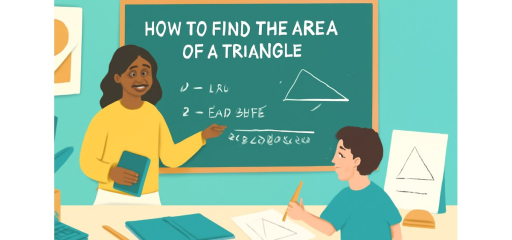
TL;DR: Five formulas cover every triangle situation you will run into. The classic one, one-half base times height, is what you reach for most of the time. Heron’s formula handles the case where you know all three side lengths. The SAS trig formula uses two sides and the angle between them. There is also a coordinate version for points on a plane, and a quick shortcut for right triangles. Master one-half base times height first and the rest fall in line.
Key takeaways:
- The classic formula is \(A = \tfrac{1}{2}bh\), where \(h\) is the perpendicular height, not the slant.
- For right triangles, the two legs serve as base and height.
- Heron’s formula handles triangles where you know all three sides but no height.
- The SAS trig formula: \(A = \tfrac{1}{2}ab\sin C\) when you know two sides and the included angle.
- On the coordinate plane, use the shoelace formula with three vertex coordinates.
Finding the area of a triangle is one of those topics that follows you from elementary school into the SAT, the GED, and even into engineering. The good news: there’s a formula for every situation, and they’re all friendlier than they look.
In this guide, we’ll cover five different formulas, when to use each one, and how to avoid the classic mistakes that drop test scores. By the end, you’ll be able to look at any triangle, by sides, by coordinates, or by sketch, and find its area in under a minute.
The classic formula
\[A = \tfrac{1}{2} \cdot b \cdot h\]
where \(b\) is the base and \(h\) is the perpendicular height (not the slanted side).
Example: a triangle with base 8 and height 5 has area \(\tfrac{1}{2}(8)(5) = 20\) square units.
The factor of \(\tfrac{1}{2}\) exists because every triangle is exactly half of a parallelogram with the same base and height. If you draw a duplicate triangle and rotate it 180°, the two together form a parallelogram. That’s the geometric reason behind the \(\tfrac{1}{2}\).
Right triangles are the easiest
For a right triangle, the two legs are the base and the height. No measuring needed, just multiply and halve.
A right triangle with legs 6 and 9 has area \(\tfrac{1}{2}(6)(9) = 27\) square units.
Heron’s formula (when you only know the sides)
If you know all three sides \(a\), \(b\), \(c\):
\(s = \tfrac{a+b+c}{2}\) (the semi-perimeter)
\(A = \sqrt{s(s-a)(s-b)(s-c)}\).
Example: sides 5, 6, 7. \(s = 9\). \(A = \sqrt{9 \cdot 4 \cdot 3 \cdot 2} = \sqrt{216} \approx 14.7\).
Another worked example. Sides 13, 14, 15. \(s = 21\). \(A = \sqrt{21 \cdot 8 \cdot 7 \cdot 6} = \sqrt{7056} = 84\) square units.
SAS formula (two sides + included angle)
If you know two sides and the angle between them:
\[A = \tfrac{1}{2} \cdot a \cdot b \cdot \sin(C)\]
This shows up on the ACT and in trigonometry.
Example: sides 10 and 12 with a 30° angle between them. \(A = \tfrac{1}{2}(10)(12)\sin(30°) = 60 \cdot 0.5 = 30\) square units.
Equilateral triangle formula
For an equilateral triangle with side \(s\):
\[A = \tfrac{\sqrt{3}}{4} s^2\]
A nice memorize-once shortcut.
Example: equilateral triangle with side 6. \(A = \tfrac{\sqrt{3}}{4} \cdot 36 = 9\sqrt{3} \approx 15.59\).
Coordinate-geometry shoelace formula
If you know the vertices \((x_1, y_1)\), \((x_2, y_2)\), \((x_3, y_3)\):
\[A = \tfrac{1}{2} \left| x_1(y_2 – y_3) + x_2(y_3 – y_1) + x_3(y_1 – y_2) \right|\]
Example: vertices $(1, 1)$, $(5, 1)$, $(3, 6)$. \(A = \tfrac{1}{2}|1(1 – 6) + 5(6 – 1) + 3(1 – 1)| = \tfrac{1}{2}|-5 + 25 + 0| = 10\).
Use this when the SAT gives you triangle vertices in the coordinate plane.
Common mistakes
- Using the slant side as the height (you must use the perpendicular height).
- Forgetting the \(\tfrac{1}{2}\).
- Mixing up area (square units) and perimeter (linear units).
- Forgetting absolute value bars in the shoelace formula. You can’t have negative area.
- Using \(\sin\) with sides that don’t form the included angle.
Quick practice
- Find the area of a triangle with base 10 and height 7. Answer: 35 square units.
- Sides 9, 12, 15. Find the area. Answer: This is a 3-4-5 multiple, right triangle. \(A = \tfrac{1}{2}(9)(12) = 54\).
- Find the area of an equilateral triangle with side 10. Answer: \(25\sqrt{3} \approx 43.30\).
- Sides 8 and 6 with an included angle of 60°. Answer: \(\tfrac{1}{2}(8)(6)\sin(60°) = 24 \cdot \tfrac{\sqrt{3}}{2} = 12\sqrt{3} \approx 20.78\).
- Triangle with vertices $(0, 0), (4, 0), (4, 3)$. Answer: 6 square units.
- Isosceles triangle with legs 13 and base 10. Answer: drop the altitude (which bisects the base) → height \(= \sqrt{13^2 – 5^2} = 12\). Area \(= \tfrac{1}{2}(10)(12) = 60\).
- Triangle with sides 7, 8, 9. Answer: \(s = 12\), \(A = \sqrt{12 \cdot 5 \cdot 4 \cdot 3} = \sqrt{720} \approx 26.83\).
- Two sides of 14 and 9 with a 45° included angle. Answer: \(\tfrac{1}{2}(14)(9)\sin(45°) \approx 44.55\).
Special triangles you should know
- 30-60-90 triangle. Sides in ratio \(1: \sqrt{3}: 2\). If the short leg is \(x\), the longer leg is \(x\sqrt{3}\) and the hypotenuse is $2x$. Area: \(\tfrac{1}{2} \cdot x \cdot x\sqrt{3} = \tfrac{x^2\sqrt{3}}{2}\).
- 45-45-90 (isosceles right) triangle. Sides in ratio \(1: 1: \sqrt{2}\). If a leg is \(x\), the area is \(\tfrac{x^2}{2}\).
These two patterns show up on virtually every SAT and ACT geometry section. Memorize them. They save real time.
Finding height from area (going backward)
Sometimes you’re given the area and one side, and you need the height. Just rearrange:
\[h = \frac{2A}{b}\]
Example: a triangle has area 48 and base 12. What’s the height? \(h = \tfrac{2 \cdot 48}{12} = 8\).
Connecting to similar triangles
If two triangles are similar with a scale factor \(k\), their areas relate by a factor of \(k^2\). Scale a triangle by 3 and the area grows by 9. This is one of the most-tested ideas on the SAT, and the source of many trap answer choices.
Real-world applications
- Architecture. Roof pitches, gables, and trusses are all triangular calculations.
- Land surveying. Plots of land are often partitioned into triangles, Heron’s formula is the surveyor’s friend.
- Computer graphics. Every 3D-rendered scene is built from tiny triangles. The shoelace formula is at the heart of rendering.
- Sailing and aviation. Triangulation locates a vessel by measuring angles to known landmarks.
Test-prep checklist
Before your geometry test or SAT:
- Memorize the five formulas above.
- Practice each one twice with different numbers.
- Drill the 3-4-5, 5-12-13, 30-60-90, and 45-45-90 ratios.
- Practice 5 coordinate-plane area problems using the shoelace formula.
- Review the area-to-scale-factor relationship (\(k^2\)).
FAQ
What’s the basic formula for the area of a triangle?
\(A = \tfrac{1}{2} \cdot b \cdot h\).
What if I only know the three sides?
Use Heron’s formula.
Does the formula change for obtuse or acute triangles?
No, as long as you use the perpendicular height.
How do I find the area of an equilateral triangle?
Use \(A = \tfrac{\sqrt{3}}{4} s^2\) where \(s\) is the side length.
Are triangle area problems on the SAT?
Yes, often in coordinate-geometry questions. Practice spotting the right base/height pair on a graph.
What if my height falls outside the triangle (obtuse case)?
Use the extension of the base. The perpendicular height may live outside the triangle, but the formula still works.
How is the SAS formula derived?
It comes from \(\tfrac{1}{2} \cdot \text{base} \cdot \text{height}\), where the height is one side times \(\sin\) of the angle between the two sides.
Can I find the area of a triangle from its perimeter alone?
No, perimeter alone doesn’t fix the shape. You also need at least one angle or one altitude.
What is the centroid of a triangle?
The centroid is where the three medians (lines from each vertex to the midpoint of the opposite side) meet. It splits the triangle into three smaller triangles of equal area, so it’s also the triangle’s “center of mass.”
How can a triangle be both right and isosceles?
A right isosceles triangle has a 90° angle and two equal legs. Its third angle is 45°. The 45-45-90 triangle is the most famous example.
Does the formula change if the triangle is obtuse?
No, the formula \(A = \tfrac{1}{2}bh\) still works, but the altitude might fall outside the triangle. You have to extend the base to meet the height. The number you get is exactly the same.
What’s the area of an equilateral triangle in terms of its side length?
\(A = \dfrac{s^2 \sqrt{3}}{4}\). Memorize this. It shows up on standardized tests often.
Can two triangles have the same area but look totally different?
Yes. A tall, thin triangle and a short, wide one can have identical areas. Area depends only on the product of base and height, not on the shape itself.
What’s the relationship between the area of a triangle and the area of a parallelogram with the same base and height?
The triangle is exactly half. That’s why the formula has a \(\tfrac{1}{2}\) in front, a parallelogram is \(bh\), and a triangle is half of one cut along a diagonal.
Why do we need so many different area formulas?
Because different problems give you different starting information. If you have base and height, use \(\tfrac{1}{2}bh\). If you have all three sides, Heron’s formula. If you have two sides and the angle between them, the sine formula. Each formula matches a real-world data situation.
One last reminder
Progress in math compounds. A 1% improvement every day for 100 days yields nearly a 3x improvement overall, because each new concept builds on the last. The students who pull ahead aren’t the ones who study the longest. They’re the ones who study consistently, review their mistakes, and refuse to skip the foundations. Show up tomorrow. Then show up the day after. The results take care of themselves.
If you found something useful here, save this article and revisit it after your next practice session. You’ll catch nuances on the second read that you missed on the first, because by then you’ll have the experience to recognize them. Happy practicing.
For more practice, jump into our 6th-grade math worksheets or grab the Middle School Math Bundle for a deep dive.
Recommended EffortlessMath Books
For full geometry coverage with worked examples and practice problems, the Geometry for Beginners walks through every triangle, quadrilateral, and circle formula. For middle schoolers building up to high school geometry, the Pre-Algebra for Beginners reviews area and perimeter alongside algebra basics.
Frequently Asked Questions
What’s the basic formula for area of a triangle?
\(A = \tfrac{1}{2}bh\), where \(b\) is the base and \(h\) is the perpendicular height. The \(\tfrac{1}{2}\) comes from the fact that a triangle is exactly half of a parallelogram with the same base and height, rotate a copy of the triangle 180 degrees and the two pieces form a parallelogram.
Is the height always the side I see?
No, and this trips students up. The height must be perpendicular to the base, even if you have to draw it outside the triangle. For an obtuse triangle, the height from one vertex can land outside the opposite side. Always confirm the height makes a right angle with the base.
How do I find the area of a right triangle?
The two legs are perpendicular, so they ARE the base and height. \(A = \tfrac{1}{2}(\text{leg}_1)(\text{leg}_2)\). A 3-4-5 right triangle has area \(\tfrac{1}{2}(3)(4) = 6\). Don’t use the hypotenuse. It’s the slanted side, not a height.
What’s Heron’s formula?
Heron’s formula gives the area from just the three side lengths. Compute \(s = \tfrac{a+b+c}{2}\) (the semi-perimeter), then \(A = \sqrt{s(s-a)(s-b)(s-c)}\). It’s useful when you have side lengths but no height, common in word problems about plots of land.
When do I use the trig area formula?
Use \(A = \tfrac{1}{2}ab\sin C\) when you know two sides and the angle between them (called the included angle). It’s faster than Heron’s when an angle is given. Common on the SAT, ACT, and trigonometry tests.
How do I find triangle area from coordinates?
Use the shoelace formula: \(A = \tfrac{1}{2}|x_1(y_2 – y_3) + x_2(y_3 – y_1) + x_3(y_1 – y_2)|\). Plug in the three vertex coordinates. The absolute value keeps the answer positive whether you go clockwise or counterclockwise.
What’s a common mistake with triangle area?
Using the slant side instead of the perpendicular height. The slant length is the side you can measure with a ruler, but the height has to make a 90-degree angle with the base. If only the slant is given, you’ll need trig (height = slant \(\times \sin\) of the base angle) to find the true height first.
How do I find the area of an equilateral triangle?
Special shortcut: \(A = \tfrac{\sqrt{3}}{4}s^2\), where \(s\) is the side length. For \(s = 6\): \(A = \tfrac{\sqrt{3}}{4}(36) = 9\sqrt{3} \approx 15.6\). It comes from splitting the equilateral triangle into two 30-60-90 right triangles.
Can triangle area be negative?
No, area is always positive. If you get a negative number from the coordinate formula, take the absolute value. A negative sign from the shoelace formula just means you listed the vertices clockwise instead of counterclockwise.
Where can I get more area practice?
EffortlessMath has worksheets on triangle area, the area cheat sheet for geometry, and the Geometry for Beginners workbook with worked examples on triangles, quadrilaterals, and circles.
Related EffortlessMath Lessons
If a topic on this page feels rusty, these short lessons go deeper:
- How to use the Pythagorean theorem
- How to find the area of a rectangle
- How to find the area of a circle (resource currently unavailable)
- How to find the perimeter of a triangle (resource currently unavailable)
- Special right triangles (30-60-90 and 45-45-90)

Related to This Article
More math articles
- A Parents’ Guide To Supporting Teens With Their Math Skills
- Comparing & Ordering Numbers Practice (Free)
- Embark on Your Mathematical Odyssey: “PERT Math for Beginners” Companion Guide
- Why Sociology Emerged
- Cultural Lag, Modernization, and Globalization
- 10 Most Common CHSPE Math Questions
- Pendleton Civil Service Reform Act
- Bonding and Molecules
- Response bias
- How to Estimate Limit Values from the Graph?






















What people say about "How to Find the Area of a Triangle"?
No one replied yet.