Top 10 ACCUPLACER Math Practice Questions


The Best Books to Ace the ACCUPLACER Math Test
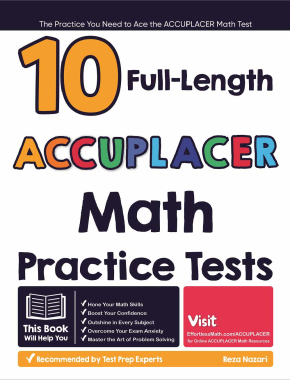
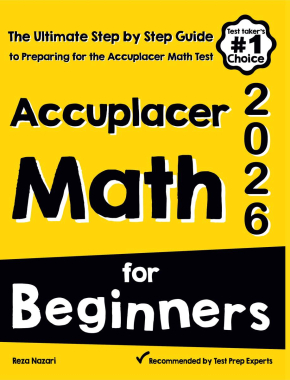
Comprehensive Analysis of Top 10 ACCUPLACER Math Questions
These ten question types represent the core mathematical skills assessed on the ACCUPLACER examination. Understanding the structure and solution methodology for each question type builds confidence and recognition of similar problems during your test. The questions progress from foundational algebra through systems of equations to basic function evaluation, covering all major content areas.
Distribution and Algebraic Simplification
When you see expressions like 3(2x – 4) + 5x, the first step is applying the distributive property. Multiply 3 by each term inside the parentheses: 3 times 2x gives 6x, and 3 times -4 gives -12. This produces 6x – 12 + 5x. Then combine like terms by adding coefficients of x: 6x plus 5x equals 11x. Your final simplified expression is 11x – 12. This pattern appears frequently on ACCUPLACER, often embedded within larger problems.
Multi-Step Linear Equation Solving
Linear equations require isolating the variable by performing inverse operations. For the equation 2x + 7 = 15, subtract 7 from both sides to get 2x = 8. Then divide both sides by 2 to obtain x = 4. Verification confirms correctness: substituting 4 back into the original equation yields 2(4) + 7 = 15, which is true. This verification step is essential for catching errors and should be performed on approximately 30 percent of problems during practice.
Extended Coverage Topics
The remaining eight question types include operations with fractions within algebraic expressions, understanding and applying exponent rules including the quotient rule and power rule, solving quadratic equations through factoring or the quadratic formula, solving systems of two linear equations using elimination or substitution, simplifying radical expressions by identifying perfect square factors, simplifying rational expressions through factoring and cancellation, evaluating functions using function notation and substitution, and setting up and solving word problems that translate English phrases into mathematical equations. Each type requires specific procedures and careful attention to mathematical notation and order of operations.
Strategic Test-Taking for ACCUPLACER Success
Time management on ACCUPLACER is critical because the test adapts to your performance. Simpler computational problems should consume 30 to 60 seconds maximum. Moderate difficulty problems warrant 60 to 90 seconds. Complex multi-step word problems may require up to two minutes when done carefully. Allocate your mental energy efficiently by reading questions completely before beginning work. Identify what the question is asking, what information is provided, and what operations are necessary.
Avoid careless errors by writing out all steps rather than attempting mental calculation. Negative signs cause frequent mistakes, particularly when multiplying negative numbers or distributing negative coefficients. Order of operations errors also appear regularly when students forget parentheses or mishandle exponent evaluation. Using the calculator feature available on your ACCUPLACER to verify arithmetic calculations is a sound strategy that prevents simple computational errors from derailing your entire solution.
Review our ultimate ACCUPLACER math formula cheat sheet to ensure you have all necessary formulas memorized. Additionally, the ultimate SAT math course provides excellent foundational algebra practice that strengthens these core ACCUPLACER skills.
Comprehensive Analysis of Top 10 ACCUPLACER Math Questions
These ten question types represent the core mathematical skills assessed on the ACCUPLACER examination. Understanding the structure and solution methodology for each question type builds confidence and recognition of similar problems during your test. The questions progress from foundational algebra through systems of equations to basic function evaluation, covering all major content areas.
Distribution and Algebraic Simplification
When you see expressions like 3(2x – 4) + 5x, the first step is applying the distributive property. Multiply 3 by each term inside the parentheses: 3 times 2x gives 6x, and 3 times -4 gives -12. This produces 6x – 12 + 5x. Then combine like terms by adding coefficients of x: 6x plus 5x equals 11x. Your final simplified expression is 11x – 12. This pattern appears frequently on ACCUPLACER, often embedded within larger problems.
Multi-Step Linear Equation Solving
Linear equations require isolating the variable by performing inverse operations. For the equation 2x + 7 = 15, subtract 7 from both sides to get 2x = 8. Then divide both sides by 2 to obtain x = 4. Verification confirms correctness: substituting 4 back into the original equation yields 2(4) + 7 = 15, which is true. This verification step is important for catching errors and should be performed on approximately 30 percent of problems during practice.
Extended Coverage Topics
The remaining eight question types include operations with fractions within algebraic expressions, understanding and applying exponent rules including the quotient rule and power rule, solving quadratic equations through factoring or the quadratic formula, solving systems of two linear equations using elimination or substitution, simplifying radical expressions by identifying perfect square factors, simplifying rational expressions through factoring and cancellation, evaluating functions using function notation and substitution, and setting up and solving word problems that translate English phrases into mathematical equations. Each type requires specific procedures and careful attention to mathematical notation and order of operations.
Strategic Test-Taking for ACCUPLACER Success
Time management on ACCUPLACER is critical because the test adapts to your performance. Simpler computational problems should consume 30 to 60 seconds maximum. Moderate difficulty problems warrant 60 to 90 seconds. Complex multi-step word problems may require up to two minutes when done carefully. Allocate your mental energy efficiently by reading questions completely before beginning work. Identify what the question is asking, what information is provided, and what operations are necessary.
Avoid careless errors by writing out all steps rather than attempting mental calculation. Negative signs cause frequent mistakes, particularly when multiplying negative numbers or distributing negative coefficients. Order of operations errors also appear regularly when students forget parentheses or mishandle exponent evaluation. Using the calculator feature available on your ACCUPLACER to verify arithmetic calculations is a sound strategy that prevents simple computational errors from derailing your entire solution.
Review our ultimate ACCUPLACER math formula cheat sheet to ensure you have all necessary formulas memorized. Additionally, the ultimate SAT math course provides excellent foundational algebra practice that strengthens these core ACCUPLACER skills.

Related to This Article
More math articles
- The Best Grade 8 Math Book for Rhode Island Students
- Free Grade 3 Math PDFs for Kentucky KSA: 49 Single-Skill Worksheets with Step-by-Step Keys
- Number Properties Puzzle – Challenge 16
- Multiplying Decimals for 5th Grade: Rules and Examples
- Grade 2 English Worksheets for Maine Students — Free PDFs
- 5 Best Desks for Online Math Teachers in 2026
- How to Self-Study Algebra: The Complete Step-by-Step Path
- How to Find Scalar Multiplication of Vectors?
- The Best Grade 7 ELA Practice Tests for Alaska Students
- The Best Grade 8 ELA Practice Tests for New Mexico Students












What people say about "Top 10 ACCUPLACER Math Practice Questions"?
No one replied yet.