YOUR ACCUPLACER STUDY COMPANION
What is a Good ACCUPLACER Score?
Because the exact score requirements vary from college to college and from class to class, it is important to check the admission requirements of the school and the courses you are interested in taking so, you find out how well you need to perform to take the…

Next-Generation ACCUPLACER scores range from 200 to 300, and there is no single passing score: each college sets its own placement cutoffs. Many colleges put their cutoffs for college-level math somewhere in the 240s to 260s, and lower scores usually lead to a developmental course, so check your school’s placement chart before you test.
Source: Prepare for ACCUPLACER, College Board.
According to what was said each university determines what the “good” ACCUPLACER test score is. Given this, our general recommendation is that you should target at least 237 or higher.
Looking for the best resource to help you succeed on the ACCUPLACER Math test?
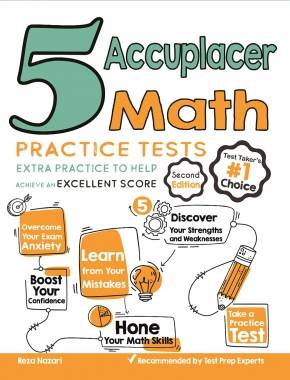
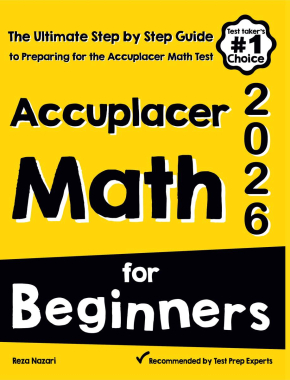
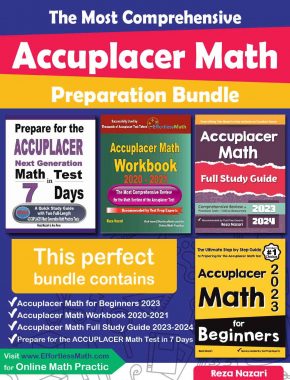
The Best Books to Ace the Accuplacer Math Test
Understanding Your ACCUPLACER Score
ACCUPLACER is a computer-adaptive placement test colleges use for math course placement. Unlike pass/fail tests, it produces a score guiding academic placement. Understanding what your score means for your path is fundamental.
Score Range and Structure
Scores range 200-300. Not a percentage; it’s a scale score. Reflects performance on items of varying difficulty. Test adapts: correct answer → harder question. Incorrect → easier. Produces precise scoring better than fixed-order tests.
Score Interpretation
Divides into: Arithmetic, Elementary Algebra, College-Level Math. Your score determines which level you start at.
What Colleges Look For
Community Colleges: Many set cutoff 240-260 for college-level. 260+ starts college algebra. Below 240 requires developmental math. Cutoffs vary by institution.
Four-Year Universities: Often higher cutoffs (270+). Many don’t use ACCUPLACER; rely on SAT/ACT instead.
Interpreting Your Score
Your score doesn’t define your ability. It’s a placement tool showing your starting point. A score of 245 means close to college-level but needs more prep. Many paths forward exist at any score level.
Common Mistakes
Mistake 1: Comparing to Percentiles
Score 250 doesn’t mean 83%. ACCUPLACER is scale score, not percentage. Look at your school’s cutoff, not the raw number.
Mistake 2: Same Score ≠ Same Placement
Different schools have different cutoffs. Always ask your school what placement your score earns there.
Mistake 3: Confusing WritePlacer with Math Score
WritePlacer is writing test (1-8 score). Math score is separate. Keep them distinct.
Mistake 4: Giving Up After Low Score
Low score indicates starting point, not endpoint. Many successful students took developmental math. It’s a bridge, not a barrier.
After Your Placement
- Use placement diagnostically: Ask your instructor which topics to focus on.
- Seek tutoring early: Free support often available at start of semester.
- Know next course’s cutoff: Work toward that score, not just passing.
- Retest if close: Many schools allow retesting after waiting period if you’re near the threshold.
- Fill gaps systematically: Weak on basics means struggling with advanced topics.
Frequently Asked Questions
Q: Good score definition?
A: Depends on your school’s cutoff. 260 excellent for many community colleges. Check your specific school.
Q: Can I retake?
A: Yes, most allow after waiting period. Check your school’s retest policy.
Q: Affects financial aid?
A: ACCUPLACER itself doesn’t directly affect aid. But failing developmental math might.
Q: Disagree with placement?
A: Talk to advisor. Some allow appeals with evidence of readiness.
For preparation, explore Algebra 1 Course and Pre-Algebra Guide.
Building Your Test-Taking Strategy
Your ACCUPLACER score reflects where you are right now, not where you can be with preparation. Many students improve significantly through targeted study. Understanding your placement and using it to guide your learning is the key to success in mathematics.
Key Points to Remember: Your score is diagnostic, not definitive. It shows your current readiness level for college-level mathematics. If you’re placed in developmental math, that’s a bridge, not a barrier. Thousands of students complete developmental courses and go on to succeed in calculus, statistics, and other advanced mathematics. The important thing is to take your placement seriously, use it as a guide for where to focus your study efforts, and take advantage of all available support services at your college.
Start building your math skills today, regardless of where your score places you. Use online resources, work with tutors, form study groups, and engage actively in your courses. Mathematics is a skill that improves with practice and persistence, not just native ability. Your ACCUPLACER score is just the beginning of your college mathematics journey, not the destination.
Your ACCUPLACER Score as a Starting Point
Think of your ACCUPLACER score as a snapshot of your mathematical knowledge and skills at this moment in time. It’s not a judgment on your intelligence or your potential. Many brilliant, mathematically talented people take ACCUPLACER and place into developmental math because they haven’t studied the specific algebra topics in a while, or because they struggle with test-taking anxiety, or because they learn differently than the test assesses.
Your score is valuable information. Use it. If you scored 240 and the cutoff is 260, focus your study efforts on the topics that are causing you the most difficulty. Arithmetic problems? Spend time there. Factoring? Tackle that specifically. By targeting your weak areas rather than trying to study everything, you can improve faster and potentially retest successfully. Many students improve 20-30 points with focused preparation. Work with tutors, use online resources, and ask your teacher for help on specific topics. You can move forward from your current score.
College is about growth and learning. Your ACCUPLACER score marks the beginning of that journey, not the end. Whether you place into college-level math immediately or need to start with developmental courses, you have the ability to succeed. Millions of students have walked this path before you and gone on to complete degrees, enter careers, and accomplish their goals. Your score is just one step in that process. Focus on learning the material, asking questions when you’re confused, and persisting even when mathematics feels challenging. That’s how success happens in college mathematics.

Related to This Article
More math articles
- How to Find Arc Length and Sector Area? (+FREE Worksheet!)
- How to Solve Word Problems by Finding Two-Variable Equations?
- Full-Length ATI TEAS 7 Math Practice Test-Answers and Explanations
- Dividing Dollars: How to Navigate Money Division in Word Problems
- The Best Grade 7 ELA Practice Tests for Alaska Students
- Using Commas Correctly
- Rounding Decimals for 5th Grade: Nearest Tenth and Hundredth
- Tehran, Yalta, Potsdam, Bretton Woods, and the United Nations
- CBEST Math Practice Test Questions
- TExES Mathematics 7-12 Flashcards













What people say about "What Is a Good ACCUPLACER Score? Score Ranges Explained"?
No one replied yet.