Political Ideology Across Generations: Age vs. Cohort
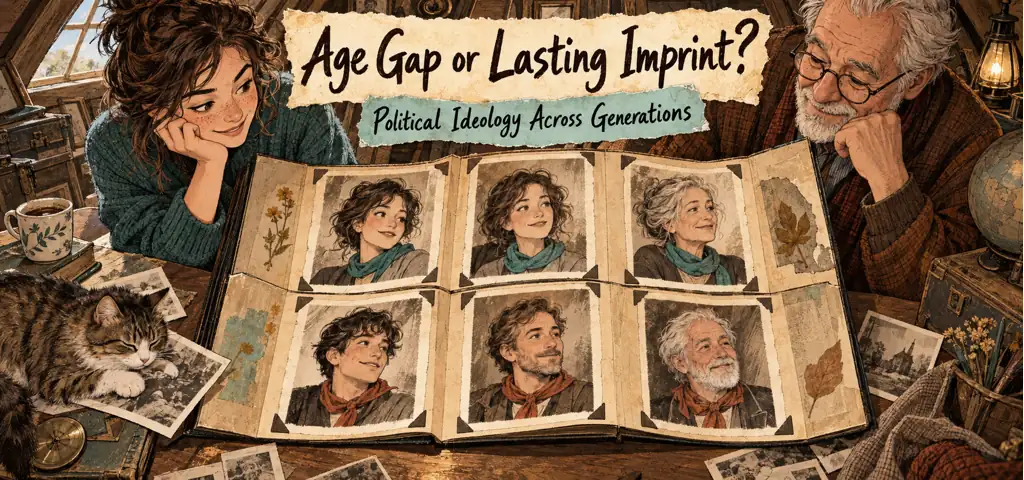
Political ideology across generations can differ because birth cohorts encounter different formative conditions, people move through life stages, and historical events affect several age groups. These explanations can overlap. An age gap in one survey does not prove a permanent generational divide or show that everyone becomes more conservative with age.
Follow Birth Cohorts as They Grow Older
Generational effects arise when cohorts shaped by different formative events retain distinct orientations as they age. They differ from life-cycle changes common to many generations.
Choose Comparisons That Answer the Question
Repeated cross-sections compare new samples over time. Panels reinterview the same people. Both provide useful comparisons for investigating a lasting cohort imprint or a life-stage difference, but neither design alone uniquely separates age, period and cohort causes.
Avoid Treating an Age Gap as a Generational Cause
A generation is not defined merely by current age. The cohort claim is that people exposed to distinctive conditions during a formative period retain an orientation as every cohort grows older. Repeated observations help trace patterns, but age, birth year and historical period remain mathematically linked. A single survey cannot identify which of the three produced an age gap.
Consider a hypothetical case in which young adults show low trust after a major scandal. If the same birth cohort’s trust remains unusually low decades later compared with other cohorts at the same age, a cohort interpretation gains support, subject to assumptions about measurement and other influences. If every cohort recovers together, a temporary period effect is more plausible.
Distinguish Individual Change from Cohort Replacement
Pew Research Center’s 2015 explanation of cohort analysis separates changes linked to life stage from historical-period and birth-cohort explanations. A birth cohort remains the same birth-year group as it ages; “young adults” names a changing age category.
Its 2023 research guidelines call for suitable historical data and comparisons at similar life stages rather than automatic use of familiar generation labels. Averages can conceal differences within a cohort, and changes in interview methods can complicate comparisons.
Separate two questions: did particular people change their views, or did the mix of people in the population change? An overall average can move as cohorts enter or leave the measured population, even when continuing members keep their positions. This is a composition explanation to test, not a reason to assume every member of a cohort thinks alike.
The abstract of Julia M. Rohrer’s 2025 research article adds a crucial limit: longitudinal observations alone do not resolve the age–period–cohort identification problem. Explain the assumptions behind a causal interpretation rather than treating a longer series as automatic proof.
Test Whether the Same People Changed
In a simplified hypothetical electorate, two equally sized cohorts support a policy at rates of 40% and 60%. Later, the 40% cohort is no longer in the measured electorate and an equally sized new cohort supports the policy at 60%. The continuing cohort remains at 60%. What happens to overall support, and does that prove the continuing voters changed their minds?
Check your reasoning
Overall support moves from 50% to 60% because the equally weighted group averages change from (40% + 60%)/2 to (60% + 60%)/2. The continuing cohort’s rate stays at 60%, so this illustration requires no change in its average position. It also does not establish that every individual kept the same view: unchanged group averages can hide people moving in opposite directions. Individual change requires evidence about individuals, not just a comparison of totals.
Video Lesson: Generational and Life-Cycle Effects
Khan Academy gives a focused explanation of this topic in Generational and lifecycle effects on political ideology | US government and civics.
If the player does not load, watch this lesson directly on YouTube.
For the companion question about a shared historical moment, see how political events can influence ideology across age groups.
Continue Studying Change Over Time

Related to This Article
More math articles
- Electioneering
- Inference, Purpose, Assumptions, and Arguments
- Grade 3 Math Flashcards (Free Online: Formulas, Terms & Concepts)
- Social Stratification, Class, Poverty, and Mobility
- 5th Grade PSSA Math Worksheets: FREE & Printable
- 6 Best Pre-Algebra Study Guides
- Tip Calculator
- 5th Grade MEAP Math FREE Sample Practice Questions
- Deviance, Crime, Harm, and Social Definition
- How to Score High in SAT Math?











What people say about "Political Ideology Across Generations: Age vs. Cohort"?
No one replied yet.