How Political Events Shape Ideology: Age, Period and Cohort
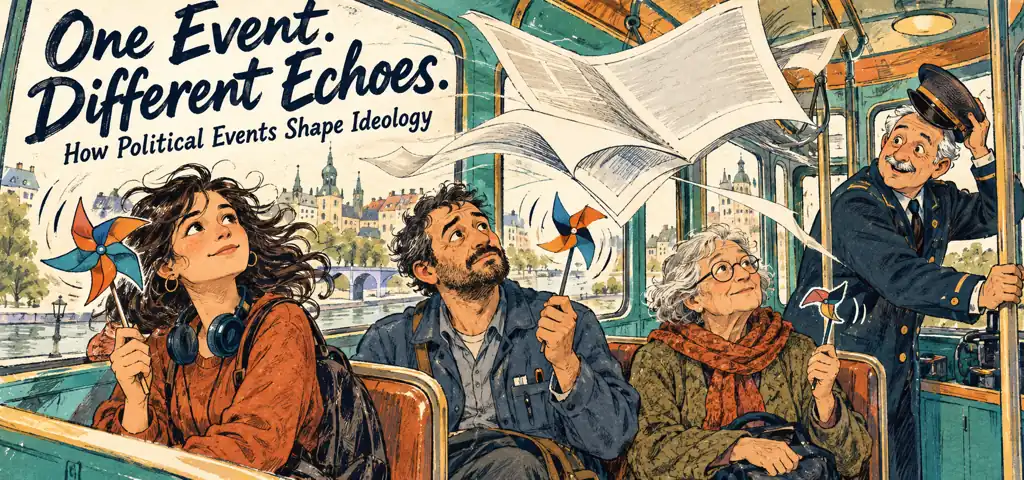
Political events can shape ideology by changing experiences, priorities and interpretations across age groups. To explain a change, distinguish a period effect linked to a shared historical moment from a cohort effect linked to a group’s formative experiences and an age effect linked to life stage. Similar timing is evidence to investigate, not a complete causal explanation.
Connect the Event to a Possible Mechanism
Wars, depressions, scandals, movements, and crises can reshape attitudes through period effects shared across cohorts. Effects vary with age, identity, elite interpretation, and direct experience.
Compare Measures Before and After the Event
Use comparable measures before and after the event. Parallel movement across several cohorts is consistent with a period effect, but does not isolate its cause. Lasting distinctiveness confined to a cohort suggests a possible formative imprint, while different exposure can explain unequal movement around the shared change.
Check Baselines, Exposure and Competing Explanations
A period effect appears when an event moves several cohorts in the same historical interval, although the size or duration of change may differ by age and experience. Evidence should include attitudes before the event and comparable measures afterward. Without that baseline, a difference observed after a crisis may be an older cohort difference rather than event-driven change.
Events are also interpreted through parties, media, leaders, and personal experience. The same recession may reduce trust broadly while affecting homeowners, recent graduates, and retirees differently. Shared timing is consistent with a period effect; changes in measurement or other simultaneous developments must also be considered. Unequal impact explains variation around it. If several age groups change immediately but only the youngest cohort retains the change, that pattern raises questions about both period and cohort influences. It does not by itself identify separate causal effects.
Keep Age, Period and Cohort Explanations Distinct
Pew Research Center’s 2015 methodological explainer distinguishes life-stage, period and cohort effects. Its discussion of Watergate and the end of the Vietnam War illustrates a historical interval associated with falling trust across generations. The example does not mean that every political event changes everyone’s ideology equally or permanently.
Pew’s 2023 guidelines for generational research emphasize historical comparisons at similar life stages and attention to survey methods and demographic differences. Comparing today’s youngest and oldest respondents alone cannot establish a generational cause.
There is also a deeper identification problem: calendar year equals birth year plus age. Julia M. Rohrer’s 2025 research abstract on age, period and cohort effects explains why observations alone cannot uniquely separate all three effects, even with longitudinal data. Stronger explanations need explicit assumptions and substantive evidence about the proposed mechanism; collecting more observations does not automatically solve the problem.
Interpret a Hypothetical Trust Pattern
In a hypothetical survey series using comparable questions and methods, trust falls among three birth cohorts immediately after a scandal. Five years later, trust has recovered in two cohorts but remains lower in the youngest. Describe the pattern without claiming that the surveys have uniquely identified its cause.
Check your reasoning
The initial decline across cohorts is consistent with a period-related influence. The youngest cohort’s persistence raises a possible cohort-specific or life-stage explanation. Check earlier trends, sample composition, uncertainty, differences in exposure and other events. The pattern does not prove that the scandal permanently changed one generation, or uniquely separate age, period and cohort effects.
Video Lesson: Events and Ideology
Khan Academy gives a focused explanation of this topic in Influence of political events on ideology | AP US Government & Politics.
If the player does not load, watch this lesson directly on YouTube.
Connect the event to possible learning pathways using our lesson on political socialization and the formation of attitudes.
Continue Studying Political Learning

Related to This Article
More math articles
- Using Number Lines to Represent Absolute Value of Integers
- What Kind of Math Is on the PERT Test?
- AP Calculus Prep Roadmap: A 4-Year Plan to Ace the Exam in 2027
- Drawing Conclusions and Making Predictions
- Free ParaPro Math Practice Test: 20 Questions and Answers
- 8th Grade OST Math Worksheets: FREE & Printable
- How to Help Your 7th Grade Student Prepare for the Kansas KAP Math Test
- Area of Rectangles for 4th Grade
- New Jersey Algebra 1 Free Worksheets: Free Printable Algebra 1 Worksheets Covering Every Skill
- The Social Construction of Reality








What people say about "How Political Events Shape Ideology: Age, Period and Cohort"?
No one replied yet.