Sunk costs belong to the past
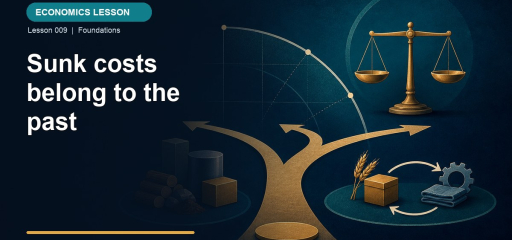
Sunk costs belong to the past: this Effortless Math guide explains the topic in plain language, shows how it works through solved examples, and gives you free practice to try immediately, so the idea sticks instead of staying abstract.
Current decisions should compare future benefits and future costs.
A nonrefundable ticket is sunk once it has been purchased. If the event becomes unpleasant and leaving offers a better use of the remaining evening, the ticket price should not keep the buyer in the seat. This does not mean past decisions are irrelevant for learning. It means the unrecoverable payment is identical whether the person stays or leaves, so it does not change the comparison between those choices.
The decision boundary is now. At that boundary, list only benefits and costs that differ across the available actions. The ticket price is the same whether the buyer stays or leaves, so it cancels from the comparison. Comfort during the remaining two hours, travel time home, and the value of another activity can still differ and therefore remain relevant.
A sunk cost is not simply a fixed cost. A lease payment may be fixed with respect to current output and still be avoidable when the lease expires. A refundable deposit was paid in the past but is not sunk because a current action can recover it. The correct test is not “Was it paid already?” but “Can the present choice change it?”
Avoidable future costs remain relevant. A firm deciding whether to complete a project should compare the future revenue from completion with the additional cost still required. Money already spent on design is sunk. A cancellation penalty that can still be avoided is not.
Completion after a disappointing start
A company has spent $900,000 developing software. Completion will cost another $120,000, and expected revenue from the finished product is $170,000. The project has lost money overall, but completion adds $50,000 relative to abandonment because the $900,000 cannot be recovered either way. Refusing to finish merely because total revenue will not cover total historical cost compounds the loss.
The reverse can also occur. If completion costs another $120,000 but brings only $80,000 in revenue, the company should stop, even if doing so makes the earlier investment feel wasted. The earlier spending is already lost. Completing would add another $40,000 loss. Economic rationality does not require pretending the original choice was wise. It requires refusing to let an unrecoverable past distort the next decision.
People commit the sunk-cost fallacy partly because persistence can signal discipline and because abandoning a project may feel like admitting error. Those psychological motives can be real while the economic classification remains clear. A firm may also continue for reputation, legal, or learning benefits. If those consequences occur in the future and differ across the choices, they are relevant benefits, not excuses for counting the sunk expenditure.
| Item | Sunk now? | Reason |
|---|---|---|
| Nonrefundable ticket already bought | Yes | No current action recovers the payment |
| Refundable reservation deposit | No | Canceling can recover it |
| Future cancellation fee | No | The present choice determines whether it is paid |
| Past research expenditure | Yes | The spending cannot be altered by the completion decision |
| Expected reputation effect | No | It is a future consequence that may differ across actions |
In an exam stem, draw a mental line at the decision date. Cross out amounts that lie before the line and cannot be recovered. Compare remaining marginal benefits and marginal costs. If an answer defends continuation because “too much has already been invested,” it is appealing to sunk cost unless the choice can still recover part of that investment.
A firm has spent $40,000 developing a device. Completing it would cost $12,000, and the completed device could be sold for $15,000. If the development spending cannot be recovered, the firm should
- abandon the device because total cost would exceed sales revenue
- complete it only if the original development budget was approved
- abandon it because accounting profit on the project is negative
- complete it only if a competitor is also developing the device
- complete it because the remaining benefit exceeds the remaining cost
complete it because the remaining benefit exceeds the remaining cost The $40,000 is sunk. From the current decision point, spending $12,000 to obtain $15,000 adds $3,000.
A student paid a nonrefundable $25 registration fee for a workshop. On the day of the workshop, attending would provide a benefit worth $18 but require $10 of travel cost. The student should
- attend because the total amount paid would otherwise be wasted
- attend because the remaining benefit exceeds the remaining cost
- skip because the total cost is $35
- skip because the registration fee exceeds the workshop benefit
- be indifferent because the fee is nonrefundable
attend because the remaining benefit exceeds the remaining cost The registration fee is sunk. Attending now yields an $18 benefit for a $10 additional cost, so attendance adds $8 of net benefit.
Watch the idea in action
A focused video lesson from Economics in Many Lessons.

Reza is an experienced Math instructor and a test-prep expert who has been tutoring students since 2008. He has helped many students raise their standardized test scores--and attend the colleges of their dreams. He works with students individually and in group settings, he tutors both live and online Math courses and the Math portion of standardized tests. He provides an individualized custom learning plan and the personalized attention that makes a difference in how students view math.
Related to This Article
More math articles
- An Odyssey Through Distance and Midpoint Formulas in the Plane
- Sit-Ins, SNCC, Freedom Rides, and Birmingham
- The Best Grade 8 Math Book for New Jersey Students
- Question order
- 6th Grade MAP Math Practice Test Questions
- The Best Grade 3 ELA Practice Tests for Idaho Students
- Geometry Puzzle – Critical Thinking 18
- Global Commodity Chains and Multinational Power
- The Best Grade 6 ELA Practice Tests for Louisiana Students
- What Are the Applications of the Law of Sines?





















What people say about "Sunk Costs Belong to the Past"?
No one replied yet.