Geometry Puzzle – Critical Thinking 18
The sum of more than two consecutive integers is 17. What is the LEAST number of integers? The clean answer is 17, the consecutive integers from -7 to 9 sum to 17, and the cancellations from pairing negatives with positives make this the smallest possible run.
Key takeaways:
- Sum of \( n \) consecutive integers starting at \( a \) is \( \frac{n(2a + n - 1)}{2} \).
- For three consecutive POSITIVE integers, the sum is divisible by 3 (since the middle term is the mean).
- 17 is prime, so it has no factor of 3, no three positive consecutive integers can sum to 17.
- Allow negatives: pairing -k with +k cancels, and the remaining positive tail can reach any target.
- Including the chain from -7 through 9 (17 terms) leaves 8 + 9 = 17, the least number of consecutive integers that sums to 17 with the constraint \( n > 2 \).
This is another great Critical Thinking Puzzle and challenge to tease your brain and help you develop your creative thinking! For additional educational resources
Challenge:
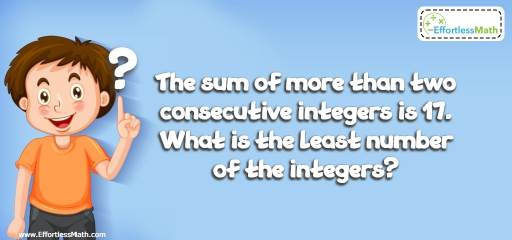
The sum of more than two consecutive integers is 17. What is the least number of the integers?
A- 3
B- 16
C- 17
D- 24
E- 28
The Absolute Best Book to Challenge Your Smart Student!

The correct answer is C.
Original price was: $27.99.$17.99Current price is: $17.99.
The sum of some consecutive integers is 17. Two positive consecutive integers do work (8 + 9 = 17), but a run of three or more positive consecutive integers cannot reach 17, so a longer run must include zero and negative numbers. Why?
Therefore, we need to consider negative numbers. We know that the sum of two consecutive positive numbers can be 17. Those numbers are 8 and 9.
We are looking for consecutive integers. The sum of negative and positive of a number is zero. For example, the sum of 1 and -1 is 0, or the sum of 2 and -2 is 0.
We found 8 and 9. The other numbers are:
9, 8, 7, 6, 5, 4, 3, 2, 1, 0, -1, -2, -3, -4, -5, -6, -7
The sum of above numbers is 17. Thus, the least number of the integers is 17.
The Absolute Best Books to Ace Algebra
Frequently Asked Questions
What is math critical thinking?
Math critical thinking means looking past the obvious approach and checking your assumptions. In this puzzle, searching only positive numbers for more than two consecutive integers that add to 17 fails, because 17 is prime. The breakthrough is allowing negative integers: from −7 to 9, the negatives cancel the positives from 1 to 7, leaving 0 + 8 + 9 = 17.
What is critical thinking in math class?
In math class, critical thinking means explaining why an answer is right and why other answers fail. For this consecutive-integer puzzle, students can show that three consecutive integers n − 1, n and n + 1 always add to 3n, a multiple of 3, so they can never total 17. Reasoning like that rules out choices without long trial and error.
Is mathematics a puzzle?
Mathematics is much more than puzzles, but many of its best ideas start as puzzle-like questions. This one asks for the fewest consecutive integers, more than two, that add to 17. Using the formula for the sum of n consecutive integers starting at a, n(2a + n − 1) ÷ 2 = 17, the smallest option with n greater than 2 is n = 17, starting at a = −7.
How do you solve math puzzles step by step?
Restate the goal, test small cases, look for a reason things fail, then widen your search. Here, try runs of 3, 4 and 5 positive integers and none hits 17. Ask why: 17 is prime, so positive runs cannot work. Then allow negatives and zero, and the run from −7 to 9 works. Finally, check it: 17 terms with an average of 1 give 17.
Are there critical thinking puzzles with answers in PDF?
Yes, printable critical thinking puzzle sets with answer keys are easy to find, and this consecutive-integer challenge works well on paper. Before checking the answer, write the integers from −7 to 9 in a row and cross off each pair that cancels, like −3 and 3. Seeing only 8 and 9 left makes the answer of 17 integers stick.
Related Lessons You May Like
- How to find prime and composite numbers (resource currently unavailable)
- How to add and subtract integers
- How to solve multi-step word problems
- How to classify triangles
- How to find the area of triangles
If your student enjoys puzzles like this, Pre-Algebra for Beginners covers the algebraic reasoning they tap. For deeper geometry exploration, Geometry for Beginners takes you further.

Related to This Article
More math articles
- Free Grade 3 English Worksheets for Nebraska Students
- Commander in chief
- Racism, Institutional Discrimination, and Privilege
- Math anxiety is a common reality, yet the signs can be misinterpreted
- Top Calculators for the GED 2026: Quick Review
- PSAT Math Worksheets: Free Topic Practice
- Ideological conflict
- Algebra Puzzle – Challenge 56
- HiSET Math Practice Test PDF with Answers (2026 Guide)
- Using Decimals and Fractions to Solve One-Step Addition and Subtraction







What people say about "Consecutive Integers Summing to 17"?
No one replied yet.