FREE 6th Grade PSSA Math Practice Test
TL;DR: Spring testing is coming and you want a low-stakes way to see where your 6th grader actually stands. Try this free PSSA-aligned practice test: 20 questions that mirror the Pennsylvania System of School Assessment, spread across the four reporting categories Pennsylvania uses on the real spring math test. Time it, then walk through the worked answers together. You’ll spot the weak topics in one sitting instead of guessing all the way to test day.
Key takeaways:
- Aligned with Pennsylvania Core Standards (PA Core) for grade 6 math.
- Four reporting categories: Numbers and Operations, Algebraic Concepts, Geometry, Data Analysis.
- PSSA grade 6 math is given in three sessions across two days in the spring.
- Calculator is allowed on the calculator-permitted sections; not on the calculator-free sections.
- Scored on 4 performance levels: Below Basic, Basic, Proficient, Advanced.
1- A baker needs to pack 143 chocolate cookies and 55 vanilla cookies into boxes so that each box has the same number of cookies and only one type of cookie per box. What is the largest number of cookies that can be put in each box?
A. 5
B. 7
C. 9
D. 11
2- What is the value of \(2{,}205 \div 315\)?
A. 5
B. 6
C. 7
D. 8
3- If \(112=22+x\), what is the value of \(x\)?
A. 78
B. 90
C. 100
D. 134
4- Car A travels 221.5 km. Car B travels 1.2 times the distance of Car A. How far does Car B travel?
A. 184.6 km
B. 221.5 km
C. 242.8 km
D. 265.8 km
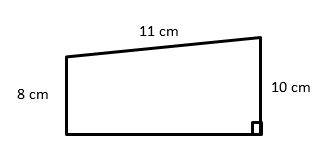
5- The perimeter of the trapezoid below is 38. What is its area?
A. 198 cm\(^2\)
B. 162 cm\(^2\)
C. 99 cm\(^2\)
D. 81cm\(^2\)
6- Which of the following expressions has the greatest value?
A. \( 3^1+12\)
B. \( 3^3-3^2\)
C. \( 3^4-60\)
D. \( 3^5-218\)
7- Alfred has \(x\) apples. Alvin has 40 apples, which is 15 apples less than number of apples Alfred owns. If Baron has \(\frac{1}{5}\) times as many apples as Alfred has. How many apples does Baron have?
A. 5
B. 11
C. 55
D. 275
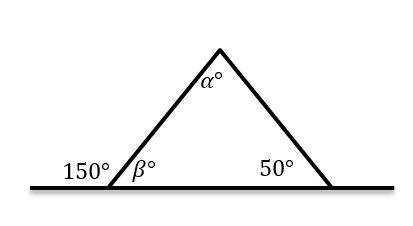
8- In the following triangle find \(α\).
A. \(100^\circ\)
B. \(90^\circ\)
C. \(60^\circ\)
D. \(30^\circ\)
9- The price of a laptop is decreased by \(15\%\) to $425. What is its original price?
A. $283
B. $430
C. $500
D. $550
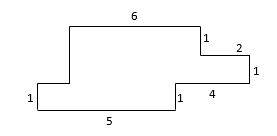
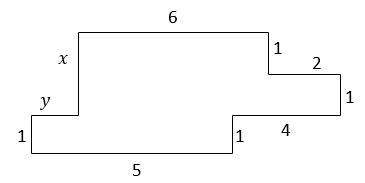
10- Find the perimeter of the shape in the following figure. (all angles are right angles)
A. 21
B. 22
C. 24
D. 20
11- What are the values of mode and median in the following set of numbers?
\(1,3,3,6,6,5,4,3,1,1,2\)
A. Mode: 1, 2, Median: 2
B. Mode: 1, 3, Median: 3
C. Mode: 2, 3, Median: 2
D. Mode: 1, 3, Median: 2.5
12- Which expression equivalent to \(x × 92\)?
A. \((x×90)+2\)
B. \(x×9×2\)
C. \((x×90)+(x×2)\)
D. \((x×90)+2\)
13- The ratio of pens to pencils in a box is 3 to 5. If there are 96 pens and pencils in the box altogether, how many more pens should be put in the box to make the ratio of pens to pencils 1: 1?
A. 22
B. 23
C. 24
D. 25
14- If point A placed at \(-\frac{24}{3}\) on a number line, which of the following points has a distance equal to 5 from point A?
A. \(-13\)
B. \(-3\)
C. \(-2\)
D. A and B
15- Which of the following shows the numbers in increasing order?
A. \(\frac{3}{13}, \frac{4}{11}, \frac{5}{14}, \frac{2}{5}\)
B. \(\frac{3}{13}, \frac{5}{14}, \frac{4}{11}, \frac{2}{5}\)
C. \(\frac{3}{13}, \frac{5}{14}, \frac{2}{5}, \frac{4}{11}\)
D. \(\frac{5}{14}, \frac{3}{13}, \frac{2}{5}, \frac{4}{11}\)
16- If \(x=- 4\), which of the following equations is true?
A. \(x(3x-1)=50\)
B. \(5(11-x^2 )=-25\)
C. \(3(-2x+5)=49\)
D. \(x(-5x-19)=-3\)
17- What is the missing prime factor of number 450?
\(450=2^1×3^2×…\) _________
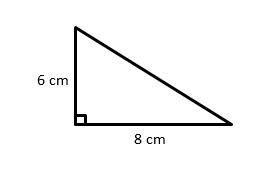
18- What is the perimeter of the following shape? (it’s a right triangle)
A. 14 cm
B. 18 cm
C. 24 cm
D. 32 cm
19- 65 is what percent of 50?
A. \(50 \%\)
B. \(77 \%\)
C. \(130 \%\)
D. \(140 \%\)
20- Which of the following expressions has a value of \(-23\)?
A. \(-10+(-8)+ \frac{5}{2}×(-2)\)
B. \(5×3+(-2)×18\)
C. \(-10+6×8÷(-4)\)
D. \((-3) × (-7) + 2\)
Answers:
1- D
First, we need to find the GCF (Greatest Common Factor) of 143 and 55.
\(143=11×13\)
\(55=5×11→\) GFC\( = 11\)
Therefore, we need 11 boxes.
2- C
\(2205÷315=\frac{2205}{315}=\frac{441}{63}=\frac{147}{21}= 7\)
3- B
\(112=22+x \)
Subtract 22 from both sides of the equation. Then:
\(x=112-22=90\)
4- D
Distance that car B travels \(=1.2 ×\) distance that car A travels
=\(1.2×221.5=265.8 \) km
5- D
The perimeter of the trapezoid is 38.
Therefore, the missing side (height) is \(= 38 – 8 – 10 – 11 = 9\)
Area of the trapezoid: \(A = \frac{1}{2} h (b_1 + b_2) = \frac{1}{2}1 (9) (8 + 10) = 81\)
6- D
A. \(3^1+12=3+12=15\)
B. \(3^3-3^2=27-9=18\)
C. \(3^4-60=81-60=21\)
D. \(3^5-218=243-218=25\)
7- B
Alfred has \(x\) apple which is 15 apples more than a number of apples Alvin owns. Therefore:
\(x-15=40→x=40+15=55\)
Alfred has 55 apples.
Let \(y\) be the number of apples that Baron has. Then: \(y=\frac{1}{5}×55=11\)
8- A
Complementary angles add up to 180 degrees.
\( β+150^\circ=180^\circ→β=180^\circ-150^\circ=30^\circ\)
The sum of all angles in a triangle is 180 degrees. Then:
\(α+β+50^\circ=180^\circ→α+30^\circ+50^\circ=180^\circ\)
\(→α+80^\circ=180^\circ→α=180^\circ-80^\circ=100^\circ\)
9- C
Let \(x\) be the original price.
If the price of a laptop is decreased by \(15\%\) to $425, then:
\(85 \% \space of \space x=425⇒ 0.85x=425 ⇒ x=425÷0.85=500\)
10- C
Let \(x\) and \(y\) be two sides of the shape. Then:
\(x+1=1+1+1→x=2\)
\(y+6+2=5+4→y+8=9→y=1\)
Then, the perimeter is:
\(1+5+1+4+1+2+1+6+2+1=24\)
11- B
First, put the numbers in order from least to greatest: \(1, 1, 1, 2, 3, 3, 3, 4, 5, 6, 6\)
The Mode of the set of numbers is: 1 and 3 (the most frequent numbers)
The median is: 3 (the number in the middle)
12- C
\(x×92=x×(90+2)=(x×90)+(x×2)\)
13- C
The ratio of pens to pencils is \(3: 5\). Therefore there are 3 pens out of all 8 pens and pencils. To find the answer, first dived 96 by 8 then multiply the result by 3.
\(96÷8=12→12×3=36\)
There are 36 pens and 60 pencils \((96-36)\). Therefore, 24 more pens should be put in the box to make the ratio \(1: 1\)
14- D
If the value of point A is greater than the value of point B, then the distance of two points on the number line is: the value of A- the value of B
A. \(-\frac{24}{3}-(-13)=-8+13=5=5\)
B. \(-3-(-\frac{24}{3})=-3+8=5=5\)
C. \(-2-(-\frac{24}{3})=-2+8=6≠5\)
15- B
\(\frac{3}{13}≅0.23, \frac{5}{14}≅0.357, \frac{4}{11}≅0.36, \frac{2}{5}=0.4\)
16- B
Plugin the value of \(x\) in the equations. \(x = -4\), then:
A.\(x(3x-1)=50→-4(3(-4)-1)=-4(-12-1)=-4(-13)=52≠50\)
B. \(5(11-x^2 )=-25→5(11-(-4)^2 )= 5(11-16)=5(-5)=-25\)
C. \(3(-2x+5)=49→3(-2(-4)+5)=3(8+5)=39≠49\)
D. \(x(-5x-19)=-3→-4(-5(-4)-19=-4(20-19)=-4≠-3\)
17- 5
Let \(x\) be the missing prime factor of 450.
\(450= 2 × 3 × 3 × x ⇒ x =\frac{450}{18} ⇒ x = 25=5×5\)
18- C
Use the Pythagorean theorem to find the hypotenuse of the triangle.
\(a^2+b^2=c^2→6^2+8^2=c^2→36+64=c^2→100=c^2→c=10\)
The perimeter of the triangle is: \(6+8+10=24\)
19- C
Use the percent formula:
\(Part = \frac{percent}{100} × whole\)
\(65= \frac{percent}{100} × 50⇒ 65 = \frac{percent ×50}{100}⇒ 65=\frac{percent ×5}{10}\)
multiply both sides by 10.
\(650 =percent ×5, \space divide \space both \space sides \space by \space 5.\)
130 = percent
The answer is \(130\%\)
20- A
Let’s check the options provided.
A. \(-10+(-8)+ (\frac{5}{2})×(-2)=-10+(-8)+(-5)=-10-13=-23\)
B. \(5×3+(-2)×18=15+(-38)=-21\)
C. \(-10+6×8÷(-4)=-10+48÷(-4)=-10-12=-22\)
D. \((-3)× (-7)+ 2=21+2=23\)
Looking for the best resource to help you succeed on the Grade 6 PSSA Math test?
The Best Books to Ace 6th Grade PSSA Math Test
Recommended EffortlessMath Books
For a workbook your child can use alongside this practice test, the 6th Grade PSSA Math for Beginners (resource currently unavailable) walks through every topic on the test with worked examples. For full Pennsylvania state-test prep with multiple practice tests, see the 6th Grade PSSA Math Test Prep Bundle (resource currently unavailable).
Frequently Asked Questions
What is the PSSA?
The PSSA (Pennsylvania System of School Assessment) is Pennsylvania’s annual state assessment, given in math and English language arts in grades 3-8 and science in grades 4 and 8. The grade 6 math PSSA is built on Pennsylvania Core Standards (PA Core), which align closely with Common Core.
What’s on the grade 6 PSSA math?
Four reporting categories: Numbers and Operations (about 26%), Algebraic Concepts (about 30%), Geometry (about 18%), and Data Analysis and Probability (about 26%). Skills include ratios and proportions, operations with fractions and decimals, one-variable equations and inequalities, area of polygons, and statistical measures.
Is a calculator allowed on the grade 6 PSSA math?
Partially. The PSSA grade 6 math has a calculator-free section and a calculator-permitted section. Pennsylvania allows four-function, scientific, or graphing calculators on the calculator-permitted portion. Confirm with your child’s school which type they should bring.
How long is the grade 6 PSSA math?
About 2 to 2.5 hours total, split into three sessions across two days. Sessions 1 and 2 each contain a mix of multiple-choice and open-ended items. Students who need extended time receive it under their IEP or 504 plan.
When is the PSSA given?
The PSSA math is administered in late April through early May, typically over two or three days during a state-set testing window. Exact dates vary by district. Your child’s teacher will share the schedule.
How is the PSSA scored?
Pennsylvania uses 4 performance levels: Below Basic, Basic, Proficient, and Advanced. The state goal is Proficient or higher. Score reports are sent home in late summer or early fall.
What’s the hardest grade 6 PSSA math topic?
Dividing fractions, writing one-variable equations from word problems, and working with negative numbers on the coordinate plane are the three biggest stumbling blocks for most grade 6 students.
How long should we study for the grade 6 PSSA math?
For most grade 6 students, 4 to 6 weeks of consistent practice at 15 to 25 minutes per day is plenty. Take a diagnostic first, identify the weakest reporting category, drill it, then build up to full-length timed practice in the final two weeks.
Does the PSSA include open-ended questions?
Yes. The PSSA includes open-ended math items that ask students to show their work and explain reasoning. These are scored by trained scorers using a rubric. Partial credit is awarded for partial answers.
Where can I find more grade 6 PSSA math practice?
EffortlessMath has the 6th Grade PSSA Math for Beginners workbook covering every grade-6 PA Core standard and the 6th Grade PSSA Math Test Prep Bundle with multiple full-length practice tests.
Related EffortlessMath Lessons
If a topic on this page feels rusty, these short lessons go deeper:

Related to This Article
More math articles
- Majority Rule and Minority Rights
- 7th Grade NYSE Math FREE Sample Practice Questions
- Purpose of the Bill of Rights
- The Best Grade 8 Math Book for Arkansas Students
- Number Properties Puzzle -Critical Thinking 5
- A Mathematical Look at Random Number Generators in Games
- How to Decide Between the ACT and SAT?
- The Roots of Expansionism and the Annexation of Hawaii
- How is the FTCE General Knowledge Test Scored?
- Number Properties Puzzle – Challenge 9

What people say about "Free 6th Grade PSSA Math Practice Test"?
No one replied yet.