Social Movements and Equal Protection
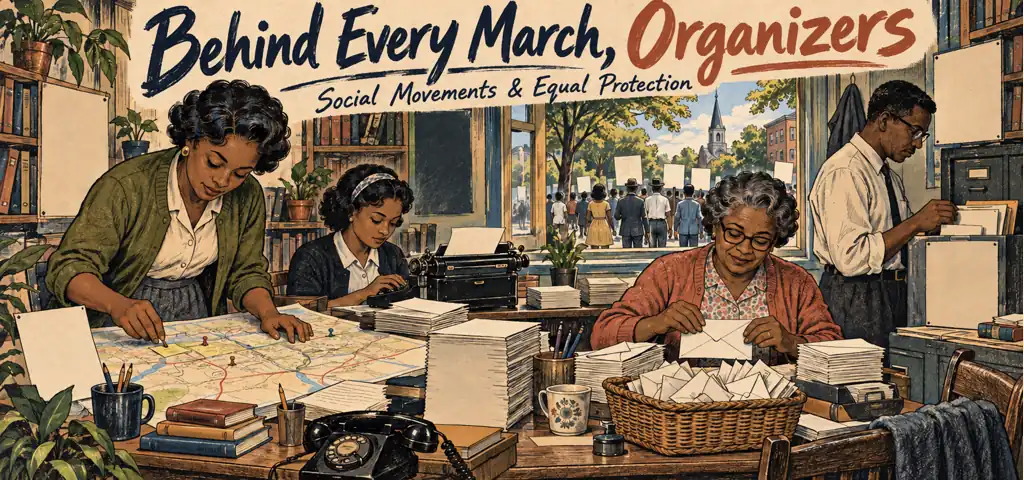
The modern Civil Rights Movement connected long-standing local work to national political and legal change. Black churches, neighborhood associations, women’s clubs, student groups, labor allies, and community organizers created networks before many campaigns attracted national attention. The NAACP developed litigation and membership organizations. The Southern Christian Leadership Conference coordinated clergy-led mass campaigns. The Student Nonviolent Coordinating Committee emphasized student initiative and deep local organizing. The Congress of Racial Equality organized direct action. And many local groups followed priorities that no national organization controlled. These institutions supplied leaders, meeting places, transportation, money, communication, training, and trust.
Different campaigns targeted different mechanisms of exclusion. The Montgomery bus boycott used sustained local economic pressure against segregated transit. Sit-ins challenged segregated service directly and helped create a new student movement. Freedom Rides tested whether federal rules governing interstate travel would be enforced against violent resistance. Freedom Summer built voter-registration and political-education efforts in Mississippi, while the Selma campaign exposed the violence and administrative barriers surrounding Black voting. Marches brought visibility, but less visible work(canvassing, teaching, collecting affidavits, raising bail, and maintaining local organizations)made the public events possible.
The mechanism behind social movements and equal protection
Movement pressure changed institutions without acquiring their formal powers. Lawyers could ask courts for injunctions. Organizers could reveal facts and increase participation. Boycotts could impose economic costs. Journalists could widen the audience. Voters could alter electoral incentives. Courts could invalidate unconstitutional government action, Congress could enact national rules, and executive officials could investigate, sue, administer funds, and enforce orders. The Civil Rights Act of 1964 addressed segregation in public accommodations, discrimination in covered employment, and discrimination in federally supported programs through different titles. The Voting Rights Act of 1965 supplied federal tools against racial exclusion from voting. Those statutes were political achievements of organized pressure as well as exercises of congressional power.
Social Movements and Equal Protection: key distinctions
No single tactic, leader, branch, or law explains the movement’s results. Strategic disagreements concerned nonviolence, self-defense, litigation, electoral work, federal alliances, economic justice, leadership, and the pace of change. Victories also required administration and could produce new conflicts over proof, coverage, remedies, and compliance. The next lesson isolates civil disobedience because it is one tactic within this larger ecosystem, not a synonym for the movement as a whole. for careful analysis, connect each actor to its actual capacity: movements mobilize people and change political costs. Courts announce and enforce judgments. Congress legislates. Presidents and agencies execute federal law. State and local institutions implement or resist it.
Practice with social movements and equal protection
Trace one civil-rights reform from movement pressure to a court ruling or statute and then to enforcement. Where could progress stall?
Check your reasoning
The movement used litigation, organizing, boycotts, demonstrations, civil disobedience, media, and electoral pressure to challenge segregation and exclusion. Its success combined social mobilization with judicial and legislative change. Brown invalidated state-mandated school segregation, but implementation required later decrees, federal enforcement, local action, and continued litigation over remedies and de facto separation.
Video lesson: Social Movements and Equal Protection
Heimler's History gives a focused explanation of this topic in Social Movements and EQUAL Protection [AP Gov Review, Unit 3 Topic 10].
If the player does not load, watch this lesson directly on YouTube.
Connect this lesson to the larger course
For a broader map connecting social movements and equal protection to civil liberties, civil rights, and equal protection, use the AP U.S. Government and Politics learning hub.

Related to This Article
More math articles
- 3rd Grade MAP Math Practice Worksheets: Free Printable PDFs
- The Best Grade 6 ELA Practice Tests for New Jersey Students
- The Ultimate AP Calculus AB Course
- How to Find the Measures of Central Tendency? (+FREE Worksheet!)
- Geometry in Action: Crafting the Circumscribed Circle of a Triangle
- PSAT 8/9 vs. PSAT 10 vs. PSAT/NMSQT: Complete Comparison for 2026
- Derivative of Logarithmic Functions: A Hard Task Made Easy
- How to Decod Decimal Numbers: Dive into Place Values
- The Election of 1912, New Freedom, Labor Law, and Progressivism’s Limits
- Top 10 Pre-Algebra Prep Books (Our 2024 Favorite Picks)












What people say about "Social Movements and Equal Protection"?
No one replied yet.