Revenue is not profit and transfer is not loss
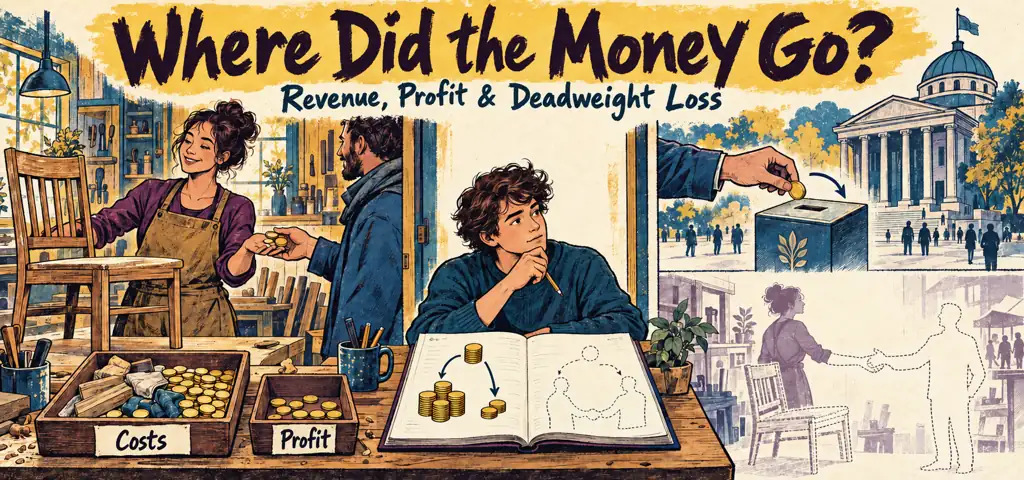
Revenue is not profit and transfer is not loss: this Effortless Math guide explains the topic in plain language, shows how it works through solved examples, and gives you free practice to try immediately, so the idea sticks instead of staying abstract.
Name what happens to each dollar.
A designer earns $52,000 in accounting profit but forgoes a $38,000 salary by operating the business. If there are no other implicit costs, economic profit is
- $90,000
- $52,000
- $14,000
- -$14,000
- -$38,000
$14,000 Economic profit subtracts the forgone salary from accounting profit: $52,000 – $38,000 = $14,000.
A firm’s accounting profit is zero while the owner’s forgone income is positive. Economic profit is
- positive by the amount of forgone income
- zero because accounting and economic profit are equal
- equal to the owner’s forgone income
- negative by the amount of forgone income
- indeterminate without knowing the firm’s current output
negative by the amount of forgone income Accounting profit has not deducted the owner’s implicit opportunity cost, so economic profit is negative by that amount.
A tax creates a $6 wedge, and buyers’ price rises by $2. Sellers’ received price must
- rise by $4
- fall by $2
- rise by $6
- fall by $4
- remain unchanged
fall by $4 The buyer and seller price changes must sum to the $6 wedge. If buyers pay $2 more, sellers receive $4 less.
A firm’s total revenue is $9,600 and its explicit and implicit costs total $8,900. Economic profit is
- $300
- $500
- $700
- $8,900
- $18,500
$700 Economic profit is $9,600 – $8,900 = $700.
Watch the idea in action
A focused video lesson from Marginal Revolution University.
A complete welfare ledger records both the payer and the recipient.
Revenue is price times quantity. Profit subtracts economic cost. Tax revenue transfers surplus to government. It is not deadweight loss. Monopoly profit transfers some consumer surplus to the firm. Underproduction creates deadweight loss. Zero economic profit means all opportunity costs, including normal return, are covered.
Revenue records receipts from sales: TR=P× Q. Economic profit subtracts explicit and implicit opportunity costs. A business with $500,000 of revenue and $460,000 of accounting expenses appears to earn $40,000 accounting profit. If the owner’s forgone salary and capital return total $55,000, economic profit is -$15,000. Large sales do not guarantee that resources are earning more than their alternatives.
Zero economic profit is not failure. It means revenue covers labor, materials, depreciation, and the normal return required to keep entrepreneurial talent and capital in the activity. In long-run competitive equilibrium, zero economic profit removes incentives for entry and exit while firms continue operating.
Welfare questions require tracking where dollars go. A tax raises the buyer-seller wedge, reduces trades, and collects revenue. The revenue is transferred to government and remains part of total surplus if it finances value dollar for dollar. The deadweight loss is the value of mutually beneficial trades that disappear. Similarly, monopoly transfers part of consumer surplus to profit through a higher price, while the output restriction creates DWL.
Account for the wedge
A tax causes consumers to lose $900 of surplus and producers to lose $600. Government collects $1,200. Net total-surplus loss is 900+600-1,200=$300. Calling the entire $1,500 private loss deadweight loss ignores the revenue received by the public sector.
Producer surplus and profit also differ. Producer surplus is revenue minus variable cost in the standard short-run graph. Economic profit subtracts both variable and fixed economic cost. A firm operating below ATC but above AVC can have positive producer surplus and negative profit. That is why shutdown and exit use different cost benchmarks.
A binding quota can create quota rent: the gap between buyer willingness to pay and seller cost is captured by whoever owns the right to sell. That rent is a transfer, while trades prevented by the quota generate DWL. Price ceilings can transfer surplus toward buyers who obtain the good, but shortages and inefficient rationing can destroy additional surplus.
For any policy diagram, create a ledger: consumer surplus, producer surplus, government revenue or quota rent, and deadweight loss. Do not label a region by whether it looks like a rectangle or triangle alone. Its economic boundaries and recipient determine what it means.
Accounting labels can create another trap. Explicit cost is a monetary payment, while implicit cost is the value of an owner-supplied resource. Both reduce economic profit, but only explicit expenses reduce accounting profit. Normal profit is the implicit entrepreneurial return required to keep the owner in the business. When a stem gives an owner’s forgone wage or forgone interest, include it in economic cost even though no check was written.

Reza is an experienced Math instructor and a test-prep expert who has been tutoring students since 2008. He has helped many students raise their standardized test scores--and attend the colleges of their dreams. He works with students individually and in group settings, he tutors both live and online Math courses and the Math portion of standardized tests. He provides an individualized custom learning plan and the personalized attention that makes a difference in how students view math.
Related to This Article
More math articles
- FREE HSPT Math Practice Test
- 8th Grade STAAR Math FREE Sample Practice Questions
- TExES Core Subjects Math Formulas
- 6th Grade FSA Math FREE Sample Practice Questions
- Candidate-centered campaigns
- A 4-Week Grade 7 ELA Study Plan: Reading, Writing, Vocabulary, and Review That Actually Fits Real Life
- Network effects can accelerate both growth and concentration
- Hawaii Smarter Balanced Grade 7 Math Worksheets: 95 Free Printable Single-Skill PDFs
- The Ultimate CLEP Calculus Course: A Comprehensive Review
- A Deep Dive Into The World of Vector-Valued Function





















What people say about "Revenue Is Not Profit, Transfer Is Not Loss"?
No one replied yet.