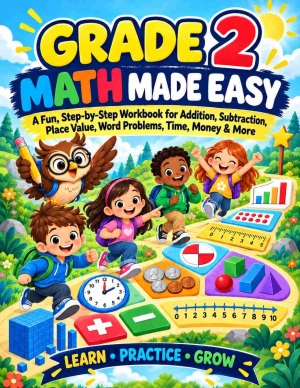
Nevada Grade 2 Math Worksheets — Free Printable PDFs

Nevada Grade 2 Math Worksheets, Free Printable PDFs: a free, printable set you can download and use right away, with answer keys, organized by topic so students can practice one skill at a time and teachers can assign exactly what a lesson needs.
Friendly, no-signup practice pages to help your second grader grow into confident math.
A second grader in Reno is drawing dots on a piece of paper, four rows, five in each row. She counts them one by one, gets twenty, then counts again by fives: five, ten, fifteen, twenty. Same answer, faster way. That little discovery, an array turning into repeated addition, is second grade math at its best.
The worksheets on this page are made to spark more moments like that. They’re all free printable PDFs, each one has a full answer key, and there’s no account to set up and no email to enter. Print a page and your child can get started.
This set follows the Grade 2 math standards Nevada has adopted, so the practice at home stays connected to what’s happening in the classroom. It’s easy for a parent to pick up, and just as easy for a teacher to drop into a lesson plan.
Second grade is a foundation year. There’s no race here. The aim is calm, steady practice, with plenty of patience for the wobbles along the way.
What the Collection Includes
The worksheets are split into eight chapters that, together, cover a full second grade math year. Work straight through for a complete path, or jump to the chapter your child needs this week.
The chapter order has a logic to it. Place value goes first because it props up nearly everything that follows, adding bigger numbers, comparing amounts, counting coins all rest on knowing what each digit is worth. After place value come addition and subtraction, word problems, arrays, measurement, time and money, graphs, and geometry.
Each worksheet starts with a short Key Ideas box, then worked examples, then practice problems, and ends with a complete answer key. Pull one sheet for a quick review or a whole chapter for a deeper session.
Place Value and Number Sense
- Understanding Place Value, Learn what hundreds, tens, and ones each mean in a number.
- Reading and Writing Numbers to 1,000, Shift between number words and digits in both directions.
- Expanded Form, Take a number apart into hundreds, tens, and ones.
- Skip Counting, Count by 2s, 5s, 10s, and 100s to uncover useful patterns.
- Comparing and Ordering 3-Digit Numbers, Compare big numbers and put a set in order.
Addition and Subtraction
- Addition Facts Within 20, Steady practice that turns small sums into instant recall.
- Subtraction Facts Within 20, Grow subtraction fluency at a comfortable pace.
- Adding Within 100, Add two-digit numbers, regrouping included.
- Subtracting Within 100, Subtract across tens with clear, simple steps.
- Adding Within 1,000, Stretch addition into three-digit numbers.
- Subtracting Within 1,000, Break larger subtraction into easy steps.
- Mentally Adding and Subtracting 10 and 100, Add and subtract tens and hundreds in your head.
Word Problems and Equations
- One-Step Word Problems, Read a short story and solve it in one move.
- Two-Step Word Problems, Solve problems that take two steps to finish.
- Finding the Unknown Number, Work out the missing number in an equation.
Odd, Even, and Arrays
- Odd and Even Numbers, Sort numbers into odd and even and learn the rule.
- Even Numbers as Equal Addends, Split even numbers into two equal parts.
- Rectangular Arrays, Arrange objects in rows and columns, a gentle start toward multiplication.
- Repeated Addition with Arrays, Add equal rows to find an array’s total.
Measurement and Length
- Measuring Length with Tools, Use rulers and other tools to measure real things.
- Estimating Lengths, Make a smart guess before reaching for the ruler.
- Comparing Lengths, Decide which object is longer and by how much.
- Adding and Subtracting Lengths, Combine and compare measurements with arithmetic.
- Length on a Number Line, Picture distance as a hop along a number line.
Time and Money
- Telling Time to the Nearest Five Minutes, Read an analog clock to the nearest five minutes.
- A.M. And P.M., Tell morning hours apart from evening hours.
- Counting Coins, Add coins together to find a total.
- Money Word Problems, Solve everyday money situations.
Data and Graphs
- Line Plots, Plot measurements above a number line and read the result.
- Picture Graphs, Use pictures to stand for amounts.
- Bar Graphs, Compare groups with bars of different heights.
Geometry
- Recognizing and Drawing Shapes, Name and draw shapes by their sides and corners.
- Partitioning Rectangles into Rows and Columns, Divide a rectangle into a grid and count the squares.
- Equal Shares: Halves, Thirds, and Fourths, Split shapes into fair, equal pieces.
Getting the Best from Each Page
The worksheets are easy to use on their own, but a handful of habits make them work even better.
Do one page per sitting. Second graders focus best in short stretches, and finishing a single sheet feels much better than grinding through several.
Read the Key Ideas box together before the pencils come out. It points to what matters and gives you both a shared starting point.
Move through the worked examples slowly, and ask your child to explain each step. When they can teach it back, the skill is theirs.
Check the answer key together when the page is finished. Treat a wrong answer as a puzzle to solve, “let’s see where this turned” keeps things light and curious.
Revisit shaky skills about a week later. If counting coins felt hard on Tuesday, try a fresh sheet the next week. That little gap is where mastery quietly takes hold.
A Note About the SBAC
In Nevada, the statewide math test, the SBAC, doesn’t begin until third grade. For a second grader, that means there’s no test to worry about and nothing to cram this year.
Second grade is the year the foundation gets built. Place value, quick and reliable math facts, careful word-problem reading. Those are the very skills the SBAC draws on when testing starts in third grade. A child who builds them now, with no pressure attached, walks into the testing years already confident.
So let this foundation year be exactly that. The calm, regular practice your child does today is the best preparation for everything that comes later.
Frequently Asked Questions
What are the Nevada 2nd grade math standards? Nevada uses the Nevada Academic Content Standards (NVACS) for math. In grade 2 they cover four areas: operations and algebraic thinking, number and operations in base ten, measurement and data, and geometry. Big goals include adding and subtracting within 100 fluently, understanding place value to 1,000, telling time, counting money and using arrays. The Nevada Department of Education posts the full list.
What is unit form in 2nd grade math? Unit form writes a number by its place value units instead of digits. For example, 345 in unit form is 3 hundreds 4 tens 5 ones, and 60 is 6 tens. Nevada second graders use it to see why 10 ones make 1 ten and 10 tens make 1 hundred, which is the idea behind regrouping when they add and subtract larger numbers.
How do you solve 2nd grade math word problems? Read the story twice, then decide whether parts are being put together, taken away or compared. Draw a quick sketch or bar model, write a number sentence and solve it. For example: 32 kids are on the bus and 14 get off at the first stop, so 32 − 14 = 18 are still riding. Finish by asking whether the answer makes sense in the story.
Is there a grade 2 math test with answers PDF? The Nevada Grade 2 worksheets are free printable PDFs, and every one has a full answer key at the end. Use a few pages from different chapters as a mini practice test, then check the answers together. Second grade has no SBAC test in Nevada, since state testing begins in grade 3, so think of it as a friendly skills check, not a high-stakes exam.
What are the math requirements for 2nd grade? By the end of second grade, most children are expected to add and subtract within 20 from memory, add and subtract within 100 with ease, read and write numbers to 1,000, measure in inches and centimeters, tell time to the nearest five minutes and solve money problems with coins and bills. Nevada teachers follow these NVACS goals, so practicing them at home pays off in class.
A Friendly Close
Second grade math comes together in small, steady moments, a worksheet, a row of dots, a parent who keeps the mood easy. Print a page, sit down with your Nevada second grader, and let their math confidence grow one comfortable step at a time.
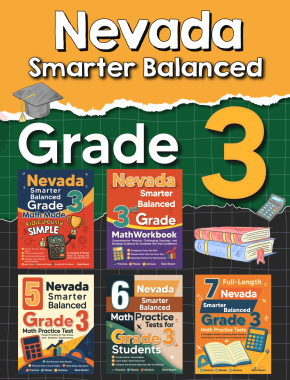
Ready for Grade 3 Math? The Nevada Grade 3 Math Bundle
Second grade is the build-up year, and when your child is ready for what comes next, this bundle makes the jump to Grade 3 math feel easy. It packs full practice-test books, complete answer keys, and step-by-step explanations for the Grade 3 math skills just ahead.
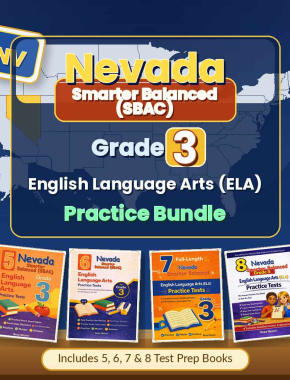
Getting Ready for Grade 3 English, Too? The Nevada Grade 3 English Bundle
Reading and writing grow right alongside math. If your second grader could use a head start in English as well, this Nevada Grade 3 English bundle covers it — practice tests, answer keys, and friendly explanations in one download.

Related to This Article
More math articles
- Parallel and Perpendicular Lines for 4th Grade
- Atlantic Trade and Mercantilism: Navigation Acts Explained
- The Best Grade 7 Math Book for South Dakota Students
- How to Add and Subtract Integers? (+FREE Worksheet!)
- Chapter 4: Ratification and Constitutional Principles
- Single-Skill Grade 3 Math for New York (NYSTP): 49 Free Practice PDFs, No Signup
- How to Prepare for the OAR Math Test?
- TASC Testing Accommodation and Support for Disabilities
- Stem –and–Leaf Plots
- How to Solve and Graph One-Step Multiplication and Division Equations



What people say about "Nevada Grade 2 Math Worksheets: Free PDFs"?
No one replied yet.