How Political Ideology Shapes Public Policy
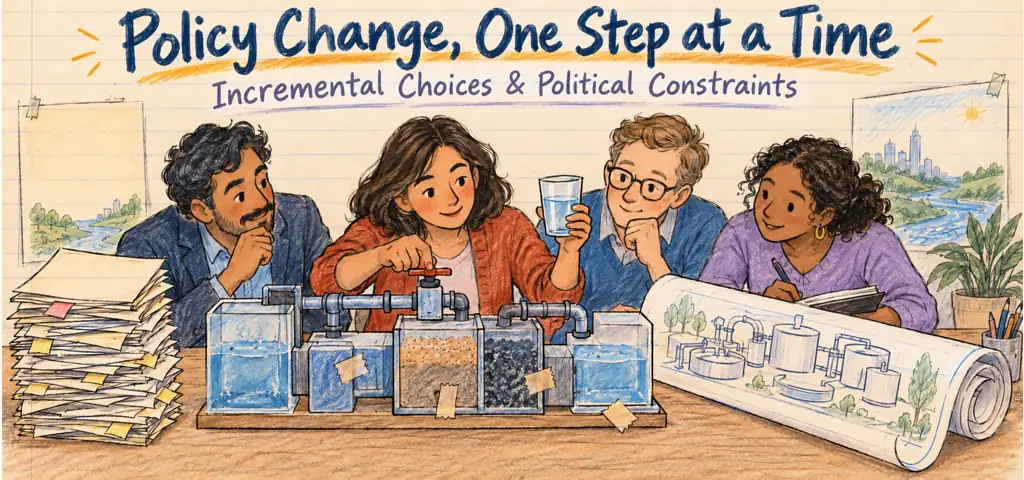
Incremental policymaking modifies an existing policy in limited steps rather than replacing the whole arrangement through one broad design. Officials might adjust an eligibility threshold, test a program in several states, raise a benefit gradually, or revise one regulatory standard while leaving the larger system intact. Incrementalism is common because decision makers face incomplete information, time limits, divided authority, and coalitions that agree on a modest change but not on a complete redesign. The existing policy becomes the starting point for bargaining.
Small steps can reduce risk. A pilot program can reveal administrative problems before national expansion, and a temporary waiver can show whether local flexibility improves results. Limited changes may preserve public expectations and make costs easier to estimate. They can also attract support from actors who would resist a sweeping reform. Incrementalism is therefore a method of coping with uncertainty and political constraint, not simply a lack of ambition.
The governing rule for how political ideology shapes public policy
The approach has costs. Repeated minor adjustments can preserve outdated assumptions, make programs unnecessarily complex, and leave urgent harms untreated. A patch added for one constituency may interact poorly with earlier rules. Path dependence develops when past choices create agencies, beneficiaries, contracts, and expectations that make another route increasingly expensive. At some point, a crisis or major electoral shift may open space for a more broad change, but even large reforms usually inherit institutions from the policy they replace.
How Political Ideology Shapes Public Policy: the legal or political boundary
Officials know that a national water standard needs revision but disagree about the ideal level and the cost of compliance. They first tighten the standard for the highest-risk contaminant, phase it in, and require data collection before the next adjustment. That is incremental policymaking. Writing inspection guidance is implementation. Comparing later water-quality data with the baseline is evaluation. in a course question, identify the size and relationship of the change: a limited alteration to an existing program points to incrementalism, regardless of whether the change is politically popular.
Reason through an example of how political ideology shapes public policy
A classmate claims that how political ideology shapes public policy always produces the same result, so correct the claim with one example and a relevant limit.
Video lesson: How Political Ideology Shapes Public Policy
Khan Academy gives a focused explanation of this topic in Ideology and policymaking | AP US Government and Politics.
If the player does not load, watch this lesson directly on YouTube.
Connect this lesson to the larger course
For a broader map connecting how political ideology shapes public policy to political culture, public opinion, and ideology, use the AP U.S. Government and Politics learning hub.

Related to This Article
More math articles
- 8th Grade MAP Math FREE Sample Practice Questions
- Quantum and Atomic Physics
- How Digital and Social Media Shapes Politics
- Free Grade 8 English Worksheets for Rhode Island Students
- What Is the Best GED Math Study Guide?
- Advanced Vocabulary Words: Emit to Fanatic
- Disasters and Collective Response
- Administrative discretion
- How to Solve Simple Interest Problems? (+FREE Worksheet!)
- Original jurisdiction






















What people say about "How Political Ideology Shapes Public Policy"?
No one replied yet.