Barriers protect the single seller
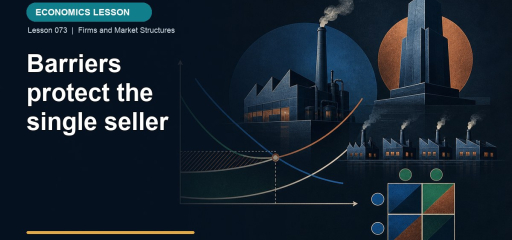
Barriers protect the single seller: this Effortless Math guide explains the topic in plain language, shows how it works through solved examples, and gives you free practice to try immediately, so the idea sticks instead of staying abstract.
One firm without a barrier invites entry.
A natural monopoly exists when
- a patent legally protects an invention
- demand is perfectly inelastic
- one firm owns all natural resources
- marginal cost exceeds average cost throughout demand
- average cost falls throughout the market’s demand range
average cost falls throughout the market’s demand range When average cost falls across market demand, duplicating the network can raise total cost, making one supplier least costly.
A network firm experiences lower average cost as its customer base expands because a large fixed platform cost is spread widely. This is
- an economy of scale
- a diseconomy of scale
- diminishing marginal utility
- a negative externality
- a sunk-benefit fallacy
an economy of scale Spreading a large fixed cost over more customers lowers average cost, a standard source of economies of scale.
A cartel raises joint profit by
- expanding output until price equals marginal cost
- making demand perfectly elastic
- eliminating every barrier to entry
- restricting total output and raising price
- requiring each member to maximize sales
restricting total output and raising price A cartel imitates monopoly by reducing combined output below the competitive amount and charging a higher price.
Watch the idea in action
A focused video lesson from EconplusDal.
Barriers can come from control of an essential resource, patents or licenses, network effects, large economies of scale, or strategic conduct. A natural monopoly exists when average cost falls over the relevant market demand, making one supplier less costly than duplication. A large firm is not automatically a monopoly, and a monopoly need not be a government-created firm.
A monopoly is a single seller in a relevant market with no close substitute and protected entry. All three elements matter. One seller today is not a durable monopoly if another firm can enter immediately. A large market share is not conclusive if buyers can readily switch to products outside a narrow definition.
Legal barriers include patents, copyrights, and exclusive licenses. Resource barriers arise when one firm controls an essential input that rivals cannot duplicate. Network effects can make a service more valuable as its user base grows, raising the difficulty of attracting users to a new network. Scale economies can make one large network cheaper than several smaller ones.
Strategic barriers require care. A low price produced by genuine efficiency benefits consumers. A predatory strategy would involve accepting losses to deter entry and later recouping them through market power. The exam typically states the relevant conduct rather than asking you to infer it from a low price alone.
| Barrier | Mechanism | Example type |
|---|---|---|
| Legal protection | Rivals are prohibited temporarily | Patent or exclusive license |
| Essential resource | Entrants cannot obtain a required input | Unique mineral source |
| Network effect | Incumbent value rises with installed users | Communication platform |
| Economies of scale | One firm serves demand at lower average cost | Utility network |
| Strategic conduct | Entry is made unprofitable by incumbent action | Capacity commitment |
One seller without monopoly protection
A town has one profitable bakery, but space is available, recipes are common, and another bakery can open at the same cost. The current seller count is one, yet profit attracts entry. Without a durable barrier, the monopoly model does not describe the long-run market.
Natural monopoly is a cost condition, not a statement that government granted exclusivity. If average cost keeps falling over the quantity demanded, duplicating networks can raise total cost. Regulation may then address price and service rather than create multiple inefficient networks.
Monopoly power is the ability to maintain price above marginal cost, constrained by demand. The firm cannot charge any price it wishes: a higher price reduces quantity demanded. Demand, cost, and the barrier together shape profit.
On an item, identify the barrier before applying monopoly rules. If no entry protection is stated, a single firm’s short-run profit may be temporary. If a barrier is stated, use market demand, MR below demand, and the two-step output-price rule.
A barrier must prevent or disadvantage a capable entrant, not merely describe the incumbent’s success. Brand popularity, large size, and current profit can disappear under entry. Patents, exclusive control of an input, network lock-in, and scale economies explain why entry may not undo the position.
Even behind a barrier, the monopolist is constrained by demand. A higher chosen price reduces sales and can lower profit. Monopoly means control over a price-output choice within market demand, not the ability to charge an arbitrary amount or guarantee profit.

Reza is an experienced Math instructor and a test-prep expert who has been tutoring students since 2008. He has helped many students raise their standardized test scores--and attend the colleges of their dreams. He works with students individually and in group settings, he tutors both live and online Math courses and the Math portion of standardized tests. He provides an individualized custom learning plan and the personalized attention that makes a difference in how students view math.
Related to This Article
More math articles
- The Ultimate PSAT Math Course (+FREE Worksheets & Tests)
- Adding Money Amounts for 4th Grade
- ACT Aspire Algebra 1 Free Worksheets: Free Printable ACT Aspire Algebra 1 Practice with Worked Keys
- The Best Grade 7 Math Book for Michigan Students
- The Best Grade 7 Math Book for Arizona Students
- Reliability, Validity, and Bias
- How to Master Motion: A Comprehensive Guide to Understanding the Distance Formula in Real-World Problems
- How to Solve Irrational Functions?
- Exterior Angle Theorem
- Grassroots lobbying



















What people say about "Barriers to Entry That Protect Monopoly"?
No one replied yet.