AP Biology

Search in AP Biology articles.

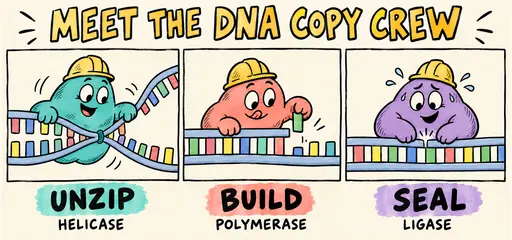
Comic enzyme crew separates DNA strands with helicase, extends a new strand with polymerase and seals a backbone nick with ligase.

DNA Replication Enzymes: Roles and Worked Examples

A typical diploid human cell preparing to divide copies roughly six billion base pairs of nuclear DNA. Each daughter cell needs a complete set. An error at every thousandth base would leave extensive damage, while the illustrative final error rate used here is about one per billion after correction.
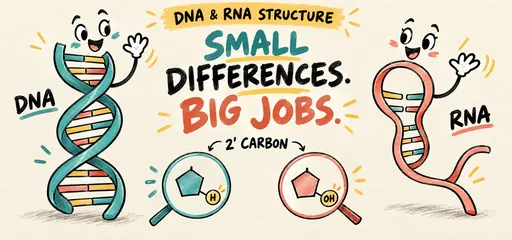
Comic DNA double helix and folded single RNA strand compare their sugar groups at the 2-prime carbon: H in DNA and OH in RNA.

DNA and RNA Structure: Key Differences and Worked Examples

A typical diploid human nucleus is only a few micrometers wide. Before replication, its DNA would stretch roughly two meters. The cell must pack that DNA, expose selected genes for reading, and copy it accurately before division. Start with the nucleotide: its sugar, phosphate, and base explain how
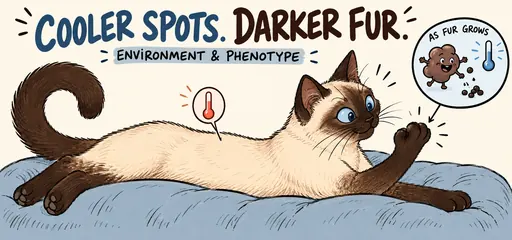
A comic Siamese cat examines its dark paw; warm-core and cool-extremity symbols illustrate temperature-sensitive pigment production as fur grows.

Environmental Effects on Phenotype: Examples and Practice

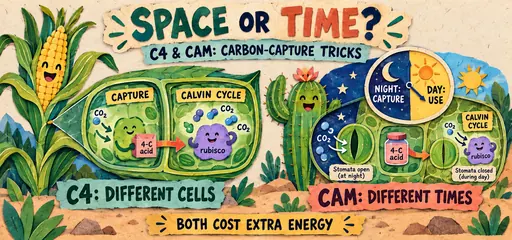
Handmade comic contrasts C4 carbon capture in different cells with CAM capture at night and use by day, showing open nighttime and closed daytime stomata.

Photorespiration, C4 and CAM Photosynthesis Explained

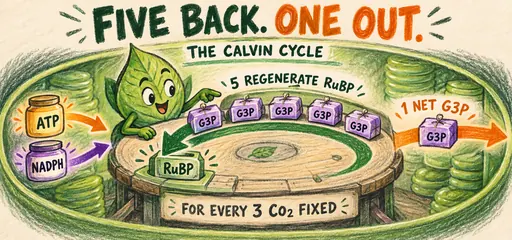
A leaf biochemist shows five G3P packages returning to regenerate RuBP and one net G3P exported per three carbon dioxide fixed, with ATP and NADPH inputs.

The Calvin Cycle Explained: Phases, ATP and G3P

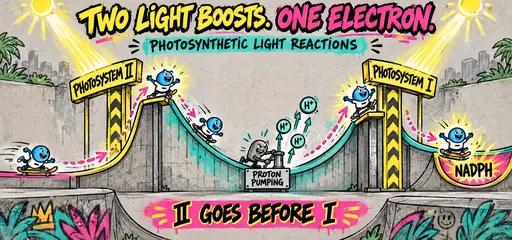
A comic electron follows two light-powered boosts, photosystem II then photosystem I, with proton pumping between them and an NADPH endpoint.

Photosynthetic Light Reactions: ATP, NADPH and Oxygen

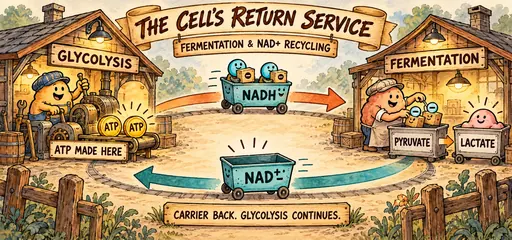
Hand-drawn fermentation comic: NADH delivers electrons to pyruvate, making lactate, while regenerated NAD+ returns to glycolysis, where ATP is made.

Fermentation and NAD+ Recycling: How Glycolysis Continues

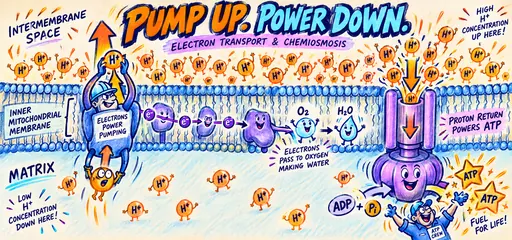
Crayon comic of mitochondrial electron transport pumping H+ into the intermembrane space and proton return through ATP synthase producing ATP in the matrix.

Electron Transport and Chemiosmosis: How ATP Forms

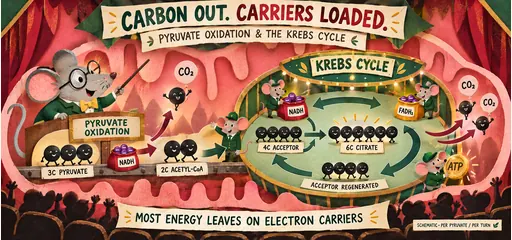
Handmade paper-theater comic showing pyruvate oxidation, acetyl-CoA entering the Krebs cycle, carbon dioxide release, acceptor regeneration and loaded electron carriers.

Pyruvate Oxidation and Krebs Cycle: Carbon and ATP Counts

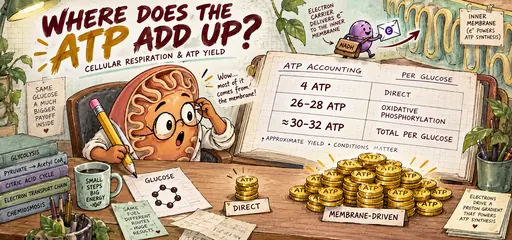
Watercolor mitochondrion accountant comparing 4 direct ATP with approximately 26–28 from oxidative phosphorylation, totaling about 30–32 ATP per glucose depending on conditions.

Cellular Respiration: Stages and 30–32 ATP Yield

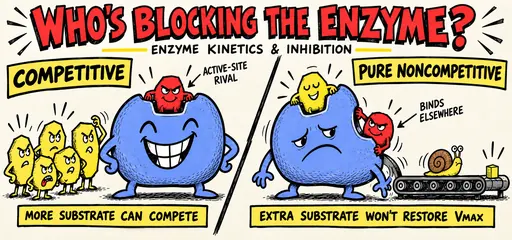
Hand-inked comic comparing competitive inhibition at the active site with pure noncompetitive inhibition at a separate site; extra substrate cannot restore the latter’s Vmax.

Enzyme Kinetics: Km, Vmax and Inhibition

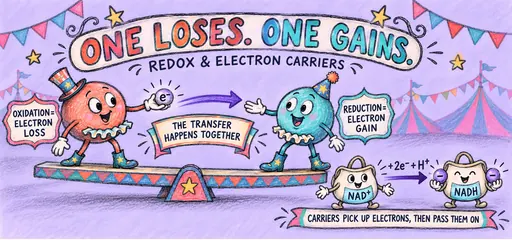
Pastel circus comic showing paired electron loss by oxidation and gain by reduction, with NAD+ accepting two electrons and a proton to form NADH.

Redox and Electron Carriers: NADH, FADH2 and NADPH