AP Biology

Search in AP Biology articles.

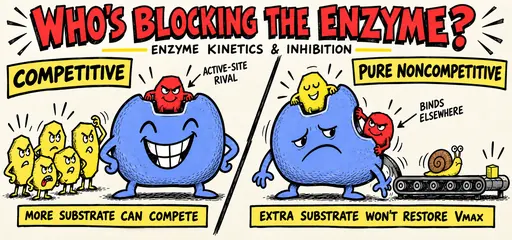
Hand-inked comic comparing competitive inhibition at the active site with pure noncompetitive inhibition at a separate site; extra substrate cannot restore the latter’s Vmax.

Enzyme Kinetics: Km, Vmax and Inhibition

Pour hydrogen peroxide on the kitchen counter and it sits there, decomposing so slowly that a sealed bottle lasts for months. Add a small piece of potato to a supervised laboratory peroxide assay and it foams quickly. The chemistry is identical in both places: peroxide breaking down into water and o
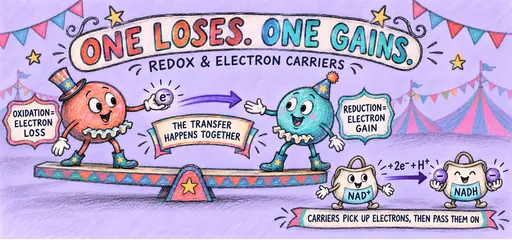
Pastel circus comic showing paired electron loss by oxidation and gain by reduction, with NAD+ accepting two electrons and a proton to form NADH.

Redox and Electron Carriers: NADH, FADH2 and NADPH

A piece of wood can burn because its reduced carbon compounds react with oxygen to form lower-free-energy products. Carbon dioxide is already highly oxidized and cannot supply the same energy through further carbon oxidation. Charcoal, by contrast, still contains reduced carbon and can burn; do not
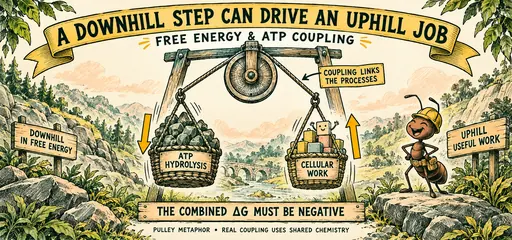
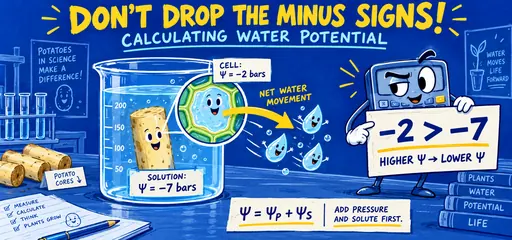
Etched comic pulley metaphor linking favorable ATP hydrolysis to cellular work; the combined free-energy change must be negative, and real coupling uses shared chemistry.

Free Energy and ATP Coupling: Worked Examples

White-pen comic of potato-core water potential: a cell at −2 bars loses water toward solution at −7 bars; compare total pressure plus solute potential.

Calculating Water Potential: Formula and Worked Examples

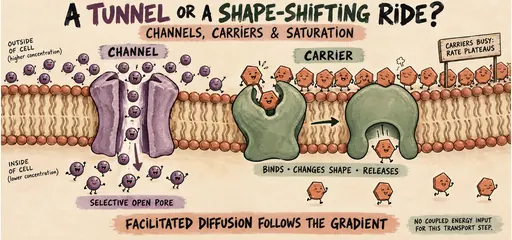
Dry-brush comic contrasting an open selective channel with a carrier binding, changing shape and releasing solute; busy carriers limit rate during facilitated diffusion.

Channels and Carriers: Facilitated Diffusion and Saturation

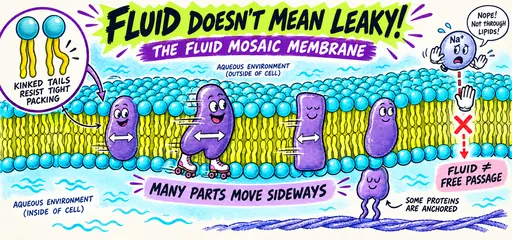
Hand-drawn roller-rink membrane comic showing lateral protein movement, an anchored protein, kinked lipid tails and a sodium ion blocked from passing through the lipid core.

Fluid Mosaic Model: Membrane Structure and Fluidity

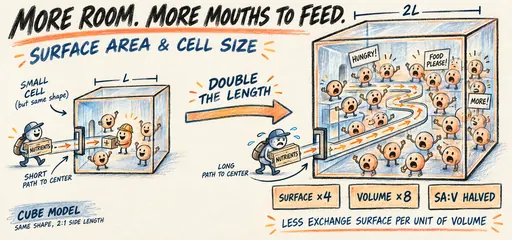
Pencil comic comparing cube-shaped cells: doubling side length multiplies surface area by four and volume by eight, halving exchange surface per unit volume.

Surface Area to Volume Ratio: Cell Size Worked Examples

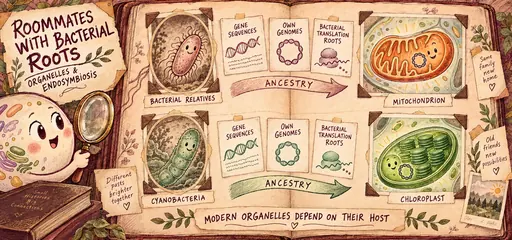
Handwritten family-album comic linking mitochondrial and chloroplast ancestry to bacterial relatives, supported by gene sequences, organelle genomes and translation machinery.

Endosymbiotic Theory: Organelles, Evidence and Gene Transfer

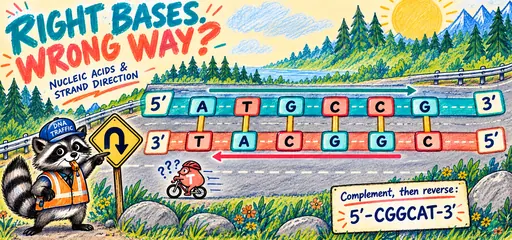
Handwritten crayon comic showing antiparallel DNA traffic lanes, complementary base pairs and the reverse complement 5′-CGGCAT-3′, with a raccoon traffic marshal.

DNA Strand Direction: Complement and Reverse Complement

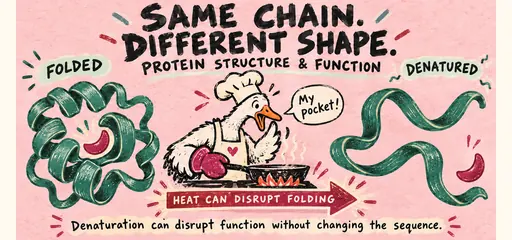
Handwritten linocut comic with a goose chef showing a folded protein losing its binding pocket after heating while its polypeptide chain remains intact.

Protein Structure: Four Levels, Folding and Function

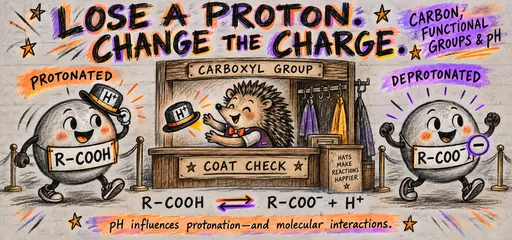
Handwritten charcoal comic of a hedgehog coat-check attendant illustrating reversible carboxyl-group deprotonation from R–COOH to R–COO− and H+.

Carbon, Functional Groups and pH: A Biology Guide