Trace incentives without assuming people are machines
A parking garage raises its daily price from $8 to $12. One commuter switches to the bus, while another keeps driving because the first bus arrives after their shift starts and no suitable carpool is available. Both responses make sense.
An incentive changes an action's relative benefit or cost. The parking charge makes driving less attractive compared with available alternatives, but predicting the response also requires knowing which alternatives a commuter can actually take. Their constraints matter.
Trace the change through a person's options
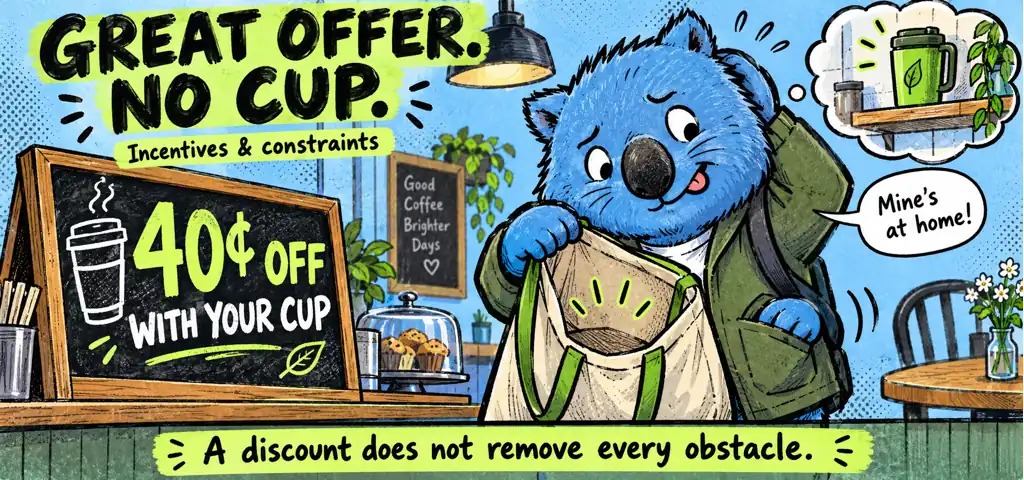
A café offers a reusable-cup discount of 40 cents. A customer who already carries a cup can claim it with little effort, while someone buying coffee unexpectedly may have no cup to use. Another forgets the offer.
Effort affects the choice too. Moving a recycling bin beside the ordinary bin reduces the trouble of recycling, while a long registration form adds to the cost of joining a program. Neither change needs a money payment. Attention and uncertainty also affect the decision, particularly when a customer must compare unfamiliar options or work out what an offer requires.
A familiar brand can save a shopper twenty minutes of comparison. That shortcut can be reasonable given the cost of searching, although it may leave the shopper paying for a feature they do not need. Purposeful choice can still be imperfect.
A higher wage can pull in two directions
An extra dollar per hour raises the reward for working, but it also allows someone to earn a given income in fewer hours if they can adjust their schedule. The effects can oppose each other.
The substitution effect encourages work because leisure now costs more in forgone earnings. If leisure is a normal good, the income effect encourages the worker to take additional leisure, with the overall response depending on the two effects' relative strength. Some jobs allow no change in hours.
Name the changed tradeoff before predicting a response. For a worker offered a higher wage, ask how strongly they value extra leisure and whether their employer allows the schedule adjustment you are imagining.
Separate a plausible story from evidence
Suppose reusable-cup use rises after the café introduces its discount. The café might also have added signs or attracted different customers, so a before-and-after comparison cannot by itself isolate the effect of the discount. Several things changed.
A carefully designed comparison can help. Comparable stores could be randomly assigned different offers while other conditions remain similar, with customer mix and implementation checked so the observed difference can be interpreted. Random assignment helps separate the offer from preexisting differences. Spillovers between stores and missing observations still need attention.
When you hear an incentive claim, identify who could respond to the changed reward and ask what evidence separates that response from other changes happening at the same time. For the café, check both the offer and who shopped there.
Watch the idea in action
A related lesson from Marginal Revolution University. Read the examples above alongside the video.

Reza is an experienced Math instructor and a test-prep expert who has been tutoring students since 2008. He has helped many students raise their standardized test scores--and attend the colleges of their dreams. He works with students individually and in group settings, he tutors both live and online Math courses and the Math portion of standardized tests. He provides an individualized custom learning plan and the personalized attention that makes a difference in how students view math.
Related to This Article
More math articles
- Math Education Trends In Canadian Education System
- 4 Best Printers for Teachers in 2026
- Striking and Driving Tools: What Shapes Tell You
- How to Perform Vector Addition and Subtraction
- What Happens If You Don’t Pass the STAAR Test?
- Rhode Island RICAS Grade 6 Math Free Worksheets: Printable Grade 6 Math Practice, Fully Worked Keys
- The Best Algebra 1 Book for Florida Students
- How to Support Grade 7 Reading at Home: 12 Smart Strategies That Build Independence
- The Best Grade 7 ELA Practice Tests for New York Students
- Word Problems Involving Comparing Rates



















What people say about "Trace Incentives Without Assuming People Are Machines"?
No one replied yet.