Top 10 Tips You MUST Know to Retake the FTCE Math Test

10- Commit to your study plan
Remember that the most important part of the FTCE General Knowledge retake is the commitment to study at regular intervals. Do not leave your review until the last few days before the FTCE General Knowledge math test. It is not a problem if you sometimes miss study sessions as long as you adhere to the general plan.
From the above tips, we can conclude that we should not let a bad test lower our self-esteem. No exam is so difficult that we cannot succeed with enough effort. We always keep in mind that if others have passed the FTCE General Knowledge Math test, we can too.
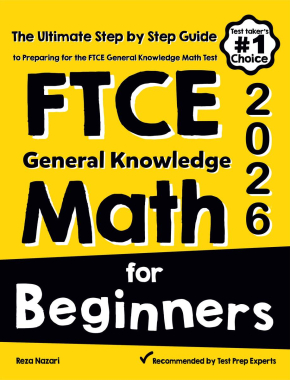
The Best Books to Ace the FTCE General Knowledge Math Test
Top 10 Strategies for FTCE Math Retake Success
Retaking the FTCE General Knowledge Math exam is an opportunity to improve. These ten strategies address both content mastery and test-taking techniques. Success comes from targeted study and systematic preparation.
Strategy One: Analyze Your Diagnostic Report Thoroughly
Your FTCE score report breaks down performance by content area. Spend considerable time identifying which topics cost you the most points. Did you struggle with algebra, geometry, or data interpretation? Were questions about ratios particularly difficult? Identify your two weakest areas and allocate seventy percent of remaining study time to these areas. Ignore topics where you already performed well.
Strategy Two: Master Fundamentals Before Advanced Topics
Many failing test-takers haven’t solidified basic skills. Before solving complex problems, ensure you can: perform operations with fractions, decimals, and percentages without calculator; solve two-step and three-step equations accurately; work with exponents and square roots correctly; convert between different number forms. Spend two to three weeks drilling fundamentals with timed sets of twenty to thirty problems.
Strategy Three: Create and Memorize Your Formula Cheat Sheet
Write out all formulas you’ll need on a reference sheet. Use it to understand each formula’s purpose, then set it aside and practice from memory. You won’t have this sheet during the actual exam, so memorization is essential. Cover formulas for area, volume, distance, probability, and statistics.
Strategy Four: Practice Under Strictly Timed Conditions
The FTCE allows approximately two minutes per question. Many students practice without time pressure, then panic during the real exam. Implement timed practice immediately: take full-length tests under strict time limits, don’t allow yourself to linger on hard problems, track your pacing to complete eighty percent of questions with five minutes remaining.
Strategy Five: Recognize and Avoid Common Pitfalls
These mistakes cost many test-takers points: misreading the question (watch for “NOT which”), unit errors (mixing inches and feet), order of operations mistakes (calculating two plus three times four as twenty instead of fourteen), negative number errors (especially with subtraction and multiplication), premature rounding (carry decimals through, round only at the end), probability confusion (mixing “at least” with “more than”).
Strategy Six: Develop Systematic Word Problem Translation
Word problems constitute twenty percent of the test. Use this systematic approach: read the entire problem carefully, identify what variable represents, circle all numerical information, underline what you’re asked to find, translate words to equations before solving, check whether your answer makes sense in context. Example: “A store buys widgets for eight dollars and sells for twelve dollars each. How many must they sell to make one hundred dollars profit?” Equation: twelve x minus eight x equals one hundred, so x equals twenty-five widgets.
Strategy Seven: Use Eliminate and Estimate Strategy
When unsure of a problem: eliminate obviously wrong answers (typically one to two are unreasonable), estimate the answer using simpler numbers, see which choice is closest. This strategy is particularly powerful for word problems and percentage questions, often yielding correct answers even with imperfect solving.
Strategy Eight: Transition to Review-Only Mode Three Weeks Before
Stop learning new material three weeks before the exam. Instead: take practice tests and review errors, redo problems you got wrong previously, focus on speed and accuracy with familiar problem types, build confidence by proving to yourself that you can pass.
Strategy Nine: Create a Personal Formula Strategy Card
For each major topic, write the key formulas and when to use them: area formulas (rectangle, triangle, circle), probability formula (favorable divided by total), percentage change (new minus old divided by old times one hundred), distance formula, slope formula. Write this by hand (not typed) because handwriting strengthens memory. Review this card weekly.
Strategy Ten: Develop Test-Day Routine and Anxiety Management
Test anxiety can lower your score by five to ten points. Create a plan: night before (light review thirty minutes max, get eight hours sleep), morning of (eat protein, avoid excessive caffeine, arrive fifteen minutes early), during test (take deep breaths, read questions carefully, skip hard ones and return), mindset (I’ve prepared for this, I can do this, this test doesn’t define me).
Eight-Week Study Timeline
Weeks one to two: review your diagnostic results, identify weak topics, solidify fundamentals with targeted drill. Weeks three to four: intensive work on your weakest area, spending sixty percent of study time here. Weeks five to six: practice tests under timed conditions, analyze patterns in your errors. Week seven: light review of previously weak areas to build confidence and momentum. Week eight: rest, avoid cramming, final review of test strategies, mental preparation.
Top 10 Strategies for FTCE Math Retake Success
Retaking the FTCE General Knowledge Math exam is an opportunity to improve. These ten strategies address both content mastery and test-taking techniques. Success comes from targeted study and systematic preparation over eight to ten weeks.
Strategy One: Analyze Your Diagnostic Report Thoroughly
Your FTCE score report breaks down performance by content area. Spend considerable time identifying which topics cost you the most points. Did you struggle with algebra, geometry, or data interpretation? Were questions about ratios particularly difficult? Identify your two weakest areas and allocate seventy percent of remaining study time to these areas. Ignore topics where you already performed well. This focused approach maximizes improvement.
Strategy Two: Master Fundamentals Before Advanced Topics
Many failing test-takers haven’t solidified basic skills. Before solving complex problems, ensure you can: perform operations with fractions, decimals, and percentages without calculator; solve two-step and three-step equations accurately; work with exponents and square roots correctly; convert between different number forms. Spend two to three weeks drilling fundamentals with timed sets of twenty to thirty problems.
Strategy Three: Create and Memorize Your Formula Cheat Sheet
Write out all formulas you’ll need on a reference sheet. Use it to understand each formula’s purpose, then set it aside and practice from memory. You won’t have this sheet during the actual exam, so memorization is essential. Cover formulas for area, volume, distance, probability, and statistics. Include the Pythagorean theorem, quadratic formula, slope, distance formula, and circle properties.
Strategy Four: Practice Under Strictly Timed Conditions
The FTCE allows approximately two minutes per question. Many students practice without time pressure, then panic during the real exam. Implement timed practice immediately: take full-length tests under strict time limits, don’t allow yourself to linger on hard problems, track your pacing to complete eighty percent of questions with five minutes remaining. Timed practice builds both speed and confidence.
Strategy Five: Recognize and Avoid Common Pitfalls
These mistakes cost many test-takers points: misreading the question (watch for “NOT which”), unit errors (mixing inches and feet), order of operations mistakes (calculating two plus three times four as twenty instead of fourteen), negative number errors (especially with subtraction and multiplication), premature rounding (carry decimals through, round only at the end), probability confusion (mixing “at least” with “more than”). Keep a log of your mistakes and review patterns weekly.
Strategy Six: Develop Systematic Word Problem Translation
Word problems constitute twenty percent of the test. Use this systematic approach: read the entire problem carefully, identify what variable represents, circle all numerical information, underline what you’re asked to find, translate words to equations before solving, check whether your answer makes sense in context. Example: “A store buys widgets for eight dollars and sells for twelve dollars each. How many must they sell to make one hundred dollars profit?” Equation: twelve x minus eight x equals one hundred, so x equals twenty-five widgets.
Strategy Seven: Use Eliminate and Estimate Strategy
When unsure of a problem: eliminate obviously wrong answers (typically one to two are unreasonable), estimate the answer using simpler numbers, see which choice is closest. This strategy is particularly powerful for word problems and percentage questions, often yielding correct answers even with imperfect solving.
Strategy Eight: Transition to Review-Only Mode Three Weeks Before
Stop learning new material three weeks before the exam. Instead: take practice tests and review errors, redo problems you got wrong previously, focus on speed and accuracy with familiar problem types, build confidence by proving to yourself that you can pass.
Strategy Nine: Create a Personal Formula Strategy Card
For each major topic, write the key formulas and when to use them: area formulas (rectangle, triangle, circle), probability formula (favorable divided by total), percentage change (new minus old divided by old times one hundred), distance formula, slope formula. Write this by hand (not typed) because handwriting strengthens memory. Review this card weekly.
Strategy Ten: Develop Test-Day Routine and Anxiety Management
Test anxiety can lower your score by five to ten points. Create a plan: night before (light review thirty minutes max, get eight hours sleep), morning of (eat protein, avoid excessive caffeine, arrive fifteen minutes early), during test (take deep breaths, read questions carefully, skip hard ones and return), mindset (I’ve prepared for this, I can do this, this test doesn’t define me).
Eight-Week Study Timeline
Weeks one to two: review your diagnostic results, identify weak topics, solidify fundamentals with targeted drill. Weeks three to four: intensive work on your weakest area, spending sixty percent of study time here. Weeks five to six: practice tests under timed conditions, analyze patterns in your errors. Week seven: light review of previously weak areas to build confidence and momentum. Week eight: rest, avoid cramming, final review of test strategies, mental preparation.

Related to This Article
More math articles
- Simple, Compound, Complex, and Compound-Complex Sentences
- The Best Grade 3 ELA Practice Tests for Illinois Students
- Top 10 Free Websites for CBEST Math Preparation
- How to Improve Your SAT Math Score by 100+ Points (2026)
- Free Grade 6 English Worksheets for Ohio Students
- How to Factor by GCF?
- Idaho ISAT Grade 4 Math Free Worksheets: 72 Free PDF Worksheets, One Skill at a Time
- Libel and slander
- Full-Length 6th Grade Common Core Math Practice Test
- How to Determine the Classification of a System of Equations?










What people say about "Tips to Retake the FTCE Math Test"?
No one replied yet.