The budget line shows purchasing possibilities
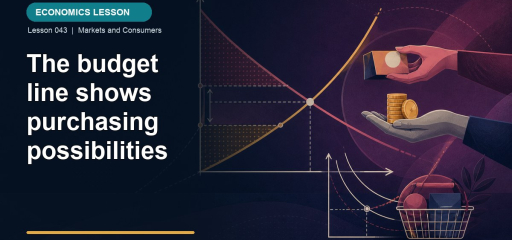
The budget line shows purchasing possibilities: this Effortless Math guide explains the topic in plain language, shows how it works through solved examples, and gives you free practice to try immediately, so the idea sticks instead of staying abstract.
Its intercepts and slope come from income and prices.
Every point on the line exhausts the budget, while points inside are affordable but leave income unspent and points outside are currently unaffordable.
With income I, prices PX and PY, affordable bundles satisfy PXX+PYY≤ I. The horizontal intercept is I/PX. The vertical intercept is I/PY. The slope is -PX/PY, the market opportunity cost of one more unit of X in units of Y.
An intercept answers an all-or-nothing question. If income is $60, PX=$6, and PY=$3, the consumer can buy at most 10 units of X or 20 units of Y. Bundles on the line exhaust the budget. Bundles inside are affordable and leave unspent income. Bundles outside are not affordable at the stated prices.
The budget equation is 6X+3Y=60. Solving for Y gives Y=20-2X, so the slope is -2. Each additional X requires giving up two Y because X costs twice as much. The slope records a market tradeoff set by relative prices, not the consumer’s preference.
Higher income shifts the line outward in parallel when prices are fixed. Lower income shifts it inward. A fall in PX rotates the line outward around the unchanged Y-intercept. A simultaneous proportional increase in income and both prices leaves the budget set unchanged.
| Change | Budget-line effect | What remains fixed |
|---|---|---|
| Income rises | Parallel outward shift | Relative price and slope |
| Income falls | Parallel inward shift | Relative price and slope |
| PX falls | X-intercept moves out. Line pivots | Y-intercept |
| PY rises | Y-intercept moves in. Line pivots | X-intercept |
| Income and both prices double | No change | Every affordable bundle |
A price change alters both purchasing power and the relative price. If PX falls, the consumer can buy more X with the same income, and X becomes cheaper in terms of Y. Those two effects later become the income and substitution effects. The rotation visually contains both.
Test a bundle before optimizing
Income is $48, notebooks cost $6, and meals cost $4. A bundle of 4 notebooks and 6 meals costs 4($6)+6($4)=$48, so it lies on the line. A bundle of 5 and 6 costs $54 and is unaffordable. Utility cannot make an outside bundle feasible. Preferences choose only among bundles inside the constraint.
Real purchasing power depends on income relative to prices. A 10 percent income increase paired with 10 percent increases in both prices leaves every maximum quantity unchanged. Nominal income rose, but the opportunity set did not. This prevents the common mistake of treating any dollar-income increase as an outward shift without checking prices.
The budget line states what can be purchased, not what should be purchased. To find the best bundle, combine it with marginal utility or indifference curves. A point on the line can be affordable but inferior to another affordable point. Feasibility comes first. Preference determines the selection within it.
When the inequality PXX+PYY≤ I is used, every point below the line belongs to the budget set. When drawing the line itself, use equality because it traces bundles that exhaust income. Confusing the budget set with its boundary can make an affordable interior bundle look impossible.
An outside point may be preferred, but preference cannot make it affordable under the stated income and prices.
A consumer’s income doubles while both prices double. The budget set will
- expand outward
- remain unchanged
- contract inward
- rotate toward good X
- rotate toward good Y
remain unchanged Every affordable bundle still satisfies the same real constraint because income and all prices change in the same proportion.
At every affordable quantity, good X provides more marginal utility per dollar than good Y. The utility-maximizing bundle may involve
- equal quantities of X and Y
- equal marginal utilities but unequal prices
- zero consumption of X
- spending beyond the budget
- a corner solution with no Y
a corner solution with no Y If X dominates in marginal utility per dollar throughout the feasible set, the optimum can occur at the boundary with no Y.
A consumer has $20 to spend on goods X and Y. Their prices are $4 and $5. Which bundle lies on the budget line?
- 5 units of X and 0 units of Y
- 4 units of X and 2 units of Y
- 3 units of X and 3 units of Y
- 2 units of X and 4 units of Y
- 0 units of X and 5 units of Y
5 units of X and 0 units of Y Five units of X cost exactly 5 units × $4 per unit = $20. Each other bundle costs more than the available income.
Watch the idea in action
A focused video lesson from Marginal Revolution University.

Reza is an experienced Math instructor and a test-prep expert who has been tutoring students since 2008. He has helped many students raise their standardized test scores--and attend the colleges of their dreams. He works with students individually and in group settings, he tutors both live and online Math courses and the Math portion of standardized tests. He provides an individualized custom learning plan and the personalized attention that makes a difference in how students view math.
Related to This Article
More math articles
- Intelligent Math Puzzle – Challenge 79
- Grade 2 Math Practice for Montana Second Graders
- The Circular Flow and Gross Domestic Product
- The Best Grade 5 Math Book for Colorado Students
- The Best Grade 7 ELA Practice Tests for Minnesota Students
- Top 10 Tips to ACE the SSAT Math Test
- Colorado CMAS Grade 4 Math Free Worksheets: Printable Grade 4 Math Practice with Full Solutions
- Cabinet
- Chapter 39: Voting Behavior
- The Best Grade 5 ELA Practice Tests for Maryland Students





















What people say about "The Budget Line and Purchasing Possibilities"?
No one replied yet.