Ranking Craps Bets From Lowest House Edge to Worst
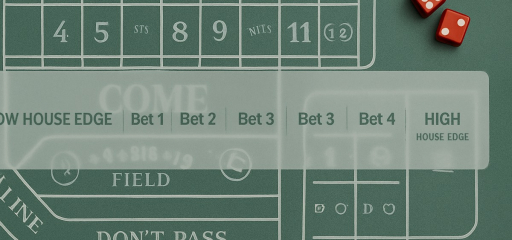
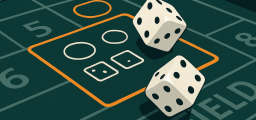
Walk up to a craps table on a Saturday night and you’ll hear roughly forty bets called out in the span of a minute, hardways, yos, horns, “any seven for the dealers”, and almost every single one is a worse bet than the quiet line the shooter is actually playing. Craps is loud, social, and a little chaotic, and that energy hides a fairly brutal truth: the bets that get the loudest cheers are usually the ones bleeding chips the fastest. The math doesn’t care how much fun you’re having.
So let’s rank them. Cleanest edge to worst edge, with the reasoning underneath. If you’ve ever wondered why a stickperson keeps nudging you toward the hardways while the dealer at the base never mentions them, the table below explains the entire psychology in a single column of percentages.
The Ranking Table, Every Major Craps Bet
Here’s the full lineup, sorted from “the casino is barely making money off you” to “please stop.” Edges are quoted per-bet-resolved, which is the standard the Wizard of Odds uses and the one that makes apples-to-apples comparisons honest.
| Rank | Bet | House Edge | Notes |
|---|---|---|---|
| 1 | Pass Line + 3x/4x/5x Odds | ~0.37% | Effective edge after diluting with free odds |
| 2 | Don’t Pass / Don’t Come (no odds) | 1.36% | The mathematically tightest flat bet |
| 3 | Pass / Come (no odds) | 1.41% | What 95% of the table is playing |
| 4 | Place 6 or 8 | 1.52% | Pays 7:6, the best of the place bets |
| 5 | Field (with 3:1 on 12) | 2.78% | Half as expensive as the 2:1 version |
| 6 | Place 5 or 9 | 4.00% | Pays 7:5 |
| 7 | Field (with 2:1 on 12) | 5.56% | Same bet, double the edge, read the layout |
| 8 | Place 4 or 10 | 6.67% | Buy bet is better if commission rules are lenient |
| 9 | Big 6 / Big 8 | 9.09% | Pays even money for a bet worth 7:6 |
| 10 | Hardway 6 or 8 | 9.09% | One of four ways to roll the total, only one wins |
| 11 | Any Craps | 11.11% | One-roll bet on 2, 3, or 12 |
| 12 | Yo (11) | 11.11% | The loudest call at the table |
| 13 | Hardway 4 or 10 | 11.11% | Only two ways to win the total at all |
| 14 | Any 7 | 16.67% | The worst common bet on the layout |
| 15 | Horn, Hop, C&E, other props | ~11 to 17% | The “prop bet” wasteland |
If you only take one thing away from this article, it’s that the top four rows are essentially the entire game, mathematically speaking. Everything below row five is a tax you’re paying for entertainment, and that’s fine, just know what you’re buying.
Why the Odds Bet Is Mathematically Free
The odds bet behind a Pass Line wager is the strangest thing on a casino floor: it’s a bet with zero house edge. Not “low,” not “favorable”, zero. The casino pays it at true mathematical odds, which means the expected value is exactly the amount wagered. Why would any business offer that? Because you can’t make the odds bet unless you’ve already made a Pass Line bet, and the Pass Line carries a 1.41% edge that funds the whole arrangement.
The true odds payouts are:
- Point of 4 or 10, pays 2:1, because there are 6 ways to roll a 7 and 3 ways to roll a 4 (or 10). Ratio: 6/3 = 2.
- Point of 5 or 9, pays 3:2, because there are 6 ways to roll a 7 and 4 ways to roll a 5 (or 9). Ratio: 6/4 = 3/2.
- Point of 6 or 8, pays 6:5, because there are 6 ways to roll a 7 and 5 ways to roll a 6 (or 8). Ratio: 6/5.
Those payouts exactly match the underlying probabilities, so on a long enough timeline the odds bet returns precisely what you put in. No cut. No vig. No nothing. Britannica’s overview of craps doesn’t even bother to give it a house edge in its summary, because there isn’t one to print.
The Worked Example: $10 Pass + $30 Odds
Here’s where the magic actually shows up in a bankroll. You put $10 on the Pass Line. That bet carries the 1.41% edge, which in dollar terms means the house expects to keep about $0.141 of it on average per resolution. Then, after a point is established, you back it with $30 in 3x odds. That $30 is mathematically neutral. The expected loss on the combined $40 of action is still just $0.141.
So your effective edge on the total wager is $0.141 ÷ $40 = 0.35%, which lines up with the ~0.37% figure quoted in the table once you average across all three possible points. Push the casino to 5x or 10x odds (some Vegas books offer it) and the effective edge drops below 0.20%. That’s better than almost any other bet in the building, blackjack with perfect basic strategy included.
The point worth dwelling on, and most craps players never internalize this, is that the casino isn’t being generous. They’re letting you bolt a neutral bet onto a slightly negative one, knowing full well that most players won’t take maximum odds, won’t even know maximum odds are allowed, and will instead drift toward the prop bets in the middle of the layout. The free money is sitting there, and the table noise is engineered to look past it.
Don’t Pass vs. Pass, The 0.05% That Nobody Plays
Don’t Pass has a house edge of 1.36%. Pass has 1.41%. Don’t Pass is, on paper, the better bet. You will almost never see someone playing it. There’s a reason, and it isn’t math.
Don’t Pass wins when the shooter craps out, when they roll a 7 before hitting their point. So you are, structurally, rooting against the table. Eight strangers high-five each other when the shooter hits, and you’re the one collecting chips when they miss. It’s socially uncomfortable in a way no other bet in the casino quite manages, and casinos absolutely understand this. The 0.05% they “lose” by offering Don’t Pass is one of the cheapest bits of crowd control they ever paid for.
I’ve played Don’t for entire sessions and gotten nothing but side-eye from a stickperson who’d happily have me on Any Seven instead, a bet that’s twelve times more expensive. The discomfort isn’t worth the nickel, honestly, unless you’re playing seriously and grinding. But it’s a clean reminder that the social layout of the table is doing a lot of work the math wouldn’t justify on its own.
The Middle of the Pack, Place Bets and the Field
Place 6 and Place 8 are quietly excellent bets. At 1.52%, they’re within shouting distance of the Pass Line, and they let you bet on a specific number without going through the come-out roll dance. If you want action on the 6 and 8 because they’re the second-most-common totals after 7, this is the way to do it. Just don’t confuse Place 6 with Big 6, which sits in the corner of the layout looking identical and costs you 9.09% instead. Same number. Six times the edge. That’s not a typo. It’s a layout designed to lure tourists.
The Field is the bet you can’t quite hate but probably shouldn’t love. It wins on 2, 3, 4, 9, 10, 11, and 12, seven of the eleven possible totals, which feels generous until you count outcomes instead of numbers. The 5, 6, 7, and 8 you lose on cover 20 of the 36 dice combinations. The Field is paying you to bet on the minority. Whether the edge is 2.78% or 5.56% depends entirely on whether the 12 pays 3:1 or 2:1, and that’s printed right on the felt. Read it. The difference is half your money over the long run.
The Worst of the Worst, Props, Hardways, and Any Seven
Any Seven is the most expensive common bet in craps at 16.67%. One roll, one number, six ways to win out of 36, paying 4:1 when the true odds are 5:1. The dealers love when you make this bet. The casino loves when you make this bet. Nobody else should.
Hardways are the showpiece of the prop section, bet that the dice will land as a pair (3-3, 4-4, 5-5) before either a 7 or the “easy” version of that total comes up. The hard 4 and hard 10 carry an 11.11% edge; the hard 6 and hard 8 are 9.09%. They pay 7:1 and 9:1 respectively, which sounds glorious until you do the combinatorial work and realize how often the easy version of any total beats you to it.
Yo (11) is the loudest bet on the table because the stickperson works it like a barker, “yo eleven, yo eleven, dollar yo for the boys”, and it costs 11.11%. The horn, the hop bets, the C&E, the world bet, all clustered between 11 and 17 percent. As the Wizard of Odds basics guide lays out in painful detail, the entire middle of the layout exists as a tax on excitement.
Here’s my second opinionated aside: a craps table where most of the action is in the prop section is a table that’s losing money fast. Not the casino. The players. And if you watch closely, you’ll notice the loudest, drunkest players are almost always the ones the dealers are encouraging to “press the hard eight.” That’s not coincidence. That’s the business model.
How to Actually Play, A Strategy That Respects the Math
If you want craps to be a long evening of relatively cheap entertainment, the formula is genuinely simple. Pass Line for the table minimum, take the maximum odds your bankroll can handle, and ignore everything else. If you want a second number working, Place the 6 or the 8. That’s it. Skip the field unless you’ve checked the 12 payout and it’s 3:1. Skip the Big 6 and Big 8 entirely; they exist as a trap.
One personal note: I started playing craps thinking the strategy was about picking winning numbers. After enough sessions I realized it’s actually about declining bets. Every time you let the stickperson talk you out of a hardway, you’ve made a small invisible profit. The discipline isn’t picking the right bet. It’s not making the wrong ones. If you want to dig deeper into the probability mechanics behind games like this, the math walkthroughs at Effortless Math are a good starting point for understanding why expected value is the only number that matters in the long run.
FAQ
Q: Is the Don’t Pass really worth playing if it’s only 0.05% better than Pass?
Mathematically, yes, but the difference is tiny on a per-bet basis. Over thousands of resolutions it adds up. Over a Saturday-night session, it’s basically a wash with social cost layered on top.
Q: Can I take odds on Don’t Pass too?
Yes. They’re called “laying odds,” and they also have zero house edge. The payouts are inverted (you risk more to win less) because you’re now the favorite. Same principle, same neutrality.
Q: Why is the Pass Line edge 1.41% if the come-out 7 wins?
Because once a point is established, a 7 beats you, and 7 is the most common roll. The come-out advantage doesn’t fully offset the point-phase disadvantage. The 1.41% is the weighted blend.
Q: Is “buying” the 4 or 10 better than “placing” it?
If the commission is only charged on wins, yes, the buy edge drops to around 1.67%. If it’s charged on every bet, the place is fine. Ask the dealer; the rule varies.
Q: Are there any prop bets worth making?
Honestly, no. The cheapest one (Hard 6 or Hard 8 at 9.09%) is still worse than the worst non-prop bet. They’re entertainment expenditures, not wagers.
Closing Thoughts
Craps is one of the few games in the casino where the best bet and the worst bet sit on the same felt, six inches apart, and the worst one is louder. The math is unambiguous: Pass Line with max odds, optional Place 6 or 8, and stop there. Everything else is paying for atmosphere, and atmosphere isn’t free. Decide how much of it you want, price it out at the table edge column, and have a great time, just don’t confuse the cheering for a strategy.

Related to This Article
More math articles
- How to Identify Relations and Functions? (+FREE Worksheet!)
- The Ultimate Grade 3 Math Course (+FREE Worksheets)
- The Best Grade 3 Math Book for Wisconsin Students
- Dragon Bonus, Lucky 6, Tiger: A Math Tour of Baccarat Side Bets
- Comparing Opposing Arguments
- What’s The Best Laptop For Online Math Teachers?
- Vermont SBAC Grade 6 Math Free Worksheets: Free Printable PDF Worksheets with Worked Solutions
- 49 Printable Arkansas ATLAS Grade 3 Math Worksheets — Free Download with Step-by-Step Keys
- How to Solve Multi-step Word Problems for Finding Starting and Ending Times
- Scientific Notation Practice — Both Directions (Free)


What people say about "Ranking Craps Bets From Lowest House Edge to Worst - Effortless Math"?
No one replied yet.