Property rights change the payoff to stewardship
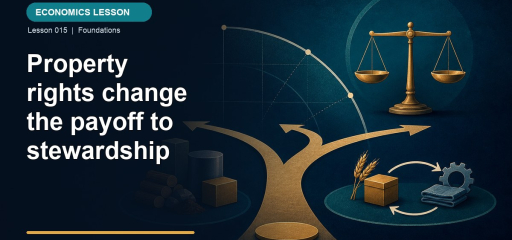
Property rights change the payoff to stewardship: this Effortless Math guide explains the topic in plain language, shows how it works through solved examples, and gives you free practice to try immediately, so the idea sticks instead of staying abstract.
Control and transferability influence investment and conservation.
Property rights specify who may use a resource, exclude others, receive its income, and transfer it. When rights are secure, an owner who improves an asset is more likely to receive the future benefit, encouraging maintenance and investment. Transferability can move a resource toward a user who values it more.
Rights are a bundle rather than a single all-or-nothing label. A tenant may have the right to use an apartment but not sell it. A patent holder may exclude competitors from a particular invention for a limited time but still face safety rules. A community may share access to grazing land under enforceable limits. To analyze incentives, ask which action is controlled, who captures the benefit, who bears the cost, and whether the right can be enforced.
Secure rights can lengthen the decision horizon. A farmer who expects to keep future gains from improved soil has a stronger incentive to invest in conservation than a farmer who expects immediate loss of access. This is a predicted incentive effect, not a claim that every owner will conserve. Credit constraints, short time horizons, imperfect information, and external effects can still influence behavior.
Poorly defined or unenforced rights can separate private incentives from social costs. In an open-access fishery, each fisher receives the value of another catch while the depletion cost is shared among all users. The result can be excessive harvest. Individual catch rights, seasonal limits, or community management can change the incentive, though every system requires monitoring and enforcement.
Open access is not the same as common ownership with rules. A common-property system can define membership, seasons, and sanctions. Open access means effective exclusion is absent, so users race to capture benefits before others do. The difference matters because “privatize it” is not the only possible solution. A well-enforced community rule can also align use with the group’s long-run interest.
Property rights do not answer every distributional or moral question. A rule can improve efficiency while producing a distribution that society considers unfair. Efficiency and equity are distinct criteria. A positive claim about incentives does not settle a normative judgment about the preferred allocation.
| Dimension | Diagnostic question | Incentive implication |
|---|---|---|
| Use | Who may employ the resource and for what purpose? | Determines which benefits are available |
| Exclusion | Can nonauthorized users be kept out? | Affects free riding and depletion |
| Income | Who receives returns from improvement? | Shapes maintenance and investment |
| Transfer | Can the right be sold, leased, or reassigned? | Can move control toward higher-valued uses |
| Enforcement | Are violations detected and remedied? | A paper right without enforcement may not change behavior |
The rule behind the behavior
Two apartment buildings are physically identical. In one, the landlord keeps the savings from insulation. In the other, regulated utility charges prevent the owner from receiving any saving. The first rule creates a stronger private incentive to invest. This does not prove that the second rule has no benefit. It identifies one behavioral effect.
The example also illustrates how to avoid overclaiming. The rule changes one payoff, but the actual investment decision still depends on insulation cost, expected savings, financing, and how long the owner expects to hold the building. A strong answer identifies the direction of the incentive under the stated assumptions without declaring that one rule guarantees a particular action.
Property-right questions often connect to externalities. If bargaining is inexpensive, rights are clear, parties are few, and agreements can be enforced, affected parties may negotiate toward a more efficient outcome. But assigning the initial right can change who pays whom and therefore the distribution of surplus. Transaction costs and bargaining power can prevent the theoretical agreement. Efficiency and distribution remain separate.
Which arrangement gives a homeowner the strongest private incentive to pay for insulation, other things equal?
- The homeowner cannot sell the property or receive lower utility bills.
- Any energy saving is transferred to an unrelated third party.
- The homeowner expects to keep the home and receives the resulting energy-cost savings.
- The insulation benefit is shared equally with all households in the city.
- The right to alter the building is uncertain and rarely enforced.
The homeowner expects to keep the home and receives the resulting energy-cost savings. The owner captures future savings and expects to retain control long enough to receive them. The other arrangements separate the investment cost from its benefit.
Watch the idea in action
A focused video lesson from Foundation for Teaching Economics.

Reza is an experienced Math instructor and a test-prep expert who has been tutoring students since 2008. He has helped many students raise their standardized test scores--and attend the colleges of their dreams. He works with students individually and in group settings, he tutors both live and online Math courses and the Math portion of standardized tests. He provides an individualized custom learning plan and the personalized attention that makes a difference in how students view math.
Related to This Article
More math articles
- Why Teaching Math At Home Is Beneficial For Your Kids?
- How to Find Asymptotes: Vertical, Horizontal and Oblique
- Prices coordinate dispersed information
- Top 10 3rd Grade PARCC Math Practice Questions
- List Of the Best Middle School Math Supply for Learning
- Which Test Is Better for You; GED, TASC, or HiSET? Find Out Now
- South Carolina SC READY Grade 6 Math Free Worksheets: 72 Free Printable Worksheets with Answer Keys
- How to Find Magnitude of Vectors?
- Montgomery, King, and the SCLC
- How to Add and Subtract Functions? (+FREE Worksheet!)
















What people say about "Property Rights and Stewardship"?
No one replied yet.