Live Dealer Baccarat and the Math That Doesn’t Move
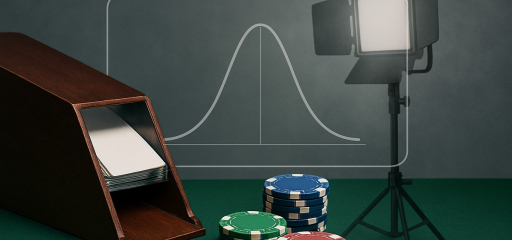
Live dealer baccarat looks like a different animal than the version sitting in the corner of a real casino floor. The studio lighting’s a little too bright, the dealer’s wearing a headset, and there’s a chat box on the right side of your screen filled with people typing “banker banker banker” in three languages. But underneath the broadcast gloss, the cards behave the same way they’ve behaved since the game crossed the Atlantic from Cuba. The shoe is real. The probabilities are fixed. And the house edge doesn’t care whether you’re sitting at the Bellagio or watching a webcam from a studio in Latvia.
I’ve spent more time than I’d like to admit comparing live dealer feeds side-by-side with the math, and what keeps jumping out at me is how aggressively the marketing tries to make these tables feel “premium” or “VIP”, when the only thing separating them from a $25 minimum at a brick-and-mortar pit is the broadcast budget. The math is identical. What changes is everything around the math.
The Numbers Don’t Move, No Matter Where You Stream From
Live dealer baccarat uses a real eight-deck shoe (sometimes six), shuffled by a human, dealt by a human, on camera, in real time. There’s no RNG involved in the card draws themselves, the cards are physical, and optical character recognition reads each one as it’s exposed and pushes the result to your screen. That setup means the probabilities are inherited directly from a standard 416-card shoe, which is exactly what you’d see at a land-based table.
Here’s what those probabilities look like, per Wizard of Odds:
| Outcome | Probability (8-deck shoe) | Payout | House Edge |
|---|---|---|---|
| Banker wins | 45.86% | 0.95 to 1 (5% commission) | 1.06% |
| Player wins | 44.62% | 1 to 1 | 1.24% |
| Tie | 9.52% | 8 to 1 | 14.36% |
Strip out the ~9.52% of hands that tie, and Banker wins about 50.68% of decided hands while Player wins about 49.32%. That tiny 1.36-percentage-point lean is why Banker carries a commission, without the 5% rake, Banker would actually be a positive-expectation bet, and casinos aren’t running charities.
It’s worth saying out loud: nothing about the “live” in live dealer baccarat changes any of this. The studio doesn’t get to fiddle with the shoe composition. The dealer can’t lean on the third-card rule. The licensed studios operate under audit regimes, UK-licensed feeds, for example, fall under the Gambling Commission’s remote technical standards, which require independent testing of game outcomes and software integrity, and breaking the probability structure would torch their license overnight.
The One Thing That Actually Changes: Pace
If the math is locked in, what’s the catch? Pace. And pace is where live dealer quietly chews through bankrolls in a way the brochure won’t tell you about.
Rough numbers from the studios and the floors:
- Land-based baccarat (full table, squeeze ritual): ~45-60 hands per hour
- Live dealer standard speed: ~60-70 hands per hour
- Live dealer “Speed Baccarat”: ~150-200 hands per hour (cards face-up, no squeeze, ~27-second rounds)
- RNG / video baccarat: 300+ hands per hour if you tap fast
Run the expected-loss arithmetic on a $20 Banker bet, the bet with the lowest edge at 1.06%, and the pace difference is the whole story.
| Format | Hands/Hour | $20/hand Expected Loss/Hour |
|---|---|---|
| Land-based, full ritual | 60 | $12.72 |
| Live dealer standard | 70 | $14.84 |
| Speed Baccarat (live) | 175 | $37.10 |
| RNG baccarat | 320 | $67.84 |
Same bet. Same house edge. Same shoe distribution. The only variable that moved is how many times per hour you’re putting money in front of it. Live dealer at standard speed costs you roughly 16% more per hour than the land-based equivalent on the same wager. Speed Baccarat costs you nearly three times as much. And RNG? Forget it. You’re effectively paying for a slot machine that happens to use baccarat as a theme.
The marketing copy never frames it this way, but pace is a hidden cost. It doesn’t show up in the house-edge column because the house edge is per-hand, not per-hour. Every “fast” variant is a multiplier on your expected loss, and nothing else.
The Variants, and Which Studio Window You’re Actually Sitting In
The big live studios (Evolution, Pragmatic Play Live, Playtech Live) all package the same shoe into a half-dozen presentation styles. The cards behave identically across all of them. What changes is the ceremony.
- Squeeze Baccarat: Dealer slowly peels the cards. Lots of theater, ~30-40 hands/hr, lowest hourly cost on a per-bet basis.
- Standard Live Baccarat: Cards turned over briskly, ~60-70 hands/hr. The default.
- Speed Baccarat: Cards dealt face-up. Round resolves in roughly 27 seconds. ~150-200 hands/hr.
- No Commission Baccarat: Banker pays 1:1 except on a winning Banker 6, which pays 0.5:1. Edge climbs to ~1.46% on Banker. Worse for you, despite the friendly name.
- Lightning / Golden Wealth / Prosperity Tree Baccarat: Multiplier overlays on certain cards. Pays for the gimmick by raising the base house edge to ~1.7-2.1%.
I’ll be blunt about the multiplier variants. They’re some of the most mathematically expensive baccarat games ever offered to retail players. The lightning-themed tables are great television. Card flips with random 8x multipliers slapped on top look spectacular on a vertical-phone stream. But every single one of them increases the house edge on the base wager to fund the multiplier payouts. You’re paying for the fireworks. Whether you think the fireworks are worth it is your call, but at least call them what they are: a tax.
Side Bets: Where the Studios Actually Make Their Money
The main bets in baccarat are mathematically tight. Banker at 1.06% is one of the lowest house edges in any casino game, table or digital. Studios know this, which is why every live dealer baccarat lobby is packed with side bets that look fun and cost real money.
| Side Bet | Typical House Edge |
|---|---|
| Player Pair | 10.36% |
| Banker Pair | 10.36% |
| Perfect Pair | ~13.0% |
| Either Pair | ~5.7% |
| Big / Small | 4.35% / 5.27% |
| Dragon Bonus (Player) | ~2.65% |
| Dragon Bonus (Banker) | ~9.37% |
| Lucky 6 / Super 6 | ~16.5% |
| Tie | 14.36% |
These aren’t borderline. They’re in slot-machine territory. A $5 Lucky 6 bet next to a $20 Banker main bet roughly doubles your expected hourly loss while only increasing your action by 25%. The side-bet menu is the studio’s revenue mix, treat it with the same skepticism you’d bring to the “buy a free spins round” button on a video slot.
If you want to dig deeper into how house edges compound when you stack bets across a session, the breakdown over at Effortless Math on expected value math is a useful primer. It’s the same arithmetic, just applied without the studio music.
Why the Studio Aesthetic Throws People Off
Here’s something I’ve never been able to shake. The first time I watched a live dealer baccarat feed end-to-end, I noticed I was making decisions faster than I would have at a real table. Not by much, maybe a beat or two per hand, but consistently. The studio is engineered for that. The countdown timer in the corner, the snappy edit on the card reveals, the dealer who’s been trained to keep the rhythm moving so the chat doesn’t get bored. It’s TV. It’s good TV.
A real casino floor doesn’t have that pacing. Players take their time. Someone’s chatting up the dealer. The pit boss is wandering past. A shoe gets shuffled and there’s a four-minute lull. You sit in those lulls, and they let you actually think about whether you want to bet the next hand. The studio strips those lulls out on purpose, because dead air is the enemy of a streaming product.
None of this is sinister, exactly. It’s just the same logic that makes Netflix autoplay the next episode. But it does mean live dealer baccarat doesn’t feel like its land-based cousin even when the math is identical. You’re being gently nudged toward making one more bet, then one more, by the production design itself. Worth knowing.
What an Even-Money Session Actually Costs
Let’s pin down a realistic session. Two hours of live dealer baccarat, standard speed, $25 Banker bets, no side action.
- Hands: ~140
- Total action: $3,500
- Expected loss at 1.06%: $37.10
- 1 standard deviation in outcomes: roughly ±$295
Translation: your most likely two-hour result lands somewhere between roughly -$330 and +$260, and the long-run drift is about thirty-seven bucks against you. Compared with most casino offerings, that’s actually a reasonable deal. The same two hours on a 4% house-edge American roulette session at the same per-hour action would cost you around $140 in expectation. Baccarat earns its reputation as the most player-friendly major table game, and live dealer doesn’t change that, provided you stay off the side bets and don’t get talked into Speed mode.
The Mistakes I See Most Often on Live Tables
A non-exhaustive list, in no particular order:
- Betting Tie because it pays 8:1. It pays 8:1 because it costs 14.36% in expectation. The payout is the disguise.
- Switching between Banker and Player based on the scoreboard. The “Big Road” and “Bead Plate” displays are gorgeous and entirely useless for prediction. The shoe has no memory.
- Treating “No Commission Baccarat” as a freebie. The half-payout on Banker 6 quietly makes it worse than the standard 5%-commission version.
- Defaulting to Speed Baccarat because it loads first. The lobby’s UX favors the high-pace variant for a reason. Pick the standard table on purpose.
- Believing the dealer can influence the cards. They draw from a pre-shuffled, audited shoe. The smile is real; the influence isn’t.
FAQ
Is live dealer baccarat rigged?
Licensed live dealer baccarat, meaning a studio operating under a UKGC, MGA, Isle of Man, or comparable license, uses a physical shoe on camera, optical card recognition, and independent game-outcome auditing. Rigging it would require corrupting a chain that’s specifically designed to be tamper-evident, and the cost-benefit doesn’t work for a regulated operator. The house edge is enough. Unlicensed offshore studios are a separate conversation; if your operator’s license can’t be verified, the math you trust on this page doesn’t apply.
Should I always bet Banker?
If you’re betting the main lines, yeah, Banker’s the lowest-edge bet on the table at 1.06% versus Player’s 1.24%, even after you subtract the 5% commission. The 0.18-percentage-point gap doesn’t feel like much, but it compounds over a few hundred hands. Just don’t switch off it because Banker “lost the last four”, the shoe doesn’t track that, and neither should you.
Why does live dealer feel more expensive than playing at a real casino?
Pace and friction. A real table averages 45-60 hands per hour with natural pauses. A live dealer table runs 60-70 at standard speed and up to 200 at Speed Baccarat. Same edge per hand, more hands per hour, more expected loss per hour. The math doesn’t move; you just face it more often.
Are the dealer’s hands actually doing anything that matters?
Not to the probabilities, no. The draw rules in baccarat are fixed. There’s no decision the dealer can make about whether to draw a third card; the rules dictate it based on point totals. The dealer’s job is presentation, pacing, and pressing the cards against the OCR sensor so the system reads them correctly. The cards do what they do.
What about card counting in live dealer baccarat?
Theoretically possible, practically pointless. Baccarat’s draw rules are so rigid that even perfect card counting only swings the edge by a tiny fraction of a percent, and only at the very end of a shoe. The studios also reshuffle before the count would matter. Time better spent on almost any other study.
Putting It Together
Live dealer baccarat is the same game it’s always been, dressed for streaming. The probabilities haven’t budged in a century, the house edges are some of the most player-friendly numbers a casino offers, and the regulated studios are running the same shoe arithmetic you’d see on any reputable land-based floor. None of the broadcast polish changes a single coefficient in the expected-value calculation. What changes is how often the calculation runs against you, every additional hand per hour is another tick of the same edge, and the studios know exactly how to dial up the pace without it feeling rushed. Play the main bets, skip the side menu, ignore the scoreboard, pick the slower variant when it’s offered, and the math will treat you about as fairly as a casino game ever will. The cards aren’t the trap. The clock is.

Related to This Article
More math articles
- The 10 Best Whiteboards for Online Tutoring
- Converting Metric Units for 5th Grade: Length, Mass, Capacity
- 5th Grade FSA Math Practice Test Questions
- The Slot Bonus Buy Trap: Math Behind Paying for the Feature
- The Ultimate OAA Algebra 1 Course (+FREE Worksheets)
- The Best Grade 6 ELA Practice Tests for Florida Students
- How to Create a Praxis Core Math Study Plan?
- Jungle Bargains: A Guide How to Find the Original Price Using Sale Prices
- Words for Actions, Movement, and Change
- 3rd Grade PARCC Math FREE Sample Practice Questions










What people say about "Live Dealer Baccarat and the Math That Doesn’t Move - Effortless Math"?
No one replied yet.