How the Federal Court System Works: Trials and Appeals
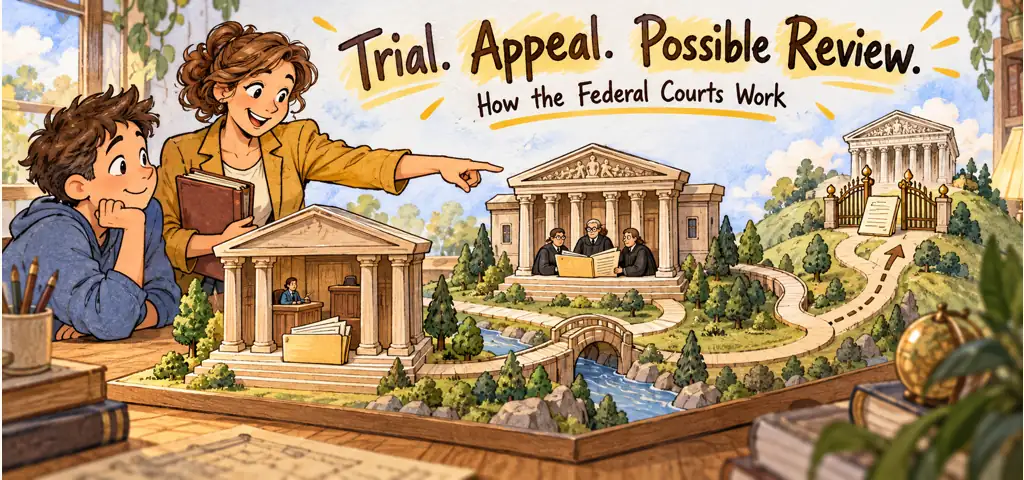
The federal court system separates trial work, appellate review and the Supreme Court’s selective review. Start with jurisdiction, not the court’s rank. Trace where the record was made, which court may review the decision and whether the next step is available as of right or requires discretionary selection.
Start with Authority to Hear the Dispute
A federal lawsuit does not begin by asking which court is most powerful. It begins by asking which court has authority to hear this dispute and what work that court is supposed to do. The structure of the federal judiciary separates trials from appeals and places the Supreme Court above lower federal courts. Article III establishes one Supreme Court and permits Congress to create inferior federal courts. Congress has used that authority to create district courts and courts of appeals, define much of their jurisdiction, and organize them into districts and circuits.
Read the District and Circuit Map
The familiar three-level map contains the district courts, the courts of appeals, and the Supreme Court. The nation has 94 federal judicial districts. Those districts are grouped into 12 regional circuits, each with a court of appeals. A thirteenth appellate court, the Federal Circuit, hears specialized categories from across the country. These numbers describe the current organization of the system, not powers fixed permanently by the Constitution. Congress created the lower courts and can reorganize them by law within constitutional limits.
Distinguish Trial Work from Appellate Review
The hierarchy divides labor. Trial courts develop records by receiving evidence, hearing witnesses, resolving disputed facts, and applying law. Appellate courts review judgments for claimed legal error. They ordinarily do not hold a second trial or receive new evidence. The Supreme Court resolves a small, selected set of disputes, including cases needed to settle important federal questions or disagreements among lower courts. A court’s position in the hierarchy does not by itself create jurisdiction. Congress and the Constitution must authorize the court to hear the category of case.
Check Which Precedent Controls
This division also creates precedent. A district judge must follow controlling decisions of the Supreme Court and the court of appeals for that district’s circuit. A circuit decision generally governs federal trial courts within that circuit, while another circuit may reach a different answer. A split may persist until the Supreme Court resolves it or the circuits reconsider. When the disagreement concerns a statute, Congress may amend that statute. District-court opinions can be persuasive, but one district judge does not bind every other district judge. The level and geographic reach of the deciding court therefore matter when a question asks what rule controls.
Keep State and Federal Systems Distinct
The federal judiciary is only one part of the American court system. State courts handle most litigation and have their own trial and appellate hierarchies. Federal courts can hear only constitutionally and statutorily authorized categories, while state courts usually possess general jurisdiction. A state court can decide a federal question and must follow controlling federal law. The U.S. Supreme Court may review the federal issue after the state system reaches the appropriate final judgment. This arrangement is a judicial expression of federalism, not evidence that state courts are inferior federal tribunals.
Follow a Typical Route and Check Its Assumptions
Hypothetical ordinary route. Assume jurisdiction and an available cause of action: a person sues a federal agency in a United States district court. After final judgment, the losing party appeals to the appropriate regional court of appeals. Only after that appellate judgment would the party ordinarily petition the Supreme Court for discretionary review. At each stage, the question changes: What facts and law govern the trial? Did the trial court commit reversible legal error? Does the Supreme Court have a reason to select this case from thousands of petitions?
The same diagram does not fit every dispute. Some statutes route review of agency action directly to a court of appeals. A federal question finally decided in the highest state court in which a decision could be had may reach the U.S. Supreme Court without passing through a lower federal court. Specialized courts and non-Article III tribunals also perform assigned work outside the basic three-level picture. Use the hierarchy as a starting map, then read the jurisdictional route supplied by law.
The most common beginner mistake is to route every important case upward through all three federal levels. Instead, ask four questions in order: Where was the record made? Which court has appellate authority over that decision? Is review a right or discretionary? Does a specialized statute change the route? The case’s political importance cannot substitute for those jurisdictional steps.
Compare the Court Map with the Review Statutes
The U.S. Courts structure guide currently identifies 94 district courts and 13 courts of appeals. Its appeals overview distinguishes the 12 regional circuits from the nationwide Federal Circuit and explains that an appeal is not a new trial with new witnesses.
28 U.S.C. § 1291 supplies a general final-decision route from district courts to courts of appeals, with exceptions and a separate treatment of Federal Circuit jurisdiction. Do not turn that starting rule into a claim that every order is immediately appealable or every dispute follows the same path.
28 U.S.C. § 1257 addresses Supreme Court certiorari review of qualifying final state-court judgments involving specified federal questions. It does not send a state case through a federal district court merely because a party raises federal law. Identify the actual judgment, federal issue and applicable route before drawing the arrows.
Explain What Changes at Each Level
Assume an ordinary federal civil case reaches final judgment in a district court and the applicable law provides an appeal to a regional court of appeals. The losing party then seeks Supreme Court certiorari. Where is the trial record developed, what does the appellate court review, and why is the Supreme Court petition a different step?
Check your reasoning
The district court develops the record and resolves the case within its jurisdiction. The court of appeals reviews the challenged decision and proceedings rather than starting the trial again. A Supreme Court certiorari petition asks for discretionary review; it does not establish that the Court will hear the case or that the petitioner will win.
The federal judiciary consists of the Supreme Court and lower courts created by Congress, chiefly district courts and courts of appeals. Jurisdiction, review, and precedent connect the levels without making lower judges employees of higher courts. Federal district courts are the principal trial courts, finding facts, hearing witnesses, and applying law in cases within federal jurisdiction.
Try Three Federal Court System Questions
Choose one answer, then check your reasoning. These are short learning checks, not an exam score. If the controls are unavailable, the explanations remain readable below each question.
Answer A. District courts resolve trial-level disputes by determining facts and applying law. An ordinary appeal reviews the proceedings and decision rather than creating a second trial.
Answer C. A petition requests review. The Court’s selection decision and its eventual merits decision are separate from filing the request.
Answer B. Section 1257 provides a certiorari route for qualifying final state-court judgments. Raising federal law does not automatically create a new trial in the federal district court or guarantee Supreme Court review.
Video Lesson: Structure of the Court System
CrashCourse gives a focused explanation of this topic in Structure of the Court System: Crash Course Government and Politics #19.
If the player does not load, watch this lesson directly on YouTube.
Follow how the Supreme Court selects and decides cases, then connect jurisdiction to judicial review and the courts’ role.
Continue Studying Court Selection and Review

Related to This Article
More math articles
- Quadratic Inequality Calculator (Free, Step-by-Step)
- 10 Most Common 7th Grade IAR Math Questions
- Utah RISE Grade 8 Math Free Worksheets: Printable Grade 8 Math Practice, Answers Included
- 10 Famous Math Problems and the History Behind Them
- Grade 7 ELA Tests: A Clear Parent Guide to Reading, Writing, and Test-Day Readiness
- How to Ace the GRE Quantitative Section (2027 Guide)
- The Best Grade 6 ELA Practice Tests for Nevada Students
- Equation Guess — Daily Math Equation Puzzle Game
- 6th Grade SBAC Math Practice Test Questions
- How to Solve Inverse Trigonometric Functions?












What people say about "How the Federal Court System Works: Trials and Appeals"?
No one replied yet.