How the Federal Bureaucracy Works
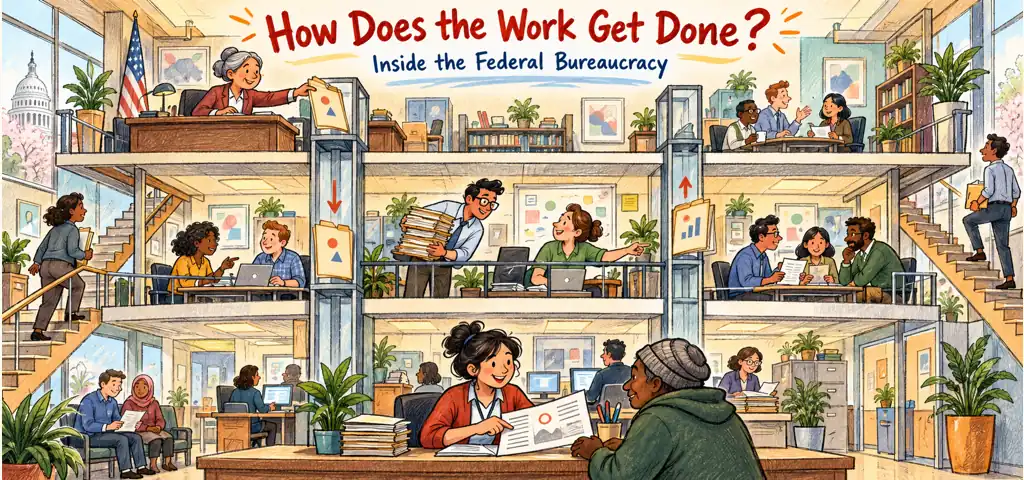
Bureaucratic hierarchy arranges offices in levels of authority. Senior leaders set lawful priorities, managers translate them into assignments, supervisors review performance, and frontline employees carry out particular tasks. No department head can personally process millions of applications or inspect thousands of sites, so authority and work must be delegated down a chain.
Hierarchy solves coordination problems. It identifies who may approve a decision, gives employees a route for questions, and lets leaders compare results across offices. Written procedures and reporting systems make similar cases more consistent. When something fails, the chain can also help locate whether the cause was an unlawful directive, poor management, weak training, or a frontline error.
A closer look at how the federal bureaucracy works
The same structure can distort information. Employees may soften bad news before sending it upward. Senior instructions can lose detail as they move through several offices. Specialized units may protect their own goals and fail to coordinate with neighbors. A leader can announce a clear national priority while field offices interpret it differently because resources and local conditions vary.
Hierarchy does not eliminate discretion. A supervisor cannot write a rule for every unusual fact a benefits specialist or inspector will face. Frontline employees often decide how a general standard applies to a person, which case is urgent, or what evidence requires follow-up. Supervision, records, review, and training aim to make that judgment consistent with law rather than pretending judgment is absent.
How the Federal Bureaucracy Works: what the rule leaves unsettled
Worked scenario. An agency head orders faster decisions on emergency claims. Regional managers assign additional teams, supervisors identify eligible urgent cases, and caseworkers apply the statutory criteria. If one office approves every claim while another rejects similar evidence, hierarchy provides a path for comparison and correction. It does not authorize the agency head to discard the eligibility law in pursuit of speed.
Do not confuse hierarchy with the civil service. Hierarchy describes relationships of supervision. Civil service describes much of the career workforce, and the merit system describes how covered personnel decisions should be made. A political appointee can stand above career employees in the same lawful chain of command.
Check your understanding of how the federal bureaucracy works
Write two sentences about how the federal bureaucracy works: one for the governing rule and another for the fact that triggers it.
Video lesson: How the Federal Bureaucracy Works
CrashCourse gives a focused explanation of this topic in Bureaucracy Basics: Crash Course Government and Politics #15.
If the player does not load, watch this lesson directly on YouTube.
Connect this lesson to the larger course
For a broader map connecting how the federal bureaucracy works to Congress, the presidency, the courts, and the bureaucracy, use the AP U.S. Government and Politics learning hub.

Related to This Article
More math articles
- Supporting Details
- FREE SAT Math Practice Test
- How to Make Math Lessons More Engaging?
- Top 10 Pre-Algebra Practice Questions
- AP Business with Personal Finance Exam: How to Study From the Course Framework (2027 Prep)
- Illinois IAR Grade 8 Math Worksheets: 72 PDF Links
- Arkansas ATLAS Grade 6 Math Free Worksheets: Free PDF Worksheets with Friendly Answer Keys
- Points, Lines, and Rays for 4th Grade
- The Best Grade 8 ELA Practice Tests for Wyoming Students
- Free SBAC Grade 5 Math Worksheets: 49 Printable Smarter Balanced–Style Practice PDFs with Answer Keys






















What people say about "How the Federal Bureaucracy Works"?
No one replied yet.