First Amendment Freedom of the Press
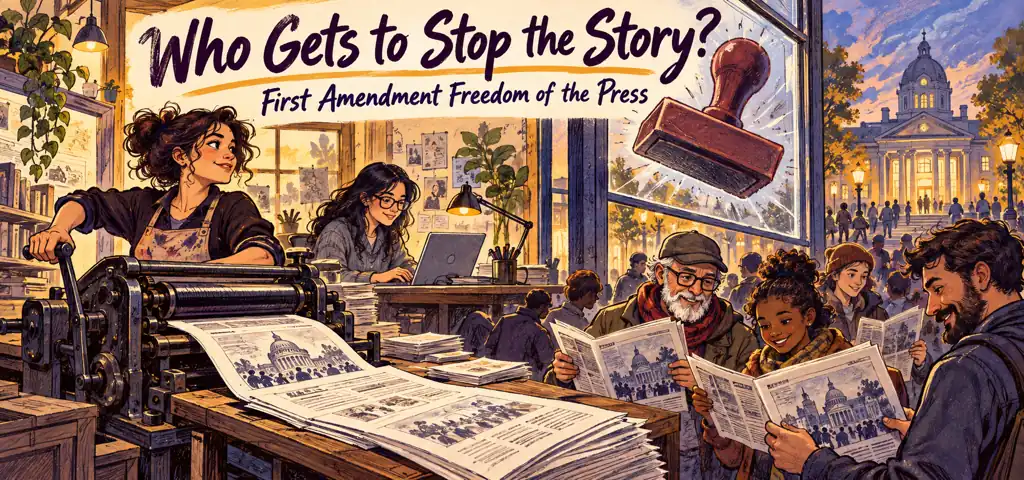
Freedom of the press protects the ability to investigate, publish, and distribute news, criticism, and opinion without government censorship or retaliation for viewpoint. The protection supports public oversight: citizens often learn what officials have done through reporters, editors, documentary makers, and independent publishers. It is not confined to owners of traditional printing presses. An individual writer or digital publisher can perform the same communicative function. Protection is strongest when government tries to stop publication in advance or singles out a publication because officials dislike its reporting. A discriminatory tax aimed at a small group of newspapers, denial of a generally available benefit based on editorial position, or regulatory threat designed to silence coverage raises serious First Amendment concerns.
The Press Clause does not create a class of citizens exempt from generally applicable law. News organizations remain subject to ordinary taxes, labor rules, property law, contracts, and constitutionally valid defamation judgments. A neutral rule does not become invalid merely because compliance costs a newspaper money, although a law’s design and selective application may reveal that the true reason is to burden the press. Editorial independence also matters. Government ordinarily cannot force a private newspaper to print a political candidate’s reply or dictate the balance of its opinion pages. The First Amendment limits government compulsion as well as direct censorship. A private editor’s refusal to publish a letter, however, ordinarily is the newspaper’s own choice rather than government action.
A practical reading of first amendment freedom of the press
Newsgathering and publication should be analyzed separately. The right to publish lawfully obtained information does not automatically create a right to trespass, steal records, enter every government facility, or ignore a valid courtroom rule. The First Amendment does not itself open every agency file or meeting, although constitutions, statutes, and court-access doctrine may provide particular rights of access. Nor did Branzburg v. Hayes recognize a universal First Amendment privilege allowing reporters to refuse every grand-jury demand for source information. Legislatures and state law may provide shield protections, but the constitutional claim is not absolute.
First Amendment Freedom of the Press: a common mistake
A state applies its ordinary sales tax to every business, including newspapers. The press bears a neutral rule along with others. If the state instead taxes only newspapers above a chosen circulation threshold after they criticize the governor, the selective structure and governmental reason matter. If an official seeks an injunction stopping the next issue, prior-restraint doctrine also applies. Four claims must remain separate: censorship of publication, discriminatory burdens, access or newsgathering, and exemption from ordinary law. Freedom of the press gives powerful protection against government suppression. It does not guarantee all requested information, immunize every gathering method, or excuse actionable falsehoods.
Apply the lesson on first amendment freedom of the press
For Press freedom, classify the speech, forum, speaker, and restriction before choosing the applicable First Amendment standard. Give one concrete example.
Check your reasoning
Freedom of the press protects publication from censorship and discriminatory burdens but does not create immunity from generally applicable laws or guarantee access to every government record. In a traditional public forum, government may impose content-neutral limits on when, where, and how expression occurs if the rules are narrowly tailored to serve a significant governmental interest and leave ample alternative channels.
Video lesson: First Amendment Freedom of the Press
CrashCourse gives a focused explanation of this topic in Freedom of the Press: Crash Course Government and Politics #26.
If the player does not load, watch this lesson directly on YouTube.
Connect this lesson to the larger course
For a broader map connecting first amendment freedom of the press to civil liberties, civil rights, and equal protection, use the AP U.S. Government and Politics learning hub.

Related to This Article
More math articles
- ACT Math Flashcards (Free Online: Formulas, Terms & Concepts)
- 7th Grade NYSE Math Worksheets: FREE & Printable
- The Best Grade 7 ELA Practice Tests for New York Students
- Triangles
- Registration requirements
- Parallel Sides in Quadrilaterals for 4th Grade
- 4th Grade Georgia Milestones Assessment System Math Worksheets: FREE & Printable
- A Comprehensive Collection of Free SHSAT Math Practice Tests
- 6th Grade LEAP Math Worksheets: FREE & Printable
- Banks, Reserves, and Deposit Expansion


















What people say about "First Amendment Freedom of the Press"?
No one replied yet.