Casino Influencer Wins, Variance, and What You Don’t See on Camera
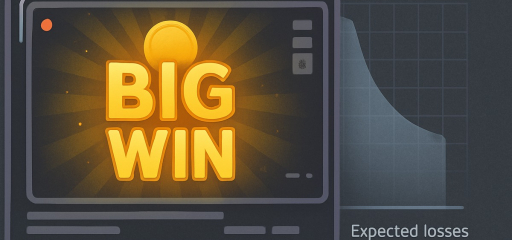
TL;DR: Casino-streaming clips of huge wins look like skill but are almost always pure variance, the statistical noise around a long-run negative expected value. The math is the same whether you’re playing slots, watching a streamer, or shaping a household budget: short runs hide the true average, and only long runs reveal it.
Key takeaways:
- Expected value (EV) is the long-run average outcome of a random process, weighted by probability.
- Variance measures how widely individual outcomes scatter around that average, high variance means big wins AND big losses are both common.
- A streamer’s highlight reel is a survivorship-biased sample; thousands of losing spins live off-screen.
- The gambler’s fallacy, the belief that a streak \”has to\” reverse, has no basis in independent random events.
- The same EV/variance lens applies to investing, insurance, and any decision under uncertainty.
You’ve seen the clips. A streamer pulls a $50,000 bonus round on a slot, screams into a microphone for ninety seconds, and the chat scrolls so fast it blurs. By the next morning the clip has eight million views on TikTok and Twitter, and somewhere a sixteen-year-old is convincing himself that gambling is actually a viable side hustle. I’ve been watching this content cycle play out for a few years now, and the gap between what’s on screen and what’s actually happening on the spreadsheet is one of the wildest disconnects in modern entertainment. Let’s walk through the math.
What a Streamer’s Session Actually Looks Like on Paper
When someone like Vegas Matt, Roshtein, Trainwreckstv, or Adin Ross sits down for a four-hour slots session, the on-camera highlight reel hides an enormous amount of churn. The volume is the thing nobody talks about. A typical high-stakes slot streamer is spinning at roughly 8 spins per minute (slots are designed to be fast), and bet sizes hover anywhere from $25 to $500 depending on the channel and the sponsor. A four-hour stream at $50/spin works out to 1,920 spins and roughly $96,000 in turnover, and that’s a single session.
Here’s where it gets uncomfortable for the “look at this amazing win” framing. On a 96% RTP slot, the house edge is 4%. So $96,000 × 4% = $3,840 in expected loss for that one stream. Do that five nights a week and you’re looking at almost a million in turnover and around $20,000 in expected losses per week, before you factor in the wild swings that variance creates around that average.
Hourly Session Math Across Common Streamer Stakes
I built the table below from the kind of numbers you’d see if you actually clocked spin rates on a few popular channels. It’s not perfectly precise, bet sizes get bumped mid-session, bonus rounds slow things down, but it’s accurate enough to make the point.
| Bet/Spin | Spins/Hour | Hourly Turnover | Expected Loss/Hour (4% edge) | 1-Sigma Swing (≈) | 4-Hour Session Turnover |
|---|---|---|---|---|---|
| $25 | 480 | $12,000 | $480 | ±$8,500 | $48,000 |
| $50 | 480 | $24,000 | $960 | ±$17,000 | $96,000 |
| $100 | 480 | $48,000 | $1,920 | ±$34,000 | $192,000 |
| $250 | 420 | $105,000 | $4,200 | ±$80,000 | $420,000 |
| $500 | 360 | $180,000 | $7,200 | ±$140,000 | $720,000 |
Look at the swing column. At $500/spin, a one-standard-deviation move per hour is $140,000. That means a perfectly “normal” session can easily land at +$200k or −$150k without anything unusual happening from a probability standpoint. So when you see a streamer cash a $300,000 hit on a Friday night, it’s not evidence of a hot streak or a loose game. It’s the math doing exactly what it’s supposed to do on the right tail of a very wide distribution.
The Selection Bias Nobody Mentions
This is the part that really bugs me, and it’s the cleanest piece of statistical sleight-of-hand on the internet right now. When a streamer’s clip channel posts “BIGGEST WIN EVER,” you’re seeing the right tail of thousands of spins. The other 95% of the session, the long stretches of $50 dribbling away on dead spins, the brutal bonus round that paid back $4 on a $50 trigger, almost never gets clipped, edited, or thumbnailed.
I’m not saying these streamers are lying. I’m saying the format itself selects for survivorship. A clip of someone losing $40,000 over three hours doesn’t go viral. A 90-second cut of a $1.2M bonus round absolutely does. So the population you’re being shown is, by construction, the winners’ tail of a distribution where the average outcome is negative. This is the same statistical trick that makes day-trading content so dangerous. You don’t see the 70% who blew up their accounts, you see the loud 5% who didn’t.
The Money Isn’t Always Theirs
Here’s the piece most viewers genuinely don’t know about: a large chunk of top-tier casino streamers operate under operator sponsorship deals, and those deals can look very different from what’s implied on screen. Reporting around the Mikki Mase baccarat story, covered in detail at PokerNews, laid out how high-volume players sometimes receive house credit, rakeback, comped suites, and outright cash deals to play and to be seen playing. Disclosures from Kick streamers in 2023 and 2024 surfaced sponsorship structures ranging from mid-six-figure monthly stipends to bankroll fronting arrangements where the streamer doesn’t carry the full downside.
That changes the math in a way the viewer can’t see. If a streamer is fronted $500,000 a month plus rakeback, and they “lose” $200,000 of it on stream while generating ad revenue and affiliate signups, their personal P&L can still be wildly positive. The losses you’re watching may be operator capital being routed through an entertainer to acquire customers who think they’re watching an honest gambler. I want to be careful here, not every streamer has this structure, and some are absolutely playing their own money. But enough of them have these arrangements that you should never assume the on-screen number is the personal number.
Comps, Cashback, and the Real Net Cost
Even when a streamer is playing their own bankroll, the casino isn’t charging them retail. High-volume players sit at the top of every loyalty tier the property offers, and the perks compound fast.
- Cashback: Top-tier players routinely get 5 to 15% loss rebates from online operators. On the $3,840 expected loss from earlier, a 10% rebate cuts $384 right off the top.
- Comp dollars: Land-based properties run point systems that translate theoretical loss into resort credit. A $96,000-turnover session can generate hundreds in points per visit.
- Suite and travel comps: Charter flights, penthouse comps, restaurant credit, show tickets, none of it lines the streamer’s pocket directly, but every comped night is a night not paid out of pocket.
- Reduced rake or juice: On table games and poker, hosted players often get reduced commission or rake-free hours.
- Custom limits: The ability to bet sizes most viewers literally cannot access at any other casino, which itself is a kind of compensation.
Stack all of that together and a streamer’s “true” net cost per session is often 30 to 50% lower than what the on-screen P&L shows. The casino is happy to absorb that because the marketing value of a viral $1M win clip is worth far more than the rebate.
A Worked Example You Can Actually Trust
Let’s run a clean example end-to-end so the numbers stop being abstract.
A streamer plays $50/spin at 8 spins per minute for 4 hours: 1,920 spins × $50 = $96,000 turnover. On a 96% RTP slot, expected loss is $96,000 × 0.04 = $3,840. So far, so simple. The variance on a single spin of a high-volatility slot can be 5 to 10× the mean, and when you compound that over 1,920 spins, the one-sigma swing around the $3,840 expected loss lands somewhere in the $15,000, $25,000 range depending on the specific game.
Translate that into a session-by-session expectation: about two-thirds of sessions will land between roughly −$28,000 and +$20,000. The remaining third produce the headline-worthy outcomes in both directions. Now layer in a 10% cashback rebate (saving $384 in expectation), $1,500 in comped travel and food across a typical visit, and an operator sponsorship that pays $30,000/month flat regardless of results. The “I lost $4,000 tonight, guys” stream you just watched might be a $5,000+ net positive for the streamer once you actually do the accounting.
Why This Content Is So Optimized for Engagement
Quick aside, because I think it’s the most interesting part of the whole phenomenon. Casino streams are, structurally, the most optimized engagement-per-second format on the internet right now. They’ve got a slot-machine schedule of reinforcement built directly into the source material, variable ratio reward, unpredictable jackpots, the dopamine hit of a near-miss every 30 seconds. You don’t have to be a clever editor to make a slots clip pop; the game does the work. Compare that to, say, a chess stream where the engagement curve requires actual narrative arc and the editor has to manufacture tension. With slots, the spinning reels are the tension. Every spin is a potential clip, which means creators effectively get hundreds of “story beats” per hour for free.
This is why I think the format is so dangerous, and why I find the “but it’s just entertainment” defense pretty weak. Entertainment that’s structurally indistinguishable from an advertisement for a regulated product, without the disclosures that actual ads require, is a category we don’t really have rules for yet. And the audience skews young. That’s a problem.
What the Viewer Should Actually Take Away
If you’re watching this content for fun, that’s fine. People watch poker, people watch sports betting, gambling-as-spectacle has been around since the first dice game. The problem is when viewers treat the streams as a model for their own play. A streamer with operator sponsorship, comped bankroll, cashback, and a $30k/month floor is not running the same experiment you’d run with your own paycheck. The expected loss is the same percentage; the ability to absorb variance is wildly, wildly different.
If gambling stops being recreational for you or someone you care about, the National Council on Problem Gambling maintains a 24/7 helpline and treatment directory at ncpgambling.org/help-treatment/. And if you want to keep sharpening the underlying probability and EV math that this whole post leans on, there’s a deep library of approachable explainers over at Effortless Math that’s worth bookmarking.
FAQ
Are streamer wins fake or rigged? Generally no, the games themselves are typically the same regulated titles available to retail players, and rigged feeds would draw regulatory action fast. The deception isn’t in the spins, it’s in what’s left out of the frame: sponsorship structure, comped bankroll, and selection bias on which sessions you see.
Can a streamer actually win long-term on negative-EV games? On the games themselves, no, RTP is RTP and the math doesn’t care who’s spinning. Long-term profit comes from the sponsorship layer (ad revenue, operator deals, affiliate cuts) sitting on top of the gambling layer, not from beating the games.
Why do the swings look so massive? High-volatility slots have per-spin standard deviations that are several multiples of the average bet. Over thousands of spins those swings compound into five- and six-figure session results in either direction, even though the long-run expectation is a steady drip of losses at the house edge.
What’s a realistic loss rate for a $50/spin viewer trying to imitate this? Roughly $1,000 per hour in expectation at 480 spins per hour and a 4% edge, and without the cashback, comps, and sponsorship offsetting it. That’s the honest comparison most clips don’t make.
Is “provably fair” or “regulated” enough of a guarantee? Those certifications tell you the random number generation works and the RTP is what it claims. They tell you nothing about whether the session you’re watching represents the streamer’s typical results or whether they’re playing with their own money.
Closing Thought
I’ll wrap with the practical version. Streamer slot content is content first, gambling second. The math we just walked through, turnover, expected loss, variance bands, comps, sponsorship, is the actual engine running underneath the highlight reel. Once you’ve seen the numbers, the clips don’t really land the same way. A $300k win on a $500 spin stops looking like a miracle and starts looking like a one-sigma outcome on the right side of a distribution that, on average, was always going to bleed money. Watch it for the spectacle if you want. Just don’t take notes.
Frequently Asked Questions
What is expected value?
The expected value of a random outcome is the long-run average you’d see if you ran the experiment infinitely many times, each outcome weighted by how likely it is. For a fair coin paying \(\$1\) on heads and \(-\$1\) on tails, the EV is \( 0.5 \times 1 + 0.5 \times (-1) = \$0 \).
What is variance?
Variance is the average squared distance of outcomes from the mean, a measure of how spread out the results are. Two games can share the same expected value but very different variance. A coin flip and a lottery that pays \(\$1{,}000{,}000\) one time in two million both can have similar EV, but the lottery has astronomically higher variance.
Why are casino games negative expected value?
Casinos build a small mathematical edge into every game, called the \”house edge.\” On American roulette, for example, the house edge is about 5.26%, so the expected value per dollar bet is roughly \( -\$0.0526 \). Over enough trials, that small per-bet deficit compounds into reliable profit for the casino.
How can a streamer hit massive wins if the EV is negative?
High variance. Slot machines in particular are designed for very large outcome ranges, meaning huge single-session wins are entirely consistent with a long-run negative expected value. Over thousands of spins, the streamer almost certainly loses money; over a short window, anything is possible.
What is survivorship bias and how does it apply to streaming clips?
Survivorship bias is the error of drawing conclusions from only the visible \”survivors\” of a process, ignoring the failures, which are statistically the majority. Viral big-win clips are the few sessions worth recording; the hundreds of losing sessions never get posted, so the audience sees a wildly skewed sample of reality.
What is the gambler’s fallacy?
It’s the (false) belief that past outcomes affect the probability of future independent events, \”red has hit five times in a row, so black is due.\” In independent random events, each trial has the same probability as the last. Roulette spins don’t remember previous spins.
What’s the law of large numbers?
It says that as the number of trials of a random experiment grows, the observed average converges on the expected value. Ten coin flips can produce 7 heads; ten thousand coin flips will be very close to 5,000. The casino’s long-run profit margin is the law of large numbers in slow motion.
Does \”hot streak\” thinking apply to anything besides gambling?
It shows up everywhere random-looking results matter: sports performance, investing returns, viral content, and small-business luck. People consistently over-interpret short streaks. The fix is to ask \”what’s the underlying base rate?\” before drawing any conclusion from a small sample.
What math class teaches this material?
The foundations sit in middle and high school statistics and probability, Common Core 7.SP and 6.SP at the introductory level, then deeper in Algebra II and AP Statistics with expected value, standard deviation, and the binomial distribution. The intuition is accessible even before the formulas land.
How do I talk to a teenager about these clips?
Start with the math, not the morality. Show how to calculate the expected value of one spin, multiply by how many spins they’d need to watch to see the average emerge, and then notice that the streamer’s session is a fraction of that. The numbers do the persuading on their own.
Related Lessons You May Like
- How to find the probability of an event
- How to solve probability problems
- How to find the measures of central tendency
- How to find experimental probability
- How to solve conditional and binomial probabilities
If you want a friendly introduction to probability and statistics that builds the intuition before the formulas, Pre-Algebra for Beginners covers the prerequisites and includes a probability chapter. For the deeper distributions, expected value, and combinatorics, Algebra II for Beginners goes further.

Related to This Article
More math articles
- How to Solve Word Problems of Absolute Value and Integers?
- How to Graph Linear Equations: Every Form, Step by Step for 2026
- How is the TABE Test Scored?
- Supermarket Sweep: How to Choose the Better Coupon in Aisle 7!
- 3rd Grade RISE Math Worksheets: FREE & Printable
- Free Grade 6 English Worksheets for Kansas Students
- ASWB Three-Option Questions: Use Evidence to Eliminate a Distractor (2027 Prep)
- The Ultimate SBAC Algebra 1 Course (+FREE Worksheets)
- How to Identify Rational and Irrational Numbers?
- How to Help Your 5th Grade Student Prepare for the North Carolina EOG Math Test







What people say about "Casino Influencer Wins, Variance, and What You Don’t See on Camera - Effortless Math"?
No one replied yet.