The Best Grade 2 Math Worksheets for Alaska Students
The Best Grade 2 Math Worksheets for Alaska Students: a free, printable set you can download and use right away, with answer keys, organized by topic so students can practice one skill at a time and teachers can assign exactly what a lesson needs.
Free printable practice to help your Alaska second grader grow into a confident math thinker.
Ask a second grader what time it is and watch what happens. They tilt their head at the clock, mouth the numbers, count the little marks by fives, and then announce, with real pride, “It’s three forty!” That small triumph, reading a clock without help, is one of dozens of skills that quietly come together in second grade.
If you’re raising or teaching a second grader in Alaska and you want practice that’s clear, friendly, and genuinely useful, this set of Grade 2 math worksheets was made for you. They’re free. They’re printable. Each one is a PDF with a complete answer key included, and there’s nothing to sign up for. Print a page from a cabin in the Interior, a home in Anchorage, or a classroom in a coastal village, and you’re set.
Second grade is the year numbers really stretch out. Kids go from counting objects on a table to picturing numbers up to 1,000. They get fast at addition and subtraction, they start measuring with rulers, counting coins, reading graphs, and finding patterns in arrays. It’s a year of “oh, I get it now” moments.
These worksheets follow the Grade 2 math standards Alaska has adopted, and they’re laid out in a way that lets you go skill by skill, at whatever pace fits your child.
What You’ll Find in the Collection
Everything is sorted into eight chapters, each one covering a major slice of second grade math. The topics within a chapter build naturally, but the chapters themselves stand on their own. Start where it makes sense for your child.
Each worksheet opens with a short Key Ideas box that explains the skill simply, gives a worked example or two, and then offers practice problems. The answer key sits at the bottom of every page. Here’s the whole collection.
Place Value and Number Sense
- Understanding Place Value, The idea that a digit’s spot decides its value, hundreds, tens, and ones.
- Reading and Writing Numbers to 1,000, Moving smoothly between number words and digits.
- Expanded Form, Showing 638 as 600 + 30 + 8 so the parts are clear.
- Skip Counting, Counting in steps of 5, 10, and 100, a habit that pays off everywhere.
- Comparing and Ordering 3-Digit Numbers, Using greater than and less than, then sorting numbers in order.
Addition and Subtraction
- Addition Facts Within 20, Building quick recall of the core sums.
- Subtraction Facts Within 20, The take-away partners, practiced toward automatic speed.
- Adding Within 100, Two-digit addition, regrouping included.
- Subtracting Within 100, Two-digit subtraction with borrowing, broken down clearly.
- Adding Within 1,000, Three-digit addition, one step at a time.
- Subtracting Within 1,000, Three-digit subtraction with careful scaffolding.
- Mentally Adding and Subtracting 10 and 100, Jumping by tens and hundreds in your head.
Word Problems and Equations
- One-Step Word Problems, Reading a short story and solving it with one operation.
- Two-Step Word Problems, Two-part problems that reward a little planning.
- Finding the Unknown Number, Solving for the missing value in an equation.
Odd, Even, and Arrays
- Odd and Even Numbers, Sorting numbers by whether they pair up evenly.
- Even Numbers as Equal Addends, Seeing an even number as two equal groups added together.
- Rectangular Arrays, Placing objects in rows and columns for faster counting.
- Repeated Addition with Arrays, Adding equal rows over and over, the runway to multiplication.
Measurement and Length
- Measuring Length with Tools, Lining up a ruler properly and reading it correctly.
- Estimating Lengths, Guessing a length first, then measuring to check.
- Comparing Lengths, Working out how much longer or shorter one thing is.
- Adding and Subtracting Lengths, Solving length problems by combining measurements.
- Length on a Number Line, Picturing distance as movement along a number line.
Time and Money
- Telling Time to the Nearest Five Minutes, Reading clocks down to the five-minute mark.
- A.M. And P.M., Telling morning hours from evening hours.
- Counting Coins, Adding up mixed coins to find a total.
- Money Word Problems, Working out totals and change in real-life situations.
Data and Graphs
- Line Plots, Marking measurements above a number line.
- Picture Graphs, Reading graphs where a picture stands for several items.
- Bar Graphs, Comparing groups with bars and answering questions about them.
Geometry
- Recognizing and Drawing Shapes, Identifying and sketching shapes by their features.
- Partitioning Rectangles into Rows and Columns, Dividing a rectangle into equal squares.
- Equal Shares: Halves, Thirds, and Fourths, Splitting shapes into equal parts, a soft introduction to fractions.
How to Use These Worksheets Well
These pages work best with a little structure. The goal isn’t to fill a binder, it’s to build understanding that stays put.
Stick to one worksheet at a time. Second graders concentrate well in short bursts, and one carefully done page beats a thick stack done in a hurry. Before the pencil moves, read the Key Ideas box together out loud. Then go through the worked examples as a team, so your child sees the method in action before trying it solo.
When the page is finished, sit down and check the answer key together. Treat mistakes as clues. Ask, “Can you show me how you did this one?” More often than not, the answer reveals exactly where the thinking slipped, and that’s a fixable thing.
Last tip: circle back. If estimating lengths felt wobbly this week, hand your child a fresh worksheet on it next week. Spacing practice out a little is one of the simplest ways to make a skill permanent.
A Word About the AK STAR Assessment
Alaska measures student progress with AK STAR, the Alaska System of Academic Readiness. The good news for second grade families: AK STAR math testing starts in third grade. Your second grader won’t take a state math assessment this year.
That makes this a no-pressure year, and a really valuable one. Second grade is the foundation. Every skill in these worksheets, place value, fact fluency, careful word-problem reading, measurement, graphs, is exactly what the third grade test later builds on. A child who leaves second grade steady with this material starts third grade with room to breathe.
So think of this year as laying groundwork, not preparing for an exam. Calm, regular practice now turns into confidence when AK STAR finally comes around.
Frequently Asked Questions
Is there really no cost or signup?
None at all. Every worksheet is a free PDF you can print straight away. No payment, no membership, no email required.
What if my child gets stuck on a worksheet?
Stop and go back to the Key Ideas box and the examples together. Sometimes re-reading the method out loud is all it takes. If it’s still hard, set the page aside and revisit it another day.
How many worksheets should we do in a week?
Two or three solid sessions a week works well for most families. Consistency beats volume. A short page done with focus is worth more than a long one done while distracted.
Do these match what’s taught in Alaska classrooms?
Yes. The topics follow the Grade 2 math standards Alaska has adopted, so they reinforce what your child is already seeing at school.
Can I use these for summer practice?
They’re perfect for it. A worksheet or two a week over the summer keeps skills sharp without feeling like extra school.
A Strong Start, One Page at a Time
Your Alaska second grader has a whole year of “I figured it out” moments ahead, with coins, clocks, rulers, and three-digit numbers. These free worksheets are here to make those moments easier to reach. Pick a chapter that fits where your child is right now, print a page, and settle in together. Steady, friendly practice is all it takes to build a math foundation that holds.
Ready for Grade 3 Math? The Alaska Grade 3 Math Bundle
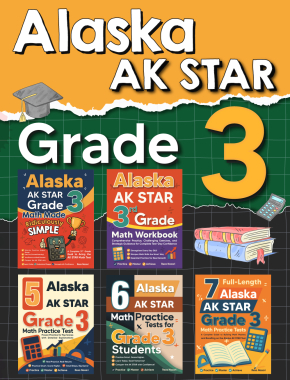
Second grade is the build-up year, and when your child is ready for what comes next, this bundle makes the jump to Grade 3 math feel easy. It packs full practice-test books, complete answer keys, and step-by-step explanations for the Grade 3 math skills just ahead.
Getting Ready for Grade 3 English, Too? The Alaska Grade 3 English Bundle
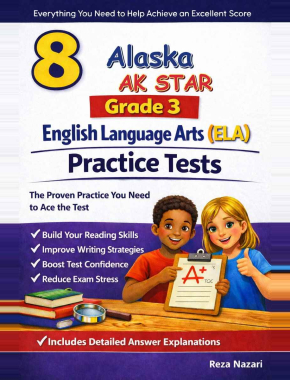
Reading and writing grow right alongside math. If your second grader could use a head start in English as well, this Alaska Grade 3 English bundle covers it — practice tests, answer keys, and friendly explanations in one download.

Related to This Article
More math articles
- How to Pass the ASVAB Math Section & Boost Your AFQT (2026)
- Plains Warfare, Reservations, and the Destruction of the Buffalo
- Free Grade 8 English Worksheets for Vermont Students
- 49 Free Grade 3 Math Worksheets for Connecticut SBAC Prep, Built Around the Real Skill List
- Earth, Moon, and Sun: Days, Seasons, Phases, and Tides
- The Ultimate ISEE Lower-Level Math Course (+FREE Worksheets & Tests)
- 10 Most Common ASVAB Math Questions
- How to Solve Systems of Equations: 3 Methods Explained
- Best SAT Math Prep Books
- Free Grade 3 English Worksheets for Wyoming Students








What people say about "Alaska Grade 2 Math Worksheets: Free PDFs"?
No one replied yet.