The competitive quantity maximizes total surplus under key assumptions
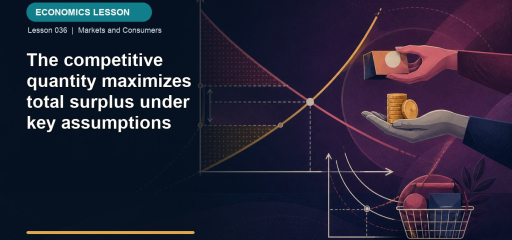
The competitive quantity maximizes total surplus under key assumptions: this Effortless Math guide explains the topic in plain language, shows how it works through solved examples, and gives you free practice to try immediately, so the idea sticks instead of staying abstract.
Include units whose marginal benefit is at least marginal cost.
When demand equals marginal social benefit and supply equals marginal social cost, every unit before equilibrium has benefit greater than cost. Every unit beyond equilibrium costs more than buyers value it. The equilibrium quantity therefore maximizes consumer plus producer surplus.
The phrase “under key assumptions” is essential. In a competitive market, no buyer or seller controls price. If demand captures all marginal social benefits and supply captures all marginal social costs, the intersection MB=MC identifies the quantity where net gains stop increasing. Units to the left create positive surplus. Units to the right would create negative surplus.
This is allocative efficiency. Productive efficiency means output is produced at the lowest feasible cost. Competitive long-run equilibrium in the standard model can achieve both, but the terms are not synonyms. A firm can produce a chosen quantity at minimum cost while the market still produces the wrong total quantity because of monopoly or an externality.
This efficiency result depends on competition and the absence of externalities or other failures. A pollution externality makes market supply understate social cost. A monopoly restricts quantity below the competitive level. The graph may look familiar, but the relevant curves differ.
A positive externality makes market demand understate marginal social benefit, so the private equilibrium quantity is too low. A negative production externality makes private supply understate marginal social cost, so the private equilibrium quantity is too high. The efficiency rule remains MSB=MSC. The error lies in using incomplete private curves.
The last efficient unit
The fourth unit has willingness to pay $18 and seller cost $15, so it creates $3 of surplus. The fifth has willingness to pay $14 and cost $17, destroying $3 if produced. The efficient quantity is four units.
For indivisible units, inspect the surplus contribution of each successive trade and stop after the final nonnegative contribution. Do not average the fourth and fifth rows or insist on an exact equality. The efficient boundary can fall between them. Adding the fifth would reduce total surplus even though its benefit is positive.
| Unit | Marginal benefit | Marginal cost | Added surplus |
|---|---|---|---|
| 1 | $28 | $8 | $20 |
| 2 | $23 | $12 | $11 |
| 3 | $18 | $16 | $2 |
| 4 | $13 | $20 | -$7 |
The efficient quantity is three and total surplus is $33. Producing four units would lower total surplus to $26. Total benefit would still rise by $13, but total cost would rise by $20. Efficiency follows the marginal difference.
Market equilibrium also determines who trades. In a well-functioning competitive market, units go to buyers with the highest willingness to pay and are produced by sellers with the lowest costs. A price control can reduce quantity or misallocate units even when a legal price looks favorable to one side.
Use social curves when the question asks for efficiency
Private equilibrium is efficient only when private marginal benefit and cost include all relevant social effects. If a spillover is stated, locate MSB and MSC before choosing the quantity.
Efficiency therefore depends on what the curves measure, not merely on whether two curves intersect.
In a competitive market without externalities, the efficient quantity includes units for which
- price is below marginal cost
- marginal benefit is at least marginal cost
- producer surplus is zero
- consumer surplus is evenly distributed
- average benefit equals average cost
marginal benefit is at least marginal cost Each unit adds to total surplus when marginal benefit covers marginal cost. Units beyond that point destroy surplus.
A pollution tax is set below marginal external cost at the efficient quantity. Other things equal, the resulting output will likely be
- below the efficient quantity
- zero
- exactly efficient
- unrelated to the tax
- above the efficient quantity
above the efficient quantity An insufficient tax leaves private marginal cost below social marginal cost, so too many units are produced.
The marginal benefit of the fifth unit of a service is $28, and its marginal cost is $31. A decision maker maximizing net benefit should
- buy the unit because total benefit may exceed total cost
- buy the unit if average benefit exceeds average cost
- ignore marginal cost once four units have been purchased
- buy the unit because its marginal benefit is positive
- stop before the fifth unit
stop before the fifth unit The fifth unit would add $28 of benefit but $31 of cost, reducing net benefit by $3. The decision should stop at four units.
Watch the idea in action
A focused video lesson from Khan Academy.

Reza is an experienced Math instructor and a test-prep expert who has been tutoring students since 2008. He has helped many students raise their standardized test scores--and attend the colleges of their dreams. He works with students individually and in group settings, he tutors both live and online Math courses and the Math portion of standardized tests. He provides an individualized custom learning plan and the personalized attention that makes a difference in how students view math.
Related to This Article
More math articles
- Other Topics Puzzle – Challenge 99
- DAT Quantitative Reasoning Math Worksheets: FREE & Printable
- Recruiting candidates
- 3rd Grade ACT Aspire Math Worksheets: FREE & Printable
- How to Find Missing Angles of Triangles
- 10 Most Common 8th Grade PSSA Math Questions
- FREE 5th Grade PARCC Math Practice Test
- Distance, Rate, and Time Problems: Six Worked Examples
- Top 10 Free Websites for ISEE Math Preparation
- Grade 3 Math: Multiplication Facts (0-5)





















What people say about "Why Competitive Quantity Maximizes Total Surplus"?
No one replied yet.