Shortage and surplus describe plans at a price
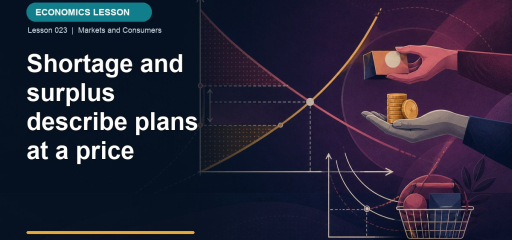
Shortage and surplus describe plans at a price: this Effortless Math guide explains the topic in plain language, shows how it works through solved examples, and gives you free practice to try immediately, so the idea sticks instead of staying abstract.
Subtract the smaller planned quantity from the larger one.
At a price below equilibrium, quantity demanded exceeds quantity supplied. Buyers compete for too few units, inventories disappear, and price tends to rise. At a price above equilibrium, sellers offer more than buyers plan to purchase. Unsold inventories create pressure to reduce price. These are tendencies in the basic model. Contracts, menu costs, or regulation can slow actual adjustment.
Equilibrium coordinates plans. It does not mean that every buyer obtains all desired units or every seller is pleased with the price. At the equilibrium price, the total quantity buyers plan to purchase equals the total quantity sellers plan to offer. No unplanned inventory change creates pressure for the market price to move in the basic model.
Shortage and surplus are measured at a specified price, not across two different rows. Write both planned quantities at that price, identify which is larger, and subtract. A shortage is Qd-Qs when positive. A surplus is Qs-Qd when positive. The words describe a gap between plans, not the physical number of goods on a shelf.
If at $6 buyers want 90 units and sellers offer 55, the shortage is 90-55=35 units. Do not report 90, 55, or their sum. At the equilibrium price the shortage and surplus are both zero because the planned quantities are equal.
Price pressure follows the side that cannot carry out its plan. During a shortage, some buyers bid more or search harder, encouraging a higher price and additional quantity supplied while reducing quantity demanded. During a surplus, sellers cut price or reduce production, encouraging more quantity demanded and less quantity supplied. Both movements close the gap along the existing curves when no determinant has changed.
| Trial price | Planned relationship | Adjustment pressure |
|---|---|---|
| Below equilibrium | Qd>Qs. Shortage | Price tends to rise |
| At equilibrium | Qd=Qs | No imbalance-driven pressure |
| Above equilibrium | Qs>Qd. Surplus | Price tends to fall |
Read a row before naming the imbalance
At $9, buyers plan 74 units and sellers plan 92. The market has an 18-unit surplus, and downward price pressure follows. Calling 74 a shortage confuses quantity demanded with the difference between plans. Calling the situation a shortage because some buyers still want the good at lower prices ignores the price specified in the row.
Regulation can prevent the price adjustment. A binding price ceiling may hold price below equilibrium, causing the shortage to persist. A binding price floor may hold it above equilibrium, causing a persistent surplus. The imbalance logic is the same. The legal rule blocks the ordinary price movement.
Do not treat equilibrium as automatically efficient in every market. With externalities, market power, asymmetric information, or public goods, private demand and supply can omit relevant social values. Equilibrium still means private plans match at a price. Efficiency requires the correct marginal social benefit and cost.
During a shortage or surplus, do not shift a curve merely because price is adjusting. The price change causes movements along both existing curves until plans match. A curve shifts only if a determinant changes during the process. This distinction keeps the adjustment mechanism separate from the event that may have created the initial imbalance.
A market has excess supply at the current price. If price is free to adjust, which sequence moves the market toward equilibrium?
- Sellers raise price, reducing quantity demanded.
- Buyers bid price up, increasing quantity supplied.
- Sellers lower price, increasing quantity demanded and reducing quantity supplied.
- Demand shifts right until all inventories are sold.
- Supply shifts left by exactly the size of the surplus.
Sellers lower price, increasing quantity demanded and reducing quantity supplied. A surplus creates downward pressure on price. A lower price encourages purchases and discourages production until planned quantities match.
At a price of $18, quantity demanded is 90 and quantity supplied is 65. Which market pressure should occur?
- A surplus pushes price downward.
- Supply shifts right until the shortage disappears.
- A shortage puts upward pressure on price.
- Demand shifts left because buyers cannot find the good.
- Price remains fixed because planned quantities need not match.
A shortage puts upward pressure on price. Planned purchases exceed planned sales by 25 units, creating a shortage and pressure for price to rise.
At a price of $12, planned purchases exceed planned sales by 24 units. Each $1 price increase reduces the shortage by 8 units. The equilibrium price is
- $15
- $18
- $20
- $24
- $30
$15 A 24-unit shortage closes after three $1 increases because each increase reduces the gap by 8 units. The clearing price is therefore $15.
Watch the idea in action
A focused video lesson from Khan Academy.

Reza is an experienced Math instructor and a test-prep expert who has been tutoring students since 2008. He has helped many students raise their standardized test scores--and attend the colleges of their dreams. He works with students individually and in group settings, he tutors both live and online Math courses and the Math portion of standardized tests. He provides an individualized custom learning plan and the personalized attention that makes a difference in how students view math.
Related to This Article
More math articles
- Media ownership
- How to Help Your 5th Grade Student Prepare for the Rhode Island RICAS Math Test
- Areas Formed by Function Contours
- Multiplying & Dividing Integers Practice (Free)
- The Double V Campaign and the Second Great Migration
- 7th Grade NHSAS Math Worksheets: FREE & Printable
- How to Find The Derivative of A Function
- Nervous System and Reflexes
- Unit Conversion Practice — Length, Mass, Volume & Time (Free)
- How to Solve Finite Geometric Series? (+FREE Worksheet!)





















What people say about "Shortage and Surplus Explained"?
No one replied yet.