Scarcity creates tradeoffs
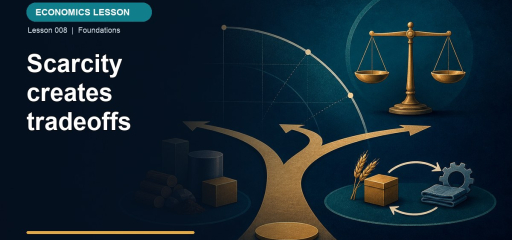
Scarcity creates tradeoffs: this Effortless Math guide explains the topic in plain language, shows how it works through solved examples, and gives you free practice to try immediately, so the idea sticks instead of staying abstract.
A resource can be abundant and still be scarce in the economic sense.
Air in ordinary conditions has a zero money price, but clean air can be scarce when production and transportation use its waste-absorbing capacity. A wealthy student faces scarce time. A government that can borrow still faces scarce labor, equipment, and future tax capacity. Scarcity is the general condition. A shortage is a specific market imbalance at a current price.
Scarcity begins with a comparison between wants and the resources available to satisfy them. It does not require that a resource be rare in nature or sold for money. Sunlight can be abundant while a sunny location at noon is scarce. Digital files can be copied at tiny marginal cost while the time, skill, and equipment required to create them remain scarce. Economic reasoning asks which limited resource constrains the choice and what alternative use must be displaced.
A shortage is narrower. It occurs when quantity demanded exceeds quantity supplied at the current price. A city can face scarce housing even when its rental market is in equilibrium. Scarcity is always present because land, labor, and materials have alternative uses. It faces a rental shortage only when planned rentals exceed available units at the prevailing or controlled price. A distractor that treats scarcity and shortage as synonyms misses the difference between a universal condition and a market outcome.
Every allocation question asks which use receives the resource and which use does not. If a city uses land for a public garden, it cannot use the same land for a parking structure at the same time. The opportunity cost is the value of the best alternative-not every alternative added together and not necessarily the money spent.
Opportunity cost is subjective to the decision maker and situation. The same hour may cost one student a paid shift and another an hour of leisure. A classroom has a construction cost, but using it for an economics course at 10 a.m. has the value of the best activity that could have occupied it at that time. Past construction spending does not measure the current opportunity cost if it cannot be recovered.
Opportunity cost includes explicit and implicit costs. Tuition is an explicit cost of attending school. Wages forgone while studying can be an implicit cost. If the next-best alternative to a free concert is a work shift paying $80, the concert’s opportunity cost includes the value of that forgone shift even though admission is zero.
Separate money paid from economic cost. A $12 movie ticket is an explicit cost. If the next-best use of the evening is a shift that nets $70, the decision also carries a forgone-earnings cost. But do not mechanically add the value of every rejected event. If visiting a friend and attending a game are also available, only the most valuable forgone alternative enters opportunity cost. Choosing one path necessarily rejects many others. The concept values the best one.
| Concept | What it asks | What it does not mean |
|---|---|---|
| Scarcity | Are resources insufficient for every desired use? | A temporary market imbalance |
| Shortage | At this price, does quantity demanded exceed quantity supplied? | Complete physical absence of the good |
| Explicit cost | What money payment does the choice require? | The entire economic cost |
| Opportunity cost | What is the value of the best alternative forgone? | The sum of all rejected alternatives |
Do not add all rejected options
Leila can work for $90, attend a concert she values at $70, or visit a friend she values at $55. If she chooses the concert, the best forgone alternative is work, so the opportunity cost is $90. The visit is not added because it is not the next-best alternative.
The example assumes the dollar figures are comparable values to Leila. If the concert also requires a $25 ticket, the precise economic cost depends on how the stated values are defined. When an exam provides a net value for each alternative, compare the net values directly. When it provides a benefit and a separate money cost, subtract or include the payment as appropriate. Read the units and wording before adding numbers that may already incorporate one another.
Scarcity also explains why efficiency matters. An allocation is productively efficient when more of one output cannot be obtained without giving up some of another, given resources and technology. Efficiency does not say the resulting distribution is fair or that the selected goods are socially preferred. It says resources are not being wasted relative to the stated objective. Equity requires an additional judgment about who receives what.
On economics questions, locate the actual choice. If no alternative is displaced, the stem may be describing a transfer rather than a resource cost. A tax payment transfers purchasing power to government, while the labor and materials drawn into tax compliance are resource costs. The exam’s basic questions usually use simpler cases, but this distinction reinforces the central rule: economic cost follows forgone use, not merely the direction of a money payment.
Choosing study time means giving up the best alternative use of that time. The opportunity cost is not every rejected activity. It is the value of the single next-best option-for example, the paid shift represented by the unused work apron and cash box.
Watch the idea in action
A focused video lesson from Jacob Clifford.

Reza is an experienced Math instructor and a test-prep expert who has been tutoring students since 2008. He has helped many students raise their standardized test scores--and attend the colleges of their dreams. He works with students individually and in group settings, he tutors both live and online Math courses and the Math portion of standardized tests. He provides an individualized custom learning plan and the personalized attention that makes a difference in how students view math.
Related to This Article
More math articles
- Horse-race coverage
- Alabama ACAP Grade 7 Math Worksheets: 95 Free Skill-by-Skill PDFs with Answer Keys
- Simplifying Radicals Practice — Simplest Radical Form (Free)
- Classifying Quadrilaterals for 4th Grade
- Probing, Dilating, and Suctioning Instruments
- DNA and RNA Structure: Key Differences and Worked Examples
- 15 Free Math Websites for Students: Lessons, Practice and Tools
- Using a Dictionary, Thesaurus, and Glossary
- Free Grade 8 English Worksheets for Indiana Students
- Algebra 2 Formula Flashcards














What people say about "Scarcity Creates Tradeoffs"?
No one replied yet.