Presidential Powers: Roles, Limits and Senate Consent
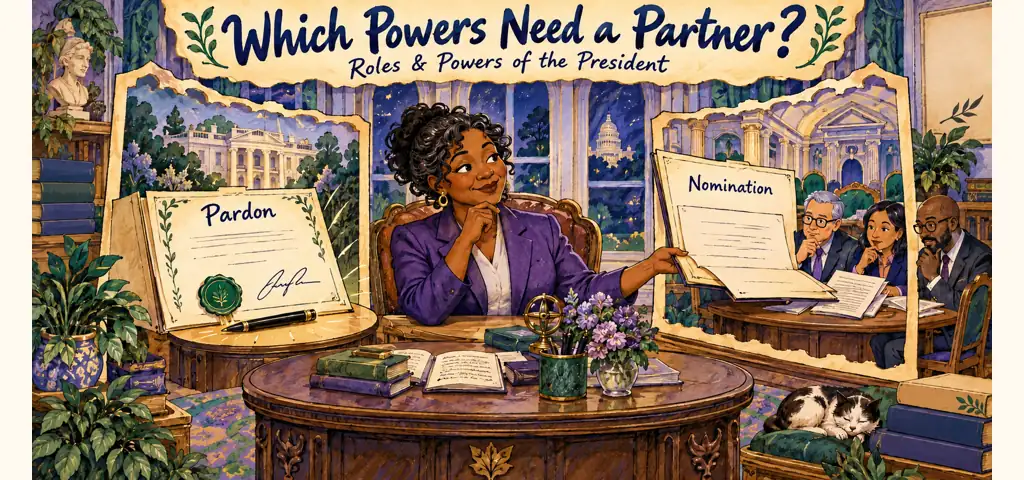
Presidential powers differ in their legal source and in who else must participate. A federal pardon, a Supreme Court nomination and a treaty do not follow the same process. First identify the act and its authority; then separate legal limits from questions about immunity or available remedies.
Match the Presidential Act to Its Legal Source
The president’s formal powers arise from the Constitution and from statutes enacted by Congress. Article II assigns the executive power, the duty to execute federal law faithfully, command of the armed forces, nomination and treaty roles, pardons for federal offenses, and several other responsibilities. Article I’s Presentment Clause supplies the presidential veto. Congress also gives executive officials authority through statutes.
A sound analysis therefore begins with a source question: Is the president relying on an exclusive constitutional power, authority shared with another institution, delegated statutory authority, or no identifiable legal authority? The category matters because the president’s title does not perform the legal analysis.
The pardon power can operate without a Senate vote, while an Article II treaty needs the consent of two-thirds of senators present. A nomination begins an appointment process but does not complete it. A military order may fall within command of operations while still depending on congressional authorization, regulation, and funding. Formal power must be matched to the particular act.
Ask How the Action Relates to Congress
Justice Jackson’s influential concurrence in Youngstown Sheet & Tube Co. v. Sawyer supplies a practical way to classify disputes involving Congress. Presidential authority is strongest when Congress has authorized the action. It enters a “zone of twilight” when Congress has neither granted nor denied authority and the branches may possess overlapping responsibilities. It is weakest when the president acts against Congress’s expressed or implied will, because the claimed power must then be exclusive enough to displace Congress. The Court invalidated President Truman’s seizure of steel mills during the Korean War. Commander-in-chief responsibilities did not create a domestic lawmaking power to take private facilities, especially when Congress had not authorized the seizure and had legislated differently. The lesson is not that presidents lose all power in emergencies. It is that an emergency label does not erase the need to identify a legal source or Congress’s constitutional role.
Separate Presidential Immunity from Lawful Authority
A separate issue is presidential immunity. For civil damages, Nixon v. Fitzgerald recognized absolute presidential immunity for acts within the outer perimeter of official responsibility. That official-act protection does not extend to unofficial conduct; Clinton v. Jones rejected temporary immunity for the unofficial, pre-presidency conduct at issue there. For criminal prosecution, Trump v. United States (2024) held that a former president has absolute immunity for conduct within exclusive and conclusive constitutional authority, at least presumptive immunity for other official acts, and no presidential immunity for unofficial acts. Courts classify the conduct by the nature of the authority involved, not simply by timing during the presidential term or an allegation about political motive.
Both doctrines differ from executive privilege, which concerns access to confidential presidential communications and is developed in an earlier lesson. Immunity and legality answer different questions. An act may be unlawful even when a particular damages action or prosecution is barred. It may still produce political consequences, impeachment, or another lawful remedy. Conversely, an unpopular action can be lawful. Keep four inquiries separate: what authority supports the act, whether another institution must participate, whether the act violates a legal limit, and whether a particular remedy is available.
Do Not Turn an Office Title into Unlimited Power
Do not treat the Take Care Clause as permission to suspend or revise statutes. Faithful execution presupposes law to execute. Do not treat broad office labels such as commander in chief or chief executive as answers to a specific spending, seizure, detention, or surveillance dispute. Name the act, locate its source, identify Congress’s position, and only then examine rights, review, and remedies.
Read the Powers and Immunity Cases Separately
Article II, Section 2 distinguishes federal pardons, appointments and treaties. The pardon power excludes impeachment cases. Treaty consent requires two-thirds of senators present; do not apply that threshold automatically to nominations. The same section allows Congress to assign certain inferior-officer appointments elsewhere, so not every federal appointment follows the Supreme Court process.
In Youngstown Sheet & Tube Co. v. Sawyer, distinguish the Court’s rejection of the steel seizure from Jackson’s concurring framework. Congressional authorization, silence and opposition are different settings. Silence does not itself supply every power an administration wants.
Nixon v. Fitzgerald concerns civil damages for official acts. Clinton v. Jones addresses a civil suit over alleged unofficial conduct before the presidency. Trump v. United States addresses criminal immunity for a former president and distinguishes core constitutional authority, other official acts and unofficial acts. Read the Court’s opinion separately from the concurrences and dissents. An immunity ruling does not, by itself, validate the underlying action or decide every other remedy.
Compare a Federal Pardon with a Supreme Court Nomination
In a hypothetical comparison, the president grants a pardon for a federal offense and separately nominates a Supreme Court justice. Which action requires Senate participation, and how might persuasion matter without replacing the legal process?
Check your reasoning
The Supreme Court appointment requires Senate advice and consent; the federal pardon does not require a Senate vote. Persuasion may help a nominee gain support, but it cannot replace the Senate’s constitutional role. Advice and political pressure can also shape a pardon decision without creating a Senate veto over that power. Keep the pardon’s federal-offense and impeachment limits in view.
Article II powers include executing law, commanding the military, nominating officers and judges, making treaties with Senate consent, vetoing legislation, granting federal pardons, and receiving ambassadors. Informal influence comes from bargaining, persuasion, agenda setting, party leadership, public appeals, and control of information and appointments.
Try Three Presidential Powers Questions
Choose one answer, then check your reasoning. These are short learning checks, not an exam score. If the controls are unavailable, the explanations remain readable below each question.
Answer B. The Supreme Court appointment requires Senate participation. A nomination starts that process; it does not complete the appointment by itself. The other listed actions do not require that confirmation vote.
Answer D. Identify the power and legal limits separately from the availability of a particular damages action or prosecution. Immunity does not itself authorize the disputed conduct.
Answer A. Article II specifies two-thirds of senators present for treaty consent. Do not transfer that treaty threshold to every nomination or confuse it with a vote across both houses.
Video Lesson: Presidential Power
CrashCourse gives a focused explanation of this topic in Presidential Power: Crash Course Government and Politics #11.
If the player does not load, watch this lesson directly on YouTube.
Follow the separate House and Senate votes in presidential vetoes and overrides, then compare legal authority with the president’s public platform.
Continue Studying Presidential Checks and Influence

Related to This Article
More math articles
- Converting Metric Units for 5th Grade: Length, Mass, Capacity
- How to Define Limits Analytically Using Correct Notation?
- Unit Circle Calculator (Free Exact Values for Any Angle)
- Incidence, Prevalence, and the Organization of Health Care
- Intelligent Math Puzzle – Challenge 87
- Shop Math: Fractions, Scale, and Dimensions
- How to Use Expanded Form to Multiply One-Digit Numbers By 3-digit or 4-digit Numbers
- Capitalism, Socialism, Mixed Economies, and Postindustrial Change
- PERT Math Formulas
- How to Find Powers and Roots of Complex Numbers











What people say about "Presidential Powers: Roles, Limits and Senate Consent"?
No one replied yet.