Political Ideology and Economic Policy
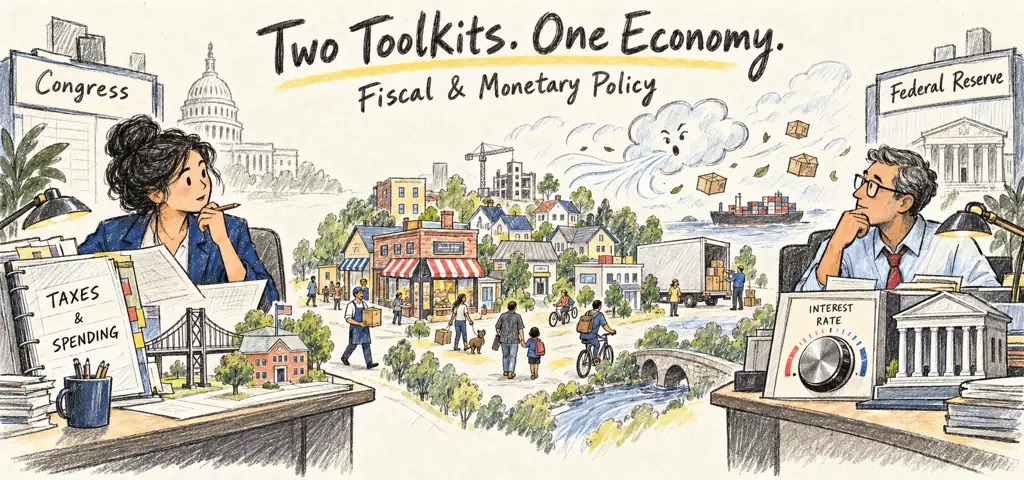
Economic policy seeks broad goals such as stable prices, high employment, sustainable growth, and a stable financial system. These goals can pull in different directions in the short run. Rapid demand may support jobs while adding inflationary pressure. Efforts to restrain inflation may slow hiring and investment. Policymakers therefore make choices under uncertainty rather than selecting one tool that guarantees prosperity. Global shocks, productivity, energy prices, supply disruptions, expectations, and private decisions can reinforce or offset government action.
Economic indicators answer different questions. Gross domestic product measures production, unemployment measures labor-market conditions under a defined survey concept, and price indexes track changes in the cost of a basket or category of goods and services. Nominal values are measured in current dollars. Real values adjust for changing prices. A budget deficit is the gap between federal spending and revenue during a period, while federal debt reflects accumulated borrowing obligations. Substituting one measure for another can create a persuasive but incorrect story.
A practical reading of political ideology and economic policy
The most important institutional division is between fiscal and monetary policy. Fiscal policy uses federal tax and spending choices made through the legislative process and administered by the executive branch. Monetary policy is conducted by the Federal Reserve to influence interest rates and broader financial conditions in pursuit of statutory economic goals. Regulatory agencies also affect economic behavior through safety, competition, labor, banking, and environmental rules, but a price or conduct regulation is not automatically fiscal or monetary policy. The actor and instrument identify the category.
Political Ideology and Economic Policy: a common mistake
Evidence must be interpreted with timing and comparison in mind. A policy announced today may take months to affect investment, hiring, or prices, while economic conditions may begin changing before enactment because people anticipate action. Supply shocks complicate demand management: tighter financial conditions may reduce price pressure, but they cannot directly produce scarce fuel or repair a damaged port. in a course question, classify the institution and direction of a tool, then reject any option claiming one action mechanically determines the economy.
Apply the lesson on political ideology and economic policy
Pick an institution connected to political ideology and economic policy and describe one related action it can take, plus one action it cannot take.
Video lesson: Political Ideology and Economic Policy
Khan Academy gives a focused explanation of this topic in Political ideology and economics | US government and civics.
If the player does not load, watch this lesson directly on YouTube.
Connect this lesson to the larger course
For a broader map connecting political ideology and economic policy to political culture, public opinion, and ideology, use the AP U.S. Government and Politics learning hub.

Related to This Article
More math articles
- Informal constitutional change
- Majority opinions
- Long Division by One Digit for 4th Grade
- How to Find the GCF and LCM (With Quick Tricks)
- The Best Grade 8 ELA Practice Tests for Alaska Students
- How to choose the right laptop for online math teaching
- The Best Grade 5 ELA Practice Tests for Kentucky Students
- The Best Grade 3 ELA Practice Tests for Indiana Students
- 5th Grade Ohio’s State Tests Math Worksheets: FREE & Printable
- FREE SAT Math Practice Test














What people say about "Political Ideology and Economic Policy"?
No one replied yet.