One Extra Zero: How American Roulette Doubles the House Edge
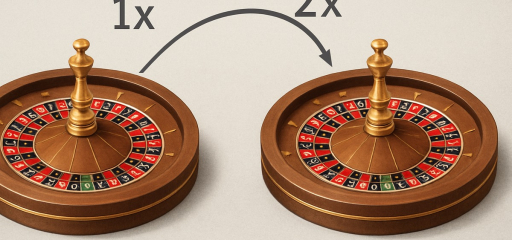
Walk past any roulette table in a Vegas pit and you’ll see two wheels that look nearly identical. Same red and black, same croupier sliding the ball into orbit, same chips stacked on the inside numbers. The only visible difference sits at the top of the layout, one tiny green pocket marked “00.” That little symbol is the single most expensive piece of paint in the casino, and most players have no idea it’s quietly doubling their long-run cost per spin.
Two Wheels, One Critical Difference
European roulette uses 37 pockets: the numbers 1 through 36, plus a single zero. American roulette uses 38 pockets: the same 1 through 36, plus a zero, plus a double-zero. That’s it. That’s the entire structural difference. The payouts, the betting layout, the table minimums, all essentially the same.
So why does this one extra pocket matter so much? Because of the gap between true odds and payout odds. If you drop a chip on a single number (a “straight-up” bet), the casino pays 35-to-1 when it hits. On a 37-pocket wheel, the true odds are 36-to-1 against you. On a 38-pocket wheel, the true odds are 37-to-1. Same payout, worse odds, and the house pockets the difference forever.
The House Edge Math, Slowed Down
Here’s the calculation without the textbook formality. On a European wheel, your single-number bet wins 1/37 of the time and loses 36/37 of the time. When it wins, you net +35 units; when it loses, you’re down 1 unit. Expected value per dollar wagered:
(1/37 × +35) + (36/37 × −1) = (35 − 36)/37 = −1/37 ≈ −0.0270
The casino keeps about 2.70 cents on every dollar. That’s the famous 2.70% house edge.
Now run it again on an American wheel. You win 1/38 of the time, lose 37/38:
(1/38 × +35) + (37/38 × −1) = (35 − 37)/38 = −2/38 ≈ −0.0526
The edge jumps to 5.26%. Adding one pocket didn’t just nudge the math up by a few percent. It nearly doubled what the casino expects to earn from your action over time. I’ve watched players sit at a double-zero wheel for three hours, complaining about being “cold,” when in reality they were just being slowly billed at twice the rate of the table next door.
Comparing Edges Across the Bet Menu
Both wheels share the same betting grid, so the house edge on every wager type follows the same pattern: roughly double on the American layout. Here’s the side-by-side that I wish more casinos would post next to the felt.
| Bet Type | Payout | European (Single 0) | American (Single + Double 0) |
|---|---|---|---|
| Straight-up (single number) | 35:1 | 2.70% | 5.26% |
| Split (two numbers) | 17:1 | 2.70% | 5.26% |
| Street (three numbers) | 11:1 | 2.70% | 5.26% |
| Corner (four numbers) | 8:1 | 2.70% | 5.26% |
| Six-line (six numbers) | 5:1 | 2.70% | 5.26% |
| Column / Dozen | 2:1 | 2.70% | 5.26% |
| Red/Black, Odd/Even, High/Low | 1:1 | 2.70% | 5.26% |
| Top Line (0, 00, 1, 2, 3) | 6:1 | N/A | 7.89% |
Notice that last row, the American-only “top line” bet (sometimes called the “basket” or “five-number bet”) is the worst wager on the entire table at 7.89%. It exists because the math doesn’t divide cleanly into a 35:1 payout when you cover five pockets on a 38-pocket wheel. Skip it. Always.
What It Actually Costs You Per Hour
House edge sounds abstract until you put a dollar sign and a clock on it. Roulette runs about 40 to 60 spins per hour depending on the table’s pace, the dealer, and how many bettors are crowded around. Let’s use 50 spins/hour as a clean middle estimate, with a flat $10 bet each spin.
- European wheel: $10 × 50 × 2.70% = $13.50/hr expected loss
- American wheel: $10 × 50 × 5.26% = $26.30/hr expected loss
- European with La Partage on even-money bets: $10 × 50 × 1.35% = $6.75/hr expected loss
Same chips. Same drinks. Same time on the stool. The American wheel just costs you roughly an extra $12.80 per hour for nothing. Stretch that over a four-day Vegas trip with five hours of play a day and you’ve handed the house an extra $256, money that could’ve covered a steakhouse dinner or a show.
The European Rules That Cut the Edge Even Further
If you can find a European wheel, ask whether it runs “La Partage” or “En Prison” rules. They sound like prison-break movie titles but they’re genuinely player-friendly.
La Partage (“the divide”) refunds half your even-money bet when the ball lands on zero. So if you bet $20 on red and zero hits, you lose $10 instead of $20. Mathematically this halves the house edge on red/black, odd/even, and high/low bets, dropping it from 2.70% to 1.35%.
En Prison (“in jail”) is a variant where, instead of taking half your bet, the casino “imprisons” your full wager when zero hits. On the next spin, if your color or property wins, you get the full bet back with no profit. If it loses, you lose the original wager. The math works out the same as La Partage, about 1.35% on those even-money bets.
French roulette tables, the elegant ones with the betting grid printed in French and the “voisins du zéro” call bets along the side, almost always include one of these rules. If you’re hunting the lowest house edge in a casino, a French wheel running La Partage on even-money bets is the holy grail at 1.35%. That’s lower than most blackjack tables with bad rules.
So Why Do American Wheels Still Exist?
Here’s where the history gets a little uncomfortable. When roulette first crossed the Atlantic to riverboat casinos in the 1800s, U.S. Operators added the double-zero (and briefly even an “American Eagle” symbol) specifically to extract more revenue per game than the European version allowed. The Encyclopedia Britannica notes that early American casinos charged operators a kind of “double-zero premium”, the extra pocket effectively paid for the table’s floor space and the dealer’s wages, with profit on top.
The European wheel never went away in casino culture. It just got relegated to the high-limit rooms. Walk into the main pit at most U.S. Properties and every wheel will be American. Wander upstairs to the $100-minimum salon, and suddenly the single-zero wheel appears, sometimes marketed as a VIP “perk.” It’s a clever bit of psychology, honestly. Casinos take a player-friendlier game and frame it as a reward for high rollers, when really they’re just letting the wheel that exists everywhere else in the world come out of the closet for guests who’ll bet enough to make the lower edge worth it.
If you want to dig deeper into the historical and mathematical analysis, the Britannica entry on roulette covers the game’s origins, and Wizard of Odds has the most thorough breakdown of every bet type and rule variation you’ll find online.
Practical Moves for Roulette Players
Roulette is never going to be a “good bet” mathematically. There’s no strategy that converts a negative expectation into a positive one. But you can absolutely reduce how much you’re paying for the entertainment. A few tactics that actually move the needle:
- Find the single-zero wheel. Ask the pit boss, check the high-limit room, or play at a property known for European tables. The minimums are often higher, but the edge is roughly half.
- Hunt for La Partage or En Prison. French tables and some boutique European wheels offer one of these rules. Stick to even-money bets at that table. That’s where the rule helps.
- Skip the top-line bet on American wheels. 7.89% is the worst wager available. There’s no situation where it’s the right play.
- Slow down your action. Edge is a percentage of total money wagered. Fewer spins per hour = less expected loss, regardless of wheel.
- Ignore “hot” and “cold” number boards. Wheels are physical objects with manufacturing tolerances, but modern casino wheels are calibrated tightly enough that any tracking edge for civilians has long since vanished. Past results don’t change future probabilities, and you can polish up your probability instincts over at Effortless Math if the gambler’s fallacy keeps tripping you up.
One more opinionated note: the “betting systems” you’ll see hawked on YouTube, Martingale, Fibonacci, Labouchere, none of them change the house edge. They redistribute when your losses arrive, sometimes hiding them behind a long string of small wins, but the long-run cost is identical to flat betting. The math is brutal and indifferent to staking patterns.
FAQ
Is European roulette always better than American roulette?
Yes, mathematically, every single bet type carries a lower house edge on a single-zero wheel. If both options are available and the table minimums are comparable, there’s no scenario where American is the better choice.
Does the house edge mean I’ll always lose 5.26%?
No. It’s a long-run average. In any given session you can win or lose much more or less than that percentage. The edge becomes more visible the more spins you play, which is why casinos love high-volume players.
What’s the worst bet on the roulette table?
On American wheels, it’s the five-number “top line” bet (0, 00, 1, 2, 3) at 7.89%. On European wheels, every bet carries the same 2.70% edge, so there’s no single “worst” bet, though if La Partage is available, even-money bets become the best at 1.35%.
Can I actually find European roulette in U.S. Casinos?
Yes, but you’ll usually find it in the high-limit room with higher minimums ($25 or $50 instead of $10). Some boutique casinos in Las Vegas and Atlantic City offer it on the main floor; it’s worth asking the pit boss before you sit down.
Do online casinos offer European roulette?
Most do, and many offer French roulette with La Partage as well. Online minimums are typically $1 or less, making the lower-edge games accessible without the high-limit-room markup. Verify the wheel type before you bet, some sites default to American.
Does the dealer’s spin technique affect outcomes?
Not in any way you can exploit. Modern casino wheels are precisely balanced, dealers are trained to vary their release point, and surveillance watches for biased wheels. Old-school “wheel clocking” doesn’t work on properly maintained equipment.
The Single-Pocket Tax
Roulette has survived for three centuries because it’s elegant, social, and just complicated enough to feel like there’s a strategy. There isn’t, the wheel doesn’t care about your system, your lucky number, or your last six spins. The only real decision you make before placing a chip is which wheel you’re playing on, and that one decision will determine whether you pay the casino at 2.70%, 5.26%, or 1.35% per spin.
Next time you spot two roulette tables side by side, take a second to count the pockets at the top of the layout. One green or two? That single extra zero is the most expensive piece of paint on the floor, and now you know exactly what it’s costing you.

Related to This Article
More math articles
- How to Graph Inverse of the Tangent Function?
- The Best Grade 6 ELA Practice Tests for Nebraska Students
- ISEE Math- Test Day Tips
- THEA Math Formulas
- How to Ace the GRE Quant Section?
- The Best Grade 7 ELA Practice Tests for Washington Students
- Full-Length 7th Grade ACT Aspire Math Practice Test-Answers and Explanations
- 7th Grade PARCC Math Worksheets: FREE & Printable
- Divided government
- Free Grade 2 English Worksheets for Mississippi Students






What people say about "One Extra Zero: How American Roulette Doubles the House Edge - Effortless Math"?
No one replied yet.