Oklahoma OSTP Grade 7 Math Worksheets: 95 Free Printable PDFs Aligned to Every Skill
The most valuable question in seventh-grade math is also the simplest: does this answer make sense? Estimation and a reasonableness check catch the errors that procedure alone misses — a decimal in the wrong place, a percent that produced an impossible total, an area larger than the figure could hold. A student in Oklahoma City, Tulsa, or Norman who pauses to ask that question saves themselves a surprising number of points.
These 95 worksheets give that habit a place to grow. Each page isolates one skill and includes word problems where a quick estimate should come before the exact work. The answer key’s tutor notes often point out what a reasonable answer would have looked like, so the check becomes a routine, not an afterthought.
The whole Grade 7 year is here in single-skill pages — integers, rational numbers, proportions, percents, equations, geometry, statistics, probability — each one a chance to practice both the method and the sanity check.
What’s on this page
The worksheets are organized into the ten strands of Grade 7 math. Each title is tagged with its standard code in brackets so you can match a page to a classroom objective or an OSTP reporting category. Every link opens a printable PDF: review and example, then practice and word problems, then answers with tutor notes.
Integers and Absolute Value
- Understanding Integers and the Number Line – [7.NS.1] make positive and negative numbers feel concrete before the operations begin
- Absolute Value – [7.NS.1] treat distance from zero as a habit, especially when negative signs sit outside the bars
- Comparing and Ordering Integers – [7.NS.1] use number-line position instead of guessing from the size of the digits
- Adding Integers – [7.NS.1] combine gains and losses without losing the sign
- Subtracting Integers – [7.NS.1] turn subtraction into adding the opposite when the signs get crowded
- Multiplying Integers – [7.NS.2] separate the sign rule from the multiplication facts
- Dividing Integers – [7.NS.2] use the same sign logic as multiplication, then check reasonableness
- Square Roots and Perfect Squares – [8.EE.2] recognize perfect squares quickly and connect square roots to side length
- Introduction to Scientific Notation – [8.EE.3] write very large and very small numbers in a cleaner, more readable form
Rational Numbers and Exponents
- Fractions, Decimals, and Rational Numbers – [7.NS.2] move between forms so the most useful representation is always available
- Adding and Subtracting Fractions (Like Denominators) – [7.NS.1] keep the denominator steady and focus attention on what happens to the numerators
- Adding and Subtracting Fractions (Unlike Denominators) – [7.NS.1] find a common denominator before the arithmetic starts to compete for attention
- Multiplying Fractions and Mixed Numbers – [7.NS.2] convert mixed numbers when needed, multiply straight across, and simplify cleanly
- Dividing Fractions and Mixed Numbers – [7.NS.2] turn division into multiplying by the reciprocal, then check that the size of the answer makes sense
- Adding and Subtracting Decimals – [7.NS.1] line up place values so tenths, hundredths, and thousandths stay in their own lanes
- Multiplying and Dividing Decimals – [7.NS.2] estimate first, then place the decimal where the answer can reasonably live
- Converting Between Fractions, Decimals, and Percents – [7.NS.2] switch forms on purpose instead of treating each representation as a separate topic
- Adding and Subtracting Rational Numbers – [7.NS.1] combine fractions, decimals, and negatives without letting the notation hide the operation
- Multiplying Integers and Rational Numbers – [7.NS.2] carry the sign rule into fractions and decimals, not just whole-number products
- Dividing Integers and Rational Numbers – [7.NS.2] use reciprocals and sign rules together, then test the answer against the original expression
- Solving Real-World Problems with Rational Numbers – [7.NS.3] translate everyday changes, debts, distances, and measurements into rational-number operations
- Exponents and Powers of Rational Numbers – [8.EE.1] read powers as repeated factors and watch how fractions and negatives behave
- Laws of Exponents – [8.EE.1] use product, quotient, and power rules as shortcuts students can justify, not tricks to memorize
Ratios, Rates, and Proportional Relationships
- Ratios and Equivalent Ratios – [7.RP.2] build the foundation for proportions, rates, and scale work
- Unit Rates and Complex Fractions – [7.RP.1] reduce messy comparisons to a clear per-one value
- Writing and Solving Proportions – [7.RP.2] set up equivalent ratios carefully before cross-products appear
- Proportional vs. Non-Proportional Relationships – [7.RP.2] look for a constant multiplier instead of assuming every table is proportional
- Constant of Proportionality (k) – [7.RP.2] identify the unit rate that ties tables, graphs, equations, and word problems together
- Graphing Proportional Relationships – [7.RP.2] connect the straight line through the origin to the unit rate in the situation
- Scale Drawings and Scale Factors – [7.G.1] connect classroom proportions to maps, models, and real measurements
- Writing Equations for Proportional Relationships – [7.RP.2] turn a constant rate into an equation and use it to predict new values
- Converting Between Measurement Systems – [7.RP.3] use conversion factors carefully so the unwanted unit cancels away
Percents and Financial Literacy
- Percents Greater Than 100% and Less Than 1% – [7.RP.3] stretch percent thinking beyond the familiar 0 to 100 range
- Finding the Percent of a Number – [7.RP.3] connect percent to multiplication so students can move past one-step guessing
- Finding the Whole Given a Part and Percent – [7.RP.3] work backward from the part to the original amount without swapping the quantities
- Percent Increase and Percent Decrease – [7.RP.3] separate the original amount from the amount of change
- Discounts, Markups, and Sales Tax – [7.RP.3] practice the kind of percent math students see in stores
- Simple Interest – [7.RP.3] keep principal, rate, and time organized in one formula
- Tips, Commissions, and Fees – [7.RP.3] apply percent work to bills, pay, service charges, and other money situations students recognize
- Percent Error: How Close Are Your Estimates? – [7.RP.3] compare the size of an error to the exact value, not just the raw difference
- Compound Interest – [7.RP.3] show why repeated percent growth is different from simple interest
- Introduction to Personal Financial Literacy – [7.RP.3] make budgeting, saving, borrowing, and earning feel like math students can actually use
Expressions, Equations, and Inequalities
- Writing and Evaluating Algebraic Expressions – [7.EE.2] translate words into variables and test expressions with real values
- Properties of Operations and Simplifying Expressions – [7.EE.1] combine like terms and use properties to make expressions easier to read
- Adding and Subtracting Linear Expressions – [7.EE.1] track coefficients and constants separately so like terms do not get blurred together
- Solving One-Step Equations – [7.EE.4] undo one operation cleanly and check by substitution
- Solving Two-Step Equations – [7.EE.4] remove the constant first, then undo the coefficient
- Solving Equations with the Distributive Property – [7.EE.4] distribute, collect like terms, and then solve the equation one layer at a time
- Writing and Graphing Inequalities – [7.EE.4] connect inequality language to open and closed points on a number line
- Solving One-Step and Two-Step Inequalities – [7.EE.4] solve like an equation while remembering when a negative multiplier reverses the sign
- Factoring Expressions – [7.EE.1] pull out a common factor so the structure of an expression becomes easier to see
- Rewriting Expressions to Solve Problems – [7.EE.2] choose an equivalent form that makes the question easier, faster, or clearer
- Solving Multi-Step Problems with Rational Numbers – [7.EE.3] keep fractions, decimals, signs, and units organized across several steps
- Introduction to Slope and Linear Relationships – [8.EE.5] read a rate of change from tables, graphs, and situations
Geometry: Angles, Triangles, and Transformations
- Adjacent, Vertical, and Linear Pair Angles – [7.G.5] use angle relationships before reaching for guesswork or a protractor
- Complementary and Supplementary Angles – [7.G.5] connect the words to 90-degree and 180-degree totals
- Angle Relationships with Parallel Lines and Transversals – [8.G.5] spot corresponding, alternate, and same-side angle patterns in a busy diagram
- Triangle Angle-Sum Theorem – [8.G.5] use the 180-degree total to solve for missing angles
- Exterior Angle Theorem – [8.G.5] connect an outside angle to the two remote interior angles that create it
- Constructing Triangles (SSS, SAS, ASA Conditions) – [7.G.2] test which side-and-angle information is enough to make one clear triangle
- Similar Figures and Proportional Sides – [7.G.1] use scale factors to move between matching sides
- Drawing Geometric Figures with Given Conditions – [7.G.2] turn a written set of constraints into a precise diagram
- Triangle Inequality Theorem – [7.G.2] check side lengths before assuming a triangle can exist
- Properties of Quadrilaterals – [7.G.2] sort rectangles, parallelograms, trapezoids, and rhombuses by the properties they must have
- Translations, Reflections, and Rotations – [8.G.1] describe how a figure moves without changing its size or shape
- Dilations and Scale Factors on the Coordinate Plane – [8.G.3] use multiplication from the origin or center of dilation to resize a figure
Two-Dimensional Geometry
- Area of Triangles – [7.G.6] practice the half-base-times-height idea until it is automatic
- Area of Quadrilaterals – [7.G.6] choose the right base and height for rectangles, parallelograms, trapezoids, and kites
- Area of Composite Figures – [7.G.6] break an irregular shape into familiar pieces before adding or subtracting area
- Circumference of Circles – [7.G.4] use diameter, radius, and pi to measure the distance around a circle
- Area of Circles – [7.G.4] connect radius, pi, and area without mixing up circumference
- Area and Perimeter of Composite Figures with Circles – [7.G.4] combine straight edges and curved pieces without losing track of which formula is being used
- Parts of a Circle – [7.G.4] name radius, diameter, chord, arc, and sector while doing real calculations
Three-Dimensional Geometry
- Nets and Surface Area of Prisms – [7.G.6] unfold a prism into faces so every rectangle has a reason to be counted
- Surface Area of Pyramids – [7.G.6] combine the base with the triangular faces and keep slant height separate from vertical height
- Volume of Prisms – [7.G.6] multiply base area by height and track cubic units
- Volume of Pyramids – [7.G.6] connect pyramid volume to one-third of a matching prism
- Cross Sections of 3-D Figures – [7.G.3] visualize the flat shape created when a solid is sliced
- Volume of Cylinders – [8.G.9] use the area of the circular base and the height as a three-dimensional stack
- Surface Area of Cylinders – [7.G.6] combine the two circles with the curved rectangle around the side
Statistics and Data
- Populations, Samples, and Sampling Methods – [7.SP.1] decide whether a sample represents the larger group or quietly leans one way
- Making Predictions from Samples – [7.SP.2] use proportional reasoning to make reasonable estimates from survey data
- Mean, Median, Mode, and Range – [7.SP.4] choose the right summary number for a data set
- Mean Absolute Deviation (MAD) – [7.SP.4] measure how spread out data values are from the mean
- Box Plots and Measures of Spread – [7.SP.4] read quartiles, medians, ranges, and IQR from one display
- Comparing Two Data Distributions – [7.SP.3] compare center and spread instead of judging by one number alone
- Histograms and Stem-and-Leaf Plots – [7.SP.4] read grouped data displays without mistaking bars or stems for individual values
- Circle Graphs (Pie Charts) – [7.SP.4] connect sectors of a circle to percents, fractions, and totals
Probability
- Introduction to Probability – [7.SP.5] write probability as a favorable-outcomes-over-total-outcomes fraction
- Sample Spaces and Counting Outcomes – [7.SP.8] list outcomes in an organized way so none are counted twice or missed
- Probability of Simple Events – [7.SP.6] turn one clear event into a fraction, decimal, or percent probability
- Compound Events (Independent) – [7.SP.8] multiply probabilities when one event does not change the other
- Compound Events (Dependent) – [7.SP.8] adjust the second probability when the first event changes the sample space
- Simulations and Experimental Probability – [7.SP.6] use trials to model chance and compare results with theoretical probability
- Probability Models – [7.SP.7] judge whether a model matches the situation before trusting its predictions
Teaching the reasonableness check
Before your student computes a word problem, ask them to estimate — roughly, out loud — what the answer should be near. Then have them solve it exactly.
If the exact answer is far from the estimate, that is the signal to re-check the steps. The tutor notes often confirm what a reasonable result looks like.
Keep sessions short, and before the OSTP, rotate strands so the estimate-then-check habit gets practiced across every kind of problem.
About the Oklahoma OSTP Grade 7 Math test
The Oklahoma School Testing Program expects Grade 7 students to compute with rational numbers and reason about proportional relationships, equations and inequalities, geometry, and probability. On a timed test, a fast reasonableness check is one of the cheapest ways to catch a careless error before it costs a point.
Steady worksheet practice keeps each skill rehearsed and the habit of checking automatic, so an OSTP answer gets a second look before it is final.
Prefer everything in one place?
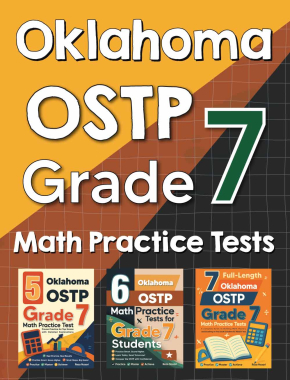
For families and teachers who want a single organized resource instead of separate PDFs, the Oklahoma OSTP Grade 7 Math Preparation Bundle collects full-length practice tests, answer keys, and structured review.
Oklahoma OSTP Grade 7 Math Preparation Bundle – 18 full-length practice tests across three books, with original questions and detailed explanations.
To finish
Asking whether an answer makes sense is a habit worth more than most. Bookmark this page, build the estimate-then-check routine, and let your student catch errors before they count.
Best Bundle to Ace the Oklahoma OSTP Grade 7 Math
Looking for one organized Grade 7 math resource for the Oklahoma OSTP? This bundle brings together full-length practice tests, answer keys, and step-by-step explanations so students can move from individual worksheet skills into complete test practice.

Related to This Article
More math articles
- 6th Grade M-STEP Math Worksheets: FREE & Printable
- The Best Grade 7 ELA Practice Tests for Georgia Students
- Integrals: Complete Explanation of the Applications and Use
- Finding Text Evidence
- TABE Math Formulas
- How Do Secant-Tangent and Tangent-Tangent Angles Work? A Complete Guide
- Roosevelt’s Square Deal, Consumer Protection, and Conservation
- Latin Roots for Actions and Ideas
- Grade 3 Math: Introduction to Multiplication
- TOEFL Score Scale and Rounding: Read Your Report (2027 Prep)










What people say about "Oklahoma OSTP Grade 7 Math: Free Worksheets"?
No one replied yet.