New Jersey Algebra 1 Free Worksheets: Free Printable Algebra 1 Worksheets Covering Every Skill
There is a sentence that quietly defines the whole year of Algebra 1: the relationship matters more than the specific numbers. For most of elementary and middle school, math was about particular cases. This many apples, that many minutes, those specific fractions. Algebra is when a student begins to describe the rules underneath all those cases at once. A line on a graph is not really about two specific points; it is about how any two quantities can be related in a steady, predictable way. A quadratic equation is not really about the x you found; it is about the shape of every problem that behaves like this one.
That is what makes ninth-grade math feel like a step up. It is also why the right kind of practice matters so much. A New Jersey student in Newark, Jersey City, Paterson, or Trenton, or anywhere in between, does not need more problems to do Algebra 1 well. They need short, focused work on one piece of the structure at a time, with honest feedback at the end of every page. Algebra rewards specificity. A worksheet on one named skill, done cleanly and checked, beats two hours of mixed practice almost every time.
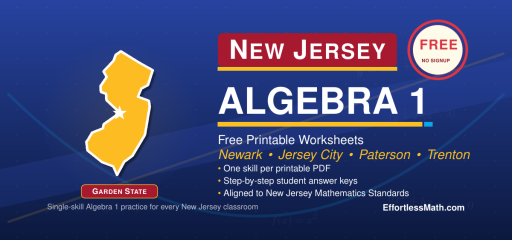
These 62 worksheets are built around that idea. One skill, one example, one honest answer key.
What’s on this page
Sixty-two single-skill PDFs aligned to the New Jersey Algebra 1 standards. The course is laid out in clean pieces: linear equations and inequalities, slope and lines, linear and exponential functions, systems of equations, exponents and radicals, factoring, and quadratic equations and functions. Each PDF lives entirely inside one of those skills, a student working on graphing systems is not also being tested on factoring quadratics.
Every page opens with a one-page Quick Review: the skill stated in plain English and one fully worked example with the reasoning visible step by step. Then twelve practice problems climb from straightforward to genuinely challenging, enough to know the skill is real, not just memorized. The final page is a student-facing answer key written in a friendly, tutoring tone, the kind a fourteen- or fifteen-year-old can read independently and actually understand.
Foundations of Algebra
This chapter lays the groundwork, moving from numbers to letters and putting properties and order-of-operations to work on real problems. Getting comfortable here pays off all the way through the New Jersey Algebra 1 course.
- Variables, Expressions, and Properties
- Order of Operations and Evaluating Expressions
- Introduction to Equations and Solutions
- Personal Financial Literacy
Solving Linear Equations
Now the central skill of the course: isolating a variable, from one clean step through multi-step solves and rearranging formulas. Time spent here is time saved when the New Jersey Algebra 1 course rolls around.
- Solving One-Step Equations
- Solving Two-Step Equations
- Solving Multi-Step Equations
- Equations with Variables on Both Sides
- Literal Equations and Formulas
Inequalities and Absolute Value
Here a single answer becomes a set: solving and graphing inequalities, handling the sign-flip rule, and unpacking absolute value. Across New Jersey, this is one of the skills that rewards regular reps.
- Solving One-Step Inequalities
- Solving Multi-Step Inequalities
- Compound Inequalities
- Absolute Value Equations
Relations, Functions, and Sequences
This unit introduces function thinking: notation, inputs and outputs, and the patterns that arithmetic and geometric sequences follow. It is worth the extra reps for New Jersey learners aiming for a strong score on the New Jersey Algebra 1 course.
- Relations and Functions
- Function Notation and Evaluating Functions
- Domain and Range
- Graphing Functions and Transformations
- Arithmetic Sequences as Linear Functions
- Geometric Sequences
- Comparing Functions
- Piecewise Functions
- Inverse Functions
Linear Functions and Their Graphs
Linear graphs take focus: slope, intercepts, point-slope and slope-intercept forms, and special line relationships. Newark families can use these pages to lock the skill in before it’s tested.
- Slope and Rate of Change
- Slope-Intercept Form
- Point-Slope Form
- Standard Form of a Linear Equation
- Writing Linear Equations from Graphs and Tables
- Parallel and Perpendicular Lines
- Inverse Variation
- Understanding Graphs as Solution Sets
Systems of Equations and Inequalities
Here several equations are solved together, and systems of inequalities mark out whole regions of valid solutions. In Newark classrooms it tends to separate confident students from hesitant ones.
- Solving Systems by Graphing
- Solving Systems by Substitution
- Solving Systems by Elimination
- Applications of Systems of Equations
- Systems of Linear Inequalities
- Solving Linear-Quadratic Systems
Factoring
Students learn to rewrite polynomials as products: greatest common factor, trinomial factoring, and recognizable special forms. Master it early and the rest of the New Jersey course leans on it with ease.
- Greatest Common Factor and GCF Factoring
- Factoring Trinomials: \(x^2 + bx + c\)
- Factoring Trinomials: \(ax^2 + bx + c\)
- Factoring Special Products
Quadratic Functions and Equations
The chapter covers parabolas and three solution paths for quadratics, plus what the discriminant reveals. It’s a frequent early hurdle for learners in Newark and across the state.
- Graphing Quadratic Functions
- Characteristics of Quadratic Functions
- Solving Quadratics by Factoring
- Solving Quadratics by Completing the Square
- Solving Quadratics by Square Roots
- The Discriminant
- The Quadratic Formula
Statistics and Probability
Data analysis and probability close out the core, from box plots and histograms to counting principles. These worksheets give New Jersey students focused, low-pressure practice.
- Measures of Center and Spread
- Scatter Plots and Correlation
- Lines of Best Fit and Predictions
- Two-Way Frequency Tables
Exponential Functions and Modeling
Here change compounds: exponential growth and decay, their graphs, and comparisons among model families. For New Jersey students, fluency here shows up directly on the New Jersey Algebra 1 course.
- Graphing Exponential Functions
- Comparing Linear, Quadratic, and Exponential Models
- Exponential Growth
- Interpreting Functions and Parameters
More Topics
- Absolute Value Inequalities
- Direct Variation
- Displaying Data with Box Plots
- Displaying Data with Histograms
- Exponential Decay
- Graphing Cube Root Functions
- Graphing Square Root Functions
How to use these worksheets at home
Algebra 1 is structured like a staircase, and the most useful study habit is to climb related steps in order rather than jumping around the building. Pair “Solving Two-Step Equations” the night before “Solving Multi-Step Equations” and the second sheet is exactly the first sheet with one extra move added. Schedule “Slope and Rate of Change” right before “Slope-Intercept Form,” and the slope a student just computed steps directly into y = mx + b. Print “Factoring Trinomials” the day before “Solving Quadratics by Factoring,” and the second worksheet effectively continues the sentence the first one started.
Frequency does the heavy lifting. Two short sittings a week, fifteen to twenty minutes each, finished cleanly and self-checked, is enough to move a New Jersey student through the year without ever needing a desperate weekend review. The point of each PDF is to leave the table with a clear answer to a small question: do I have this one yet, or do I need its prerequisite. If yes, move on. If not yet, print the page whose title names the underlying piece. That is faster than any sweeping review.
Treat the answer key as part of the lesson. Hand it over, let your student grade their own page, and ask them for one quiet sentence about whichever problem went wrong. The skill of correcting your own reasoning is part of the math content at this age, and it is hard to teach from across the table, a 14-year-old has to do it themselves before it sticks.
A note about Algebra 1 in New Jersey
New Jersey high schools build Algebra 1 around the state’s Algebra 1 standards, which align with the Common Core framework. Districts across the state typically close the course with a cumulative spring assessment, whether a state-supported exam or a district end-of-course test, that draws from the same set of standards these worksheets are aligned to. The expected skills are consistent: solve linear equations and inequalities, work fluently with linear and exponential functions, solve systems, manipulate algebraic expressions including those with exponents, factor and solve quadratics, and reason about real-world data and key features of graphs.
Because each PDF maps to one standard, the full set functions as a personal checklist for that spring window. Print a sheet, see how the page goes, and let it decide the next one. A clean answer key is permission to move forward; a stumble is a quiet pointer to the prerequisite that needs another twenty minutes. That kind of targeted study is how a long course becomes manageable.
A short closing
Algebra 1 grows the way most real skills grow, slowly, page by page, in a way that is hard to see day to day and obvious by the end of the year. Bookmark this page, print one PDF tonight, and let your New Jersey student begin with the smallest, closest-to-easy skill on the list. By the time spring arrives, the structure of the course will have quietly built itself.
New to Algebra? Start with the basics


Related to This Article
More math articles
- The Best Grade 4 ELA Practice Tests for New Mexico Students
- What are the Undefined Limits: Defining from Tables and Graphs
- Which Test Should You Take: GED, TASC, or HiSET?
- AP Business with Personal Finance: Break-Even Analysis Step by Step (2027 Prep)
- Triangle Calculator (Right Triangle & SSS Solver, with Diagram)
- Judicial review
- The Best Algebra 1 Book for Louisiana Students
- Free South Carolina SC READY Grade 5 Math Practice: 49 Printable PDFs for Classrooms, Tutors, and Parents
- Civil Rights Movement
- AP Cybersecurity Risk Assessment: Threat, Vulnerability and Impact (2027 Prep)










What people say about "New Jersey Algebra 1: Free Worksheets"?
No one replied yet.