The Hidden Arithmetic That Breaks the Martingale System Every Time
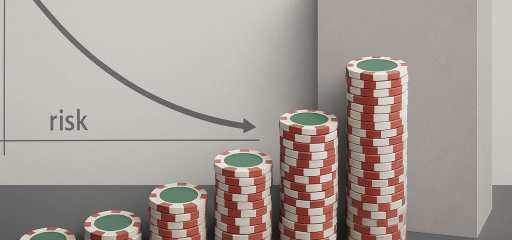
The Martingale is everywhere because it works, at least for about three days. Double your bet after every loss. Eventually you’ll win. That win covers all the earlier losses and leaves you up one unit. It’s almost too simple to ignore, and it definitely sounds like you’ve found something the casinos don’t want you to know. You haven’t.
Here’s what actually happens: the math isn’t on your side. Not because you haven’t heard of it yet, but because it’s impossible. The Martingale doesn’t change the underlying game’s expected value. It doesn’t make a bad bet less bad. It just rearranges when your losses hit and how much money they demand from you when they do.
What it does change is the size of your bets and the speed at which they blow past what you can actually afford. And that’s where things fall apart, not tomorrow, but this Thursday night at the table after you’ve lost six in a row and suddenly you’re being asked to bet more than you planned to risk in a month.
Start With the Simplest Version
Let’s say you’re betting $10 on something that’s close to even money. Red in roulette. Banker in baccarat. Heads on a coin flip. You lose. So you bet $20 the next time. You lose again. Now it’s $40. Lose again: $80. Lose again: $160. This continues until you finally win. When that happens, the winning bet covers everything you’ve already lost and puts $10 in your pocket.
The first few rounds look beautiful. You lose $10, then you lose $20, then you lose $40. That’s $70 in total losses. Your fourth bet is $80, you win, and boom. You’re up $10. The system works. You’ve turned chaos into profit with pure mathematics.
But the system doesn’t stop after three losses. What if you get five in a row? Then seven? Then nine? Exponential doubling doesn’t care about how good the first few examples looked. Each new loss triggers a bigger bet. Each bigger bet is a bigger risk. The promised gain stays fixed at $10. The required rescue bet keeps getting more absurd.
The Numbers Get Genuinely Ugly Fast
| Consecutive Loss # | Your Next Bet Must Be | You’ve Already Lost | Your Profit If This One Hits |
|---|---|---|---|
| 1 | $20 | $10 | $10 |
| 3 | $80 | $70 | $10 |
| 5 | $320 | $310 | $10 |
| 8 | $2,560 | $2,550 | $10 |
| 10 | $10,240 | $10,230 | $10 |
This is the entire Martingale system compressed into one table. The payout never changes. You’re always chasing that $10 profit. But the amount you’re risking climbs toward the stratosphere. After nine consecutive losses (which sounds unlikely until you sit at a table for ninety minutes and watch it happen), you’re betting $5,120 to win your original $10.

You’re not trying to win money anymore. You’re trying to dig yourself out of a hole you created by following the system. Your brain is doing the math on every bet, watching your deficit grow, calculating how much you’d lose if this loss were the one before the final win.
To understand why probability and expected value matter here, check out Effortless Math’s lessons on probability problems and expected value of random variables. The Martingale is counting on the fact that you’ll focus on all those $10 wins you rack up in short sessions and ignore the one catastrophic loss that wipes out fifty of them.
Then the Casino’s Table Limit Hits
Every casino sets a maximum bet. The limits exist for exactly this reason, to stop you from escalating infinitely. A table that allows $10 minimums might cap out at $5,000 or $10,000. That sounds high until the Martingale math catches up.
Picture this: you’re at a $10 minimum table with a $5,000 maximum. You’re down nine losses. The math says your next bet should be $5,120. That’s too high. The dealer shakes their head. You’ve hit the limit.
At this point, you’ve lost $5,110. You can’t place the bet that would recover it. The entire system collapses because the casino anticipated this exact scenario and built the rules to prevent it. The sales pitch for Martingale always leads with “You only need one win to recover.” What they don’t mention is “You need that win before mathematics makes your required bet bigger than what the table allows.” That’s not a flaw of the system. That’s the entire system.
Most Players Bleed Out Before the Table Does
You’ll probably hit your personal bankroll limit before you hit the table’s maximum bet. You don’t have $5,120 sitting around ready to risk for a $10 return. The average person doesn’t. The average rational person definitely doesn’t.
This isn’t weakness or poor planning. It’s the real world. Infinite bankroll is a mathematical fantasy, not an actual resource you can access. A betting system that only works with unlimited money isn’t a betting system. It’s a thought experiment.
The Martingale depends on a long list of assumptions that casinos deliberately prevent: infinite money, no maximum bet, no time pressure, perfect emotional control under stress, and the ability to play forever without the edges of probability catching up to you. Real gambling has none of those things. Real casinos specifically don’t allow those things. They’ve had centuries to figure out what breaks betting systems, and table limits are job one.
The House Edge Is Still There, Martingale Doesn’t Erase It
Here’s the fundamental issue: the Martingale doesn’t change expected value. It doesn’t change the math of the underlying game. At an American roulette table, the red/black bet loses to two green pockets (0 and 00). That 5.26% house edge sits there on every single spin, regardless of how much you’re betting. Doubling your bets after losses doesn’t move those green pockets off the wheel.
This is baseline probability: if every single bet you make has negative expected value, then every sequence of those bets also has negative expected value. You can’t fix a bad math problem by making the numbers bigger. You can only accelerate the rate at which the math wins.
The idea that you’re “playing the sequence instead of the individual spin” is attractive. It’s also wrong. The sequence is made of individual spins. Bad math plus more bad math doesn’t equal good math. It equals more bad math, faster. For the deeper math, the MIT OpenCourseWare material on computing expectation walks through how to multiply outcomes by their probabilities and add them. That’s all gambling is. The Martingale doesn’t change what’s on either side of that multiplication.
Why It Feels Like It’s Working
The Martingale is dangerously seductive because it actually does produce small wins frequently. Long losing streaks are rare. Short sessions with quick wins are common. So if you play for an hour, you might rack up five or six $10 wins. That feels like control. That feels like you’ve cracked something.
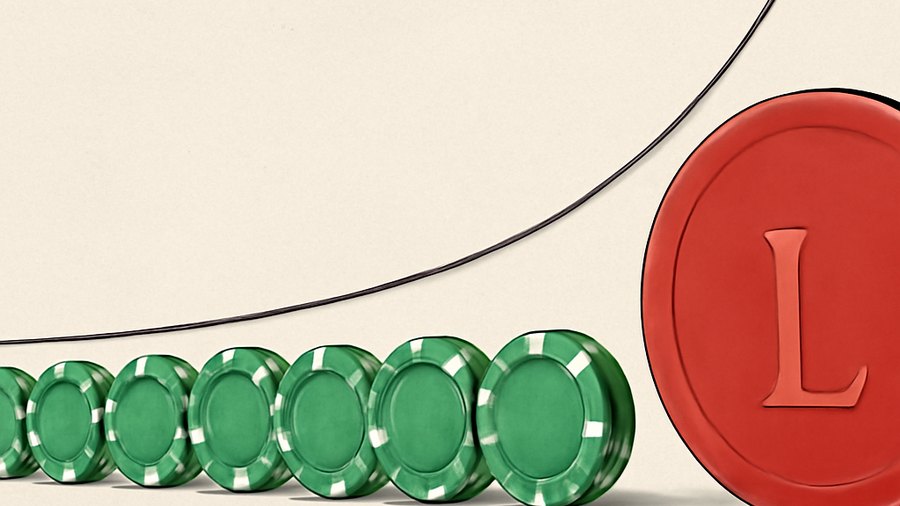
You think: “I’ve won six times in a row. This system is real.” And technically, yes, you have won six times. But you’ve only risked maybe $600 to do it. You’re up $60. This is where probability and severe events diverge: you can be winning 80% of the time and still lose money overall if the remaining 20% erase all your gains.
The losing session is inevitable. After you’ve had twenty winning sessions at $10 each, you’re up $200. You’re feeling smart. Then one unlucky streak hits, you chase the doubling sequence, and you lose $1,200 trying to recover. Now you’re down $1,000 total. The system had a 95% win rate over those sessions. Your account is still underwater.
Insurance companies and casinos make billions on this exact principle: they understand that high frequency of small losses isn’t the danger. Low frequency of catastrophic events is. Most people feel frequency more strongly than severity, until the severe event arrives. Then they feel it very clearly.
Martingale on Roulette: The Classic Example With a Fatal Flaw
Roulette is ground zero for Martingale discussions because the red/black bet pays even money and almost feels like a coin flip. You know it’s not quite 50/50, but it’s close. Except American roulette has 38 pockets. Eighteen red, eighteen black, plus 0 and 00. That’s 20 ways to lose and 18 ways to win on a red bet. The house gets that 5.26% edge from the two green pockets that exist purely to tilt the odds against you. As Britannica explains, that edge applies to every single bet, every single time.
The Martingale player will insist they’re not trying to beat individual spins. They’re trying to beat the pattern. But patterns are made of spins. If every spin has a negative mathematical edge, then every sequence of spins also has a negative mathematical edge. You’re not escaping the math. You’re just risking more money per spin to stay in the game until it catches you.
Want to practice the arithmetic without real money at stake? Effortless Math’s free math worksheets cover the percentage math that creates house edges. That’s your training ground, not the casino floor.
The Theoretical Martingale vs. Reality
In pure theory, infinite bankroll, infinite table limits, infinite time, no stress, the Martingale has odd properties. You’d eventually see a win. The probability of it approaches certainty as play continues forever. That’s the version enthusiasts always quote, because it’s mathematically elegant.
Real casinos don’t operate in theory. Table limits exist. Your bankroll is finite. You’re tired after four hours. You make worse decisions the more money’s on the line. You have a job tomorrow. You can’t actually play forever. The theoretical Martingale that works is not the practical Martingale you’d use. The practical version is a risk-concentration machine that bunches all your losses into a few catastrophic moments.
Quick Questions People Always Ask
Does Martingale improve my odds of winning a session? It improves the odds that you’ll have a winning session. It doesn’t improve the odds of making money long-term. The wins are small and frequent. The losses are large and rare. Over time, large and rare beats small and frequent.
Why do casinos let you try Martingale if they’re so worried? They’re not worried. Table limits already prevent infinite doubling. The system also makes people bet more total money, which increases how much the house edge grinds away. Casinos don’t need to ban Martingale. They just need to let the math work itself out.
Is flat betting better? Not by much, but yes, it’s better because it doesn’t hide the catastrophe as well. You bet $10 every time, you lose $10 every time, and the house edge slowly accumulates. With Martingale, you bet $10 for a while, feel like you’re winning, then suddenly you’re risking thousands. Flat betting lets you see the problem directly instead of being surprised by it.
The Real Math Behind the Collapse
The Martingale fails because it demands conditions that don’t exist in gambling. It needs unlimited money. It needs unlimited table permission. It needs unlimited emotional discipline. It needs you to be able to play forever without randomness ever catching up. Real people have none of these things. Real casinos are specifically designed to prevent all of them.
The simplest explanation: Martingale doesn’t kill the house edge. It delays the moment when the house edge becomes painful. And the trade is ugly. You’re risking exponentially more money to win a fixed amount, and probability says you’ll eventually need a bet size that either the casino won’t allow or your wallet can’t cover.
Sources

Related to This Article
More math articles
- Sixth Amendment
- Executive privilege
- The Illinois IAR Grade 5 Math Worksheet Pack — 49 Free Printable Pages with Solutions
- The Ultimate 6th Grade SC Ready Math Course (+FREE Worksheets)
- 10 Most Common 5th Grade IAR Math Questions
- CLEP U.S. History I 053: Missouri Compromise and Sectional Balance
- 7th Grade Math Worksheets for Florida (FAST): 95 Free Printable PDFs
- A 96% RTP Slot Over a Million Spins: The Distribution, Not the Average
- The Best Grade 4 Math Book for South Dakota Students
- How to Evaluate One Variable? (+FREE Worksheet!)









What people say about "The Hidden Arithmetic That Breaks the Martingale System Every Time - Effortless Math"?
No one replied yet.