Begin with the choice
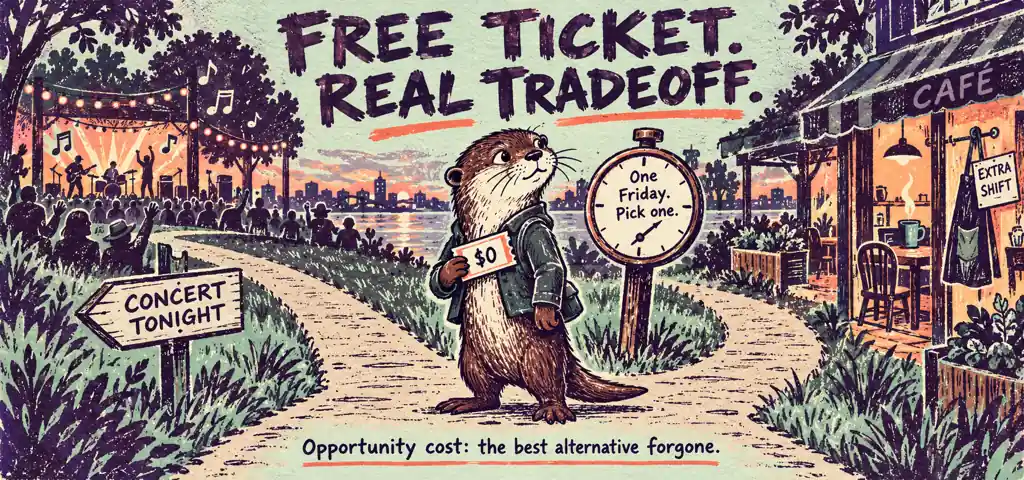
A free concert ticket lands in your inbox. You can go on Friday, but attending would use the same evening you had set aside for an extra shift at work or a quiet night at home. The ticket costs nothing.
Your evening is scarce. In economics, scarcity means resources are limited relative to the uses people have for them, even when the resource seems plentiful at first glance. A bakery might have a large kitchen and still have to turn down orders because its ovens are occupied.
Find the alternative you would really choose
Suppose the ticket cannot be sold. You value the work shift at $80 after travel expenses and other burdens, while an evening at home would be worth $50 to you. Attending has an opportunity cost of $80.
Why not $130? You could not work the shift and spend those same hours at home, so adding both amounts would charge you for a combination you could never choose. Opportunity cost is the value of the best alternative forgone.
Someone who badly needs rest might value staying home above the shift, even with exactly the same wage and travel expenses on offer. Preferences change the comparison. The dollar values in this example cannot tell us how everyone values health, family commitments, or enjoyment.
Separate available choices from past payments
Now suppose you bought the ticket last month. If you cannot return or sell it, that payment is a sunk cost because you cannot recover it whichever option you choose tonight. Compare the consequences still within your control.
Resale changes the calculation. With a buyer offering $60 for the ticket and the $80 work shift still available, attending gives up an alternative worth $140: selling the ticket and working. Those benefits can be combined.
Before calculating, list the feasible options and identify the resource they compete for. Checking the options first prevents you from inserting every number into an equation, including amounts that cannot be earned together or payments that are already unrecoverable.
A choice beyond your wallet
A town uses a donated building as a library. Using it still gives up the best feasible alternative, perhaps renting it to a business or housing another public service that residents would otherwise choose. Any additional maintenance required for library use also consumes resources.
Some maintenance might be needed under either use. Include the difference caused by choosing the library, together with the value of the best forgone use, when comparing the alternatives. Calling the building free leaves those tradeoffs unchanged.
For your next decision, name the alternative you would choose if your first choice disappeared. Check that you could really take it.
Watch the idea in action
A related lesson from Marginal Revolution University. Read the examples above alongside the video.

Reza is an experienced Math instructor and a test-prep expert who has been tutoring students since 2008. He has helped many students raise their standardized test scores--and attend the colleges of their dreams. He works with students individually and in group settings, he tutors both live and online Math courses and the Math portion of standardized tests. He provides an individualized custom learning plan and the personalized attention that makes a difference in how students view math.
Related to This Article
More math articles
- Grade 3 Math: Introduction to Division
- Volume Calculation Method of Cross-Sections
- Acids, Bases, and the pH Scale
- Top 10 ISEE Middle-Level Math Practice Questions
- CLEP U.S. History I 070: Abolitionists and Antislavery Politics
- The Best Grade 3 ELA Practice Tests for Rhode Island Students
- 4th Grade OST Math Worksheets: FREE & Printable
- South Dakota SBAC Grade 4 Math Free Worksheets: Printable Standards-Aligned Practice PDFs, Free
- Best Digital Pen Tablet for Online Math Teaching in 2026
- Grade 3 Math: Word Problems: Addition and Subtraction














What people say about "Economics: Begin With the Choice"?
No one replied yet.