YOUR PSAT 10 STUDY COMPANION
The Ultimate PSAT 10 Math Formula Cheat Sheet
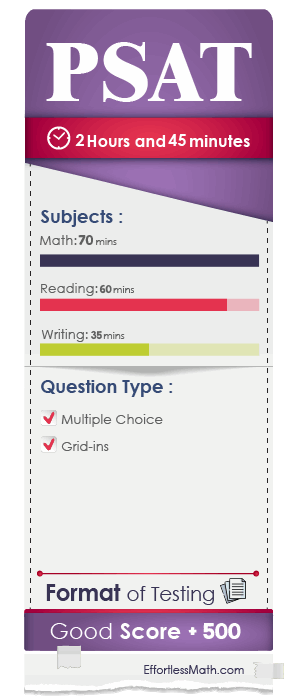
TL;DR: Wondering what the PSAT 10 actually hands you on test day? The same 12-formula reference panel the SAT gives you, and not a formula more. The quadratic formula, slope, and exponent rules are NOT on that sheet, so you'll need them locked in your head before you sit down. This page walks you through every formula worth knowing cold for the Digital PSAT 10 Math test, so the reference panel becomes a backup, not a crutch.
TL;DR: Wondering what the PSAT 10 actually hands you on test day? The same 12-formula reference panel the SAT gives you, and not a formula more. The quadratic formula, slope, and exponent rules are NOT on that sheet, so you’ll need them locked in your head before you sit down. This page walks you through every formula worth knowing cold for the Digital PSAT 10 Math test, so the reference panel becomes a backup, not a crutch.
Quick answer: This PSAT cheat sheet puts PSAT 10 math on one printable page. It lists the geometry formulas the test gives you on its built-in reference sheet, the formulas you still need to memorize (slope, quadratic formula, percent change, exponent rules, mean and median), and a few test-day tips. Example: the slope through (1, 2) and (3, 8) is (8 − 2) ÷ (3 − 1) = 3.
Key takeaways:
- Digital PSAT 10 Math: 2 modules x 22 questions, 70 minutes total.
- Same 12-formula reference page as the SAT is on every screen.
- The built-in Desmos graphing calculator is available throughout.
- Memorize quadratic formula, slope, exponent rules. They’re NOT on the sheet.
- Score scale: 160-760 per section (lower ceiling than the full SAT’s 200-800).
The PSAT 10 Math covers many topics, from as early as elementary school all the way to high school.
While you have probably learned many of these formulas at some point, it may have been a long time since you’ve actually used them. This is where most test takers have a hard time preparing for the test.
So, what formulas do you need to have memorized for the PSAT 10 Math before the test day?
Following is a quick formula reference sheet that lists all important PSAT 10 Math formulas you MUST know before you sit down for the test.
If you learn every formula in this PSAT 10 Math Formula Cheat Sheet, you will save yourself valuable time on the test and probably get a few extra questions correct.
Looking for a comprehensive and complete list of all PSAT 10 Math formulas? Please have a look at the PSAT 10 Math Formulas
The Absolute Best Book to Ace the PSAT 10 Math Test
r />\(\frac{a}{b}-\frac{c}{d}=\frac{ad-cb}{bd}\)
Multiplying and Dividing Fractions:
\(\frac{a}{b} × \frac{c}{d}=\frac{a×c}{b×d}\)
\(\frac{a}{b} ÷ \frac{c}{d}=\frac{\frac{a}{b}}{\frac{c}{d}}=\frac{ad}{bc}\)
Decimals
Is a fraction written in a special form? For example, instead of writing \(\frac{1}{2}\) you can write \(0.5\).
Mixed Numbers
A number is composed of a whole number and a fraction. Example: \(2 \frac{2}{ 3}\) Converting between improper fractions and mixed numbers: \(a \frac{c}{b}=a+\frac{c}{b}= \frac{ab+ c}{b}\)
Factoring Numbers
Factor a number means breaking it up into numbers that can be multiplied together to get the original number. Example:\(12=2×2×3\)
Integers
\( \{…,-3,-2,-1,0,1,2,3,…\} \)
Includes: zero, counting numbers, and the negative of the counting numbers
Real Numbers
All numbers that are on a number line. Integers plus fractions, decimals, and irrationals, etc.) (\(\sqrt{2},\sqrt{3},π\), etc.)
Order of Operations
PEMDAS
(parentheses/ exponents/ multiply/ divide/ add/ subtract)
Absolute Value
Refers to the distance of a number from, the distances are positive as the absolute value of a number cannot be negative. \(|-22|=22\)
Ratios
A ratio is a comparison of two numbers by division. Example: \(3: 5\), or \(\frac{3}{5}\)
Percentages
Use the following formula to find part, whole, or percent
part \(=\frac{percent}{100}×whole\)
Proportional Ratios
A proportion means that two ratios are equal. It can be written in two ways:
\(\frac{a}{b}=\frac{c}{d}\), \(a: b = c: d \)
Percent of Change
\(\frac{New \ Value \ – \ Old \ Value}{Old Value}×100\%\)
Expressions and Variables
A variable is a letter that represents unspecified numbers. One may use a variable in the same manner as all other numbers: Addition: \(2+a\): \(2\) plus a
Subtraction: \(y-3\): \(y\) minus \(3\)
Division: \(\frac{4}{x}\): 4 divided by x
Multiplication: \(5a\): \(5\) times a
Distributive Property
\(a(b+c)=ab+ac\)
Equations
The values of the two mathematical expressions are equal.
\(ax+b=c\)
Distance from A to B:
\(\sqrt{(x_{1}-x_{2})^2+(y_{1}-y_{2})^2 }\)
Parallel and Perpendicular lines:
Parallel lines have equal slopes. Perpendicular lines (i.e., those that make a \(90^° \) angle where they intersect) have negative reciprocal slopes: \(m_{1}\).\(m_{2}=-1\).
Parallel Lines (l \(\parallel\) m)
Mid-point of the segment AB:
M (\(\frac{x_{1}+x_{2}}{2}, \frac{y_{1}+y_{2}}{2}\))
Slope of the line:
\(\frac{y_{2}- y_{1}}{x_{2} – x_{1} }=\frac{rise}{run}\)
Point-slope form:
Given the slope m and a point \((x_{1},y_{1})\) on the line, the equation of the line is
\((y-y_{1})=m \ (x-x_{1})\).
Slope-intercept form:
given the slope m and the y-intercept b, then the equation of the line is:
\(y=mx+b\).
Factoring:
“FOIL”
\((x+a)(x+b)\)
\(=x^2+(b+a)x +ab\) “Difference of Squares”
\(a^2-b^2= (a+b)(a-b)\)
\(a^2+2ab+b^2=(a+b)(a+b) \)
\(a^2-2ab+b^2=(a-b)(a-b)\) “Reverse FOIL”
\(x^2+(b+a)x+ab=\) \((x+a)(x+b)\)
Exponents:
Refers to the number of times a number is multiplied by itself.
\(8 = 2 × 2 × 2 = 2^3\)
Scientific Notation:
It is a way of expressing numbers that are too big or too small to be conveniently written in decimal form.
In scientific notation all numbers are written in this form: \(m \times 10^n\)
Scientific notation:
\(5×10^0\)
\(-2.5×10^4\)
\(5×10^{-1}\)
(2.122456×10^3)
Square:
The number we get after multiplying an integer (not a fraction) by itself. Example: \(2×2=4,2^2=4\)
Square Roots:
A square root of \(x\) is a number r whose square is \(x: r^2=x\)
\(r\) is a square root of \(x\)
Pythagorean Theorem:
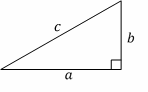
\(a^2+b^2=c^2\)
Triangles
Area: \(A=\frac{1}{2}bh\) where \(b\) is the base and \(h\) is the height.
Perimeter: \(P=a+b+c\) (sum of all three sides).
Pythagorean Theorem (right triangles): \(a^2+b^2=c^2\) where \(c\) is the hypotenuse.
Sum of interior angles: \(180°\)
All triangles:
Area \(=\frac{1}{2}\) b. H
Angles on the inside of any triangle add up to \(180^\circ\).
Equilateral:
These triangles have three equal sides, and all three angles are \(60^\circ\).
Isosceles:
An isosceles triangle has two equal sides. The “base” angles (the ones opposite the two sides) are equal (see the \(45^\circ\) triangle above).
Circles
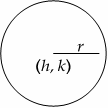
Area \(=πr^2\)
Circumference \(=2πr\)
Full circle \(=360^\circ\)
Rectangles
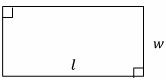
(Square if l=w)
Area=lw
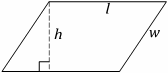
Parallelogram
(Rhombus if l=w)
Area=lh
Regular polygons are n-sided figures with all sides equal and all angles equal.
The sum of the inside angles of an n-sided regular polygon is
\((n-2).180^\circ\).
Area of a trapezoid:
\(A =\frac{1}{2} h (b_{1}+b_{2})\)
Surface Area and Volume of a Rectangular/right prism:
\(SA=ph+2B\)
\(V=Bh\)
Surface Area and Volume of a Cylinder:
\(SA =2πrh+2πr^2\)
\(V =πr^2 h \)
Surface Area and Volume of a Cone
\(SA =πrs+πr^2\)
\(V=\frac{1}{3} \ πr^2 \ h\)
Surface Area and Volume of a Sphere
\(SA =4πr^2\)
\(V =\frac{4}{3} \ πr^3\)
(p \(=\) perimeter of base B; \(π ~ 3.14 \))
Simple interest:
\(I=prt\)
(I = interest, p = principal, r = rate, t = time)
mean:
mean: \(\frac{sum \ of \ the \ data}{of \ data \ entires}\)
mode:
value in the list that appears most often
range:
largest value \(-\) smallest value
Median
The middle value in the list (which must be sorted)
Example: median of
\( \{3,10,9,27,50\} = 10\)
Example: median of
\( \{3,9,10,27\}=\frac{(9+10)}{2}=9.5 \)
Average
\( \frac{sum \ of \ terms}{number \ of \ terms}\)
Average speed
\(\frac{total \ distance}{total \ time}\)
Probability
\(\frac{number \ of \ desired \ outcomes}{number \ of \ total \ outcomes}\)
The probability of two different events A and B both happening is:
P(A and B)=p(A).p(B)
as long as the events are independent, meaning one does not change the chance of the other. (For mutually exclusive events, P(A and B) = 0.)
Powers, Exponents, Roots
\(x^a.x^b=x^{a+b}\)
\(\frac{x^a}{x^b} = x^{a-b}\)
\(\frac{1}{x^b }= x^{-b}\)
\((x^a)^b=x^{a.b}\)
\((xy)^a= x^a.y^a\)
\(x^0=1\)
\(\sqrt{xy}=\sqrt{x}.\sqrt{y}\)
\((-1)^n=-1\), if n is odd.
\((-1)^n=+1\), if n is even.
If 0 < x < 1, then
0 < x³ < x² < x < √x < ∛x < 1.
Simple Interest
The charge for borrowing money or the return for lending it.
Interest = principal \(×\) rate \(×\) time
OR
\(I=prt\)
Powers/ Exponents
\(x^a×x^b=x^{a+b}\)
\(\frac{x^a}{x^b}=x^{a-b}\)
\((x^a)^b=x^{ab}\)
\(x^0=1\)
\(x^{-a}=\frac{1}{x^a}\)
\(x^{\frac{1}{n}}=\sqrt[n]{x}\)
Positive Exponents
An exponent is simply shorthand for multiplying that number of identical factors. So \(4^3\) is the same as (4)(4)(4), three identical factors of 4. And \(x^3\) is just three factors of x, \((x)(x)(x)\).
Negative Exponents
A negative exponent means to divide by that number of factors instead of multiplying.
So \(4^{-3}\) is the same as \( \frac{1}{4^3}\) and
\(x^{-3}=\frac{1}{x^3}\)
Factorials
Factorial- the product of a number and all counting numbers below it.
8 factorial \(=8!=\)
\(8×7×6×5×4×3×2×1=40,320\)
5 factorial \(=5!=\)
\(5×4×3×2×1=120\)
2 factorial \(=2!=2× 1=2\)
Multiplying Two Powers of the SAME Base
When the bases are the same, you find the new power by just adding the exponents
\(x^a.x^b=x^{a+b }\)
Powers of Powers
For the power of power: you multiply the exponents.
\((x^a)^b=x^{(ab)}\)
Dividing Powers
\(\frac{x^a}{x^b} =x^a x^{-b}= x^{a-b}\)
The Zero Exponent
Anything to the 0 power is 1.
\(x^0= 1\)
College Entrance Tests
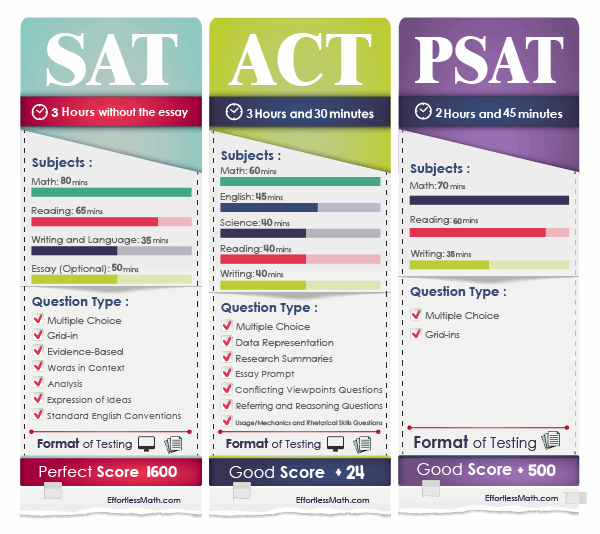
The Best Books to Ace the PSAT 10 Math Test
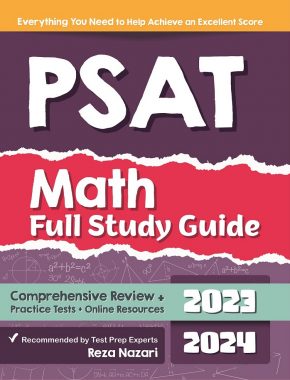
Recommended EffortlessMath Books
For a workbook that pairs with this cheat sheet, the PSAT 10 Math for Beginners walks through every Digital PSAT 10 topic with worked examples and Desmos strategies. For complete prep with multiple full-length practice tests, see the PSAT 10 Math Test Prep Bundle (resource currently unavailable).
Given on the test vs. formulas you must memorize
The digital PSAT 10 has a reference sheet you can open during the Math section. It covers basic geometry. Everything else on this list has to come from memory.
| Given on the reference sheet | Memorize these |
|---|---|
| Circle: A = πr², C = 2πr | Slope: m = (y₂ − y₁) ÷ (x₂ − x₁) |
| Rectangle: A = lw; Triangle: A = ½bh | Lines: y = mx + b and y − y₁ = m(x − x₁) |
| Pythagorean theorem: c² = a² + b² | Quadratic formula: x = (−b ± √(b² − 4ac)) ÷ 2a |
| Special right triangles: 30-60-90 and 45-45-90 | Percent change: (new − old) ÷ old × 100% |
| Volumes: box lwh, cylinder πr²h, sphere ⁴⁄₃πr³, cone ⅓πr²h, pyramid ⅓lwh | Exponent rules: xᵃ · xᵇ = xᵃ⁺ᵇ, (xᵃ)ᵇ = xᵃᵇ, x⁻ᵃ = 1 ÷ xᵃ |
| A circle has 360° (2π radians); a triangle’s angles add to 180° | Circle equation: (x − h)² + (y − k)² = r²; mean, median, probability |
PSAT 10 math at a glance, plus 5 test-day strategies
The Math section has 44 questions in two modules of 22. You get 35 minutes per module, so 70 minutes in all. Most questions are multiple choice. A few have no choices at all, so you enter the number you worked out. You can use the built-in Desmos calculator on every math question, or bring an approved calculator. Math is scored from 160 to 760, and the total score runs from 320 to 1520.
- Graph it. Type a system or a quadratic into Desmos and read the intersection or the vertex.
- Plug in the choices. When the algebra gets messy, test each answer choice in the original equation.
- Watch the units. Rate and percent questions often switch units halfway through.
- Don’t leave blanks. There is no penalty for a wrong answer.
- Pace yourself. Each module gives you 35 minutes for 22 questions, so plan on roughly 95 seconds per problem. Flag hard ones and come back.
Frequently Asked Questions
Does the PSAT 10 have a reference sheet?
Yes. On the digital PSAT 10, a reference panel can be opened on any math question. It holds the same 12 geometry items the SAT shows, such as circle area and circumference, rectangle and triangle area, five volume formulas, the Pythagorean theorem and special right triangle ratios. Algebra rules like slope and the quadratic formula are not on it, so learn those before test day.
What formulas should I memorize for the PSAT?
For the PSAT 10, memorize slope, y = mx + b, point-slope form, the quadratic formula, exponent rules, percent change, mean and median, and SOH CAH TOA. Practice using them, not just reciting them. For instance, if a score drops from 80 to 60, the percent change is (60 − 80) ÷ 80 = −0.25, a 25% decrease.
Is there a PSAT math cheat sheet I can print?
Yes. The one-page PSAT 10 math cheat sheet can be printed from your browser or saved as a PDF. It splits the formulas given on the test from the ones you must memorize. A good way to use it is to cover the memorize column, write each formula from memory, and check yourself. It is a study tool only and cannot be used during the test.
What is on the PSAT 10 math section?
PSAT 10 math has two adaptive modules of 22 questions each, 70 minutes in total. Questions come from algebra, advanced math, problem solving and data analysis, and geometry and trigonometry. A Desmos graphing calculator is built into the app, and math scores range from 160 to 760, with a total PSAT 10 score from 320 to 1520.
Is the PSAT/NMSQT formula sheet the same as the PSAT 10?
Yes. The PSAT 10 and the PSAT/NMSQT use the same math content and the same built-in reference sheet, so one set of formulas prepares you for both. The main difference is timing and purpose: the PSAT/NMSQT is usually taken in the fall and is used for National Merit, while the PSAT 10 is given to sophomores in the spring.
What are some PSAT math hacks?
The best PSAT 10 shortcuts are honest test skills. Use the built-in Desmos calculator to graph equations and find intersections, plug answer choices back into the problem, and pick easy numbers for variables when a question is abstract. For example, to test whether 2(x + 3) equals 2x + 6, try x = 1: both sides give 8.
Related EffortlessMath Lessons
If a topic on this page feels rusty, these short lessons go deeper:

Related to This Article
More math articles
- The Best Grade 8 ELA Practice Tests for Oklahoma Students
- Convert Units of Measurement
- How to Solve Prime Factorization with Exponents?
- The Antiwar Movement and the Draft: 1968, Protest and Reform
- Stereotypes, Prejudice, and Discrimination
- Biological Indicators and Process Challenge Devices
- How to Understand Decimals Conveyed in Words
- 10 Must-Have Elementary Classroom Math Supplies
- What is the Relationship between Dilations and Angles in Geometry
- Cell Division: Mitosis and Meiosis






What people say about "PSAT Cheat Sheet: Printable PSAT 10 Math Formulas"?
No one replied yet.